
Capitalize on today's evolving market dynamics.
With changes to taxes and interest rates, it's a good time to meet with a wealth advisor.

Media attention and high valuations do not necessarily make an initial public offering, or IPO, a favorable investment.
IPOs may better suit long-term investors who can hold shares through periods of volatility.
Individual investors can buy shares of newly public companies through a brokerage account or gain exposure through small- and mid-cap growth mutual funds.
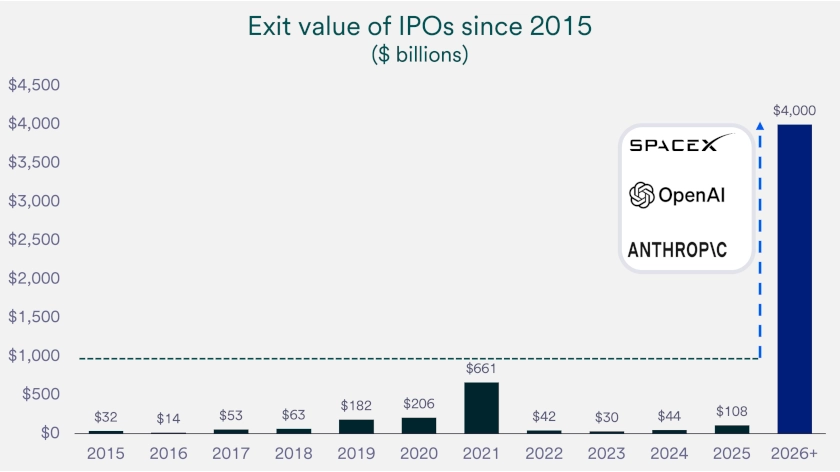
The record-breaking initial public offering (IPO) of the Elon Musk-backed Space Exploration Technologies, better known as SpaceX or by its ticker symbol SPCX, captured investors’ attention with a valuation of $1.75 trillion. Leading artificial intelligence (AI) companies OpenAI and Anthropic indicated plans to launch their own IPOs by year-end. 2026 appears likely to generate greater IPO exit value than the sum of the prior 10 years. When well-known or highly regarded companies announce plans to go public, media coverage of their IPOs often captures individual investors’ attention.
An IPO marks a significant milestone: The company gains access to public markets and can raise capital to expand its operations. Yet investors may misunderstand the opportunities and risks involved. Prospective shareholders may view the IPO calendar as a chance to invest early in a company’s public-market journey. However, positive media coverage alone does not make an IPO an appropriate investment. Before buying shares, investors should understand the common misconceptions and potential opportunities associated with IPO investing.
“Not all IPOs are proven to be long-term winners. In fact, while many IPOs have flourished, the company path toward financial greatness is littered with failed IPOs.”
Terry Sandven, chief equity strategist for U.S. Bank
Through an IPO, a privately held company lists on a public exchange, such as the New York Stock Exchange or the Nasdaq Stock Market, and offers stock to public investors for the first time. The company makes a percentage of its ownership available to investors and sets an initial public offering price. Once the shares begin trading on a public exchange, individual investors can buy and sell the shares in the public market.
Private companies use IPOs to raise equity capital. The capital may fund future growth, repay debt or allow existing investors to sell some of their holdings.
IPOs present both opportunities and challenges. Companies that trade at fair valuations and sustain consistent growth may generate favorable returns for investors, but many do not. Newly public companies often provide less historical financial information than established public companies, which can make their performance and prospects harder to assess. As a result, IPOs may involve greater speculation and uncertainty than established stocks.
Investors should not invest in an IPO solely because the company attracts positive attention. A high valuation may create an unfavorable balance between potential risk and reward at the current price.
Investors should remember that an IPO company has yet to establish a track record as a public company. Competition can also affect the company’s performance after it goes public. These and other factors can negatively affect performance and make the investment more difficult to evaluate.
Not always. New public companies can carry greater risk and their stock may experience more volatility because they lack an established track record in the public market. Terry Sandven, chief equity strategist with U.S. Bank Asset Management, describes IPO investment results as mixed. “Not all IPOs are proven to be long-term winners,” he explains. “In fact, while many IPOs have flourished, the company path toward financial greatness is littered with failed IPOs.”
Expected growth often attracts investors to an IPO. Investors may accept higher valuations based on anticipated future growth, which can cause IPOs to trade at elevated multiples. However, these valuations can become difficult to sustain when economic growth slows, investor concerns rise and market sentiment becomes more risk averse, Sandven warns.
Not necessarily. Companies pursuing IPOs provide audited financial statements, but those statements cannot establish the stability or predictability of future results. Factors outside a company’s control can shape its performance. For example, global growth, inflation, tariffs, interest rates, government regulation and the stage of the economic cycle may create challenges for the company.
Institutional investors and fund managers generally receive the largest IPO allocations because they can purchase larger blocks of shares. Individual investors generally receive smaller allocations of shares or may not receive an allocation at all.
Investment bankers who underwrite IPOs typically seek long-term investors who are more likely to hold their shares rather than sell them quickly in the open market, which can increase price volatility.
When a highly anticipated company goes public, demand may exceed the number of shares available through the IPO. Individual investors may therefore need to wait until the shares begin trading on the stock exchange.
Companies typically complete several rounds of private financing before going public. IPO investors therefore do not invest at the company’s earliest stage; instead, they become some of its first public shareholders.
The IPO offering price may differ from the market price once the shares begin trading on an exchange. The company and its underwriters set the offering price before trading begins and allocate shares at that price primarily to institutional investors and other eligible investors, which may include employees and other qualifying individual investors.
After weighing the risks and opportunities, investors who remain interested in a specific IPO can identify the date when its shares will begin trading publicly. Once trading begins, they may purchase available shares through a brokerage account.
Rather than trying to obtain shares at the IPO offering price, individual investors may consider small- and mid-cap growth mutual funds, many of which actively invest in newly public companies. Sandven offers potential IPO investors one central piece of advice: Buyer beware.
“Know the company, the drivers of growth, the competitive landscape, valuations of similar companies and company-specific risks,” Sandven says. He emphasizes that IPOs do not all offer the same opportunity. “Ideally, companies with competitive advantages in high-growth markets and with high barriers to entry trading at reasonable valuations afford IPO investors with a wonderful opportunity to participate in the early growth phase of the company’s life cycle. Unfortunately, the future for IPO companies is often less clear, impacted by several unknowns including fundamental, macro and geopolitical issues beyond a company’s control.”
Because IPOs can experience significant volatility, they may better suit long-term investors who can tolerate a substantial loss of principal. A financial professional can help you evaluate whether IPO investing fits your long-term investment strategy.
Learn about our approach to investment management.
Hedge funds are alternative investments for diversifying and potentially enhancing investor portfolios. Review the risks, benefits and investment strategies specific to hedge funds.
Let us help you craft a portfolio that reflects your goals, time-horizon and values.


 Equal Housing Lender. Deposit products are offered by U.S. Bank National Association. Member FDIC. Mortgage, Home Equity and Credit products are offered by U.S. Bank National Association. Loan approval is subject to credit approval and program guidelines. Not all loan programs are available in all states for all loan amounts. Interest rates and program terms are subject to change without notice.