
Capitalize on today's evolving market dynamics.
With changes to taxes and interest rates, it's a good time to meet with a wealth advisor.
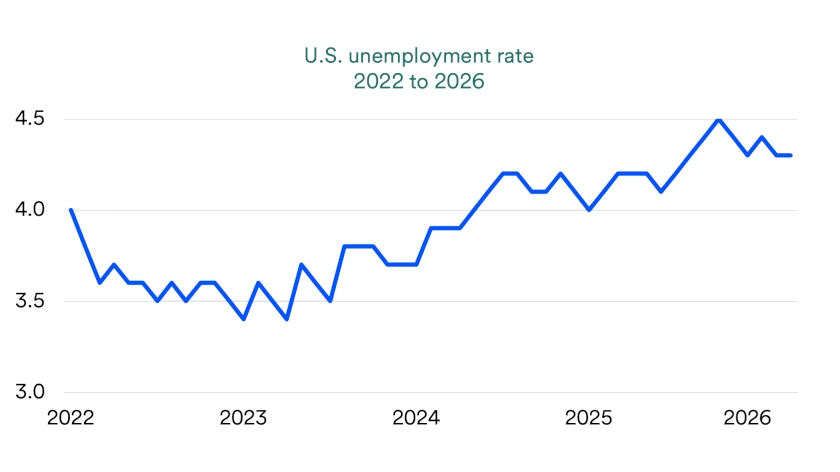
The April jobs report showed the U.S. labor market still adding jobs, with nonfarm payrolls rising 115,000 and the unemployment rate unchanged at 4.3%.
Wage growth stayed positive, with average hourly earnings up 0.2% from March and 3.6% from a year ago, slightly above April consumer inflation of 3.8%.
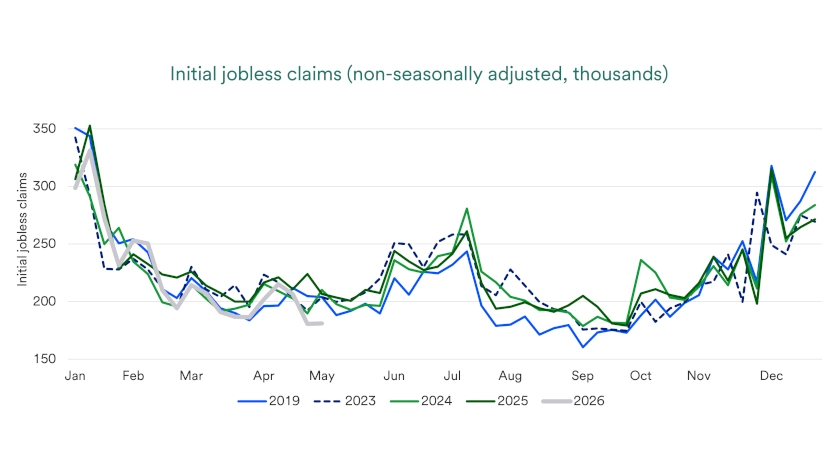
Hiring demand looks softer than last year, but layoffs remain contained, with 6.9 million job openings, 202,000 initial jobless claims, and March layoff announcements concentrated in select industries.
The April jobs report showed ongoing hiring strength. U.S. employers added 115,000 jobs in March, for a monthly average gain of 76,000 so far in 2026. The unemployment rate was unchanged from March at 4.3%. That mix points to a labor market that still has forward momentum.
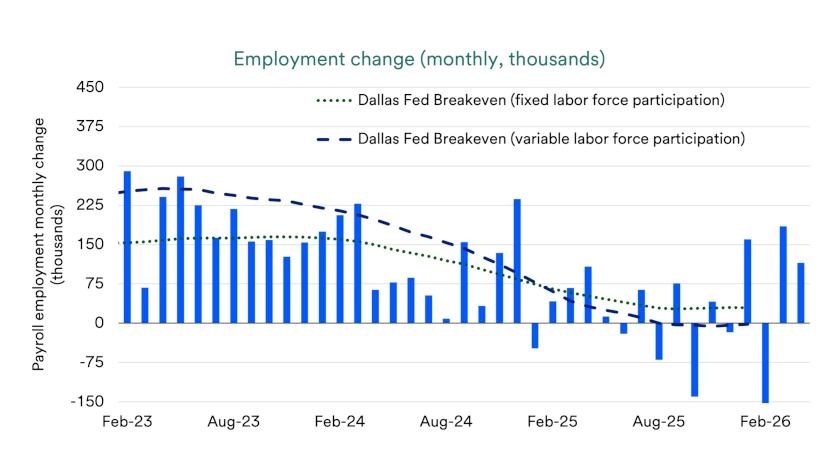
The details highlight broadening gains across industries. Job growth was strongest in health care (+37,000), transportation and warehousing (+30,000), and retail trade (+22,000). Federal government employment continued to fall, losing 18,000 jobs. The Bureau of Labor Statistics (BLS) revised February payrolls down by 23,000 to a loss of -156,000 jobs, though March saw a +7,000 revision to +185,000, leaving the two-month net revision 16,000 lower than previously reported.¹
The Dallas Federal Reserve Bank offers an important way to frame current hiring. In a March 31 analysis, Dallas Fed economists said investors should focus on the “break-even” rate of employment growth, meaning the number of new jobs needed each month to keep the unemployment rate steady. They concluded the break-even rate has moved much lower than previously assumed. Their updated work showed break-even job growth peaked at about 250,000 per month in 2023, fell to roughly 10,000 by July 2025, and then moved near zero, averaging about negative 3,000 jobs per month from August through December 2025, largely because net unauthorized immigration outflows and shifts in labor force participation slowed labor force growth. The same analysis said payroll growth from December 2025 through February 2026 slightly exceeded that lower break-even pace, which was consistent with a stable unemployment rate. 2 Against that backdrop, April’s 115,000 payroll gain and 4.3% unemployment rate suggest the labor market still looks balanced, even if hiring no longer resembles the faster pace investors became used to earlier in the expansion. 1
Wage growth remained constructive, even if it lost a little speed. April average hourly earnings rose 3.6% from a year earlier, compared with 3.4% year-over-year in March. 1 April consumer prices were up 3.8% from a year ago due to higher energy prices, which means wage growth slightly lagged inflation for the first time since 2023, although wages still exceeded core inflation, which doesn’t include more volatile food and energy prices. 3
“The April jobs report shows a labor market that is still growing, but in a more selective way. Investors should pay close attention to the mix of hiring, wages and labor supply because those details often tell the real story for the economy and markets.”
Rob Haworth, senior investment strategy director with U.S. Bank Asset Management Group
The broader household survey also showed a labor market that has softened but not broken. Labor force participation held at 61.8%, the employment-population ratio slipped to 59.1%, and the number of people working part time for economic reasons increased to 4.9 million. Long-term unemployment stayed elevated at 1.8 million, which is up over the year, so the labor market still looks less comfortable than the headline payroll number alone might suggest. 1
“The April jobs report shows a labor market that is still growing, but in a more selective way,” says Rob Haworth, senior investment strategy director with U.S. Bank Asset Management Group. “Investors should pay close attention to the mix of hiring, wages and labor supply because those details often tell the real story for the economy and markets.”
Other recent labor market readings support the same message. The March Job Openings and Labor Turnover Survey (JOLTS) showed 6.9 million job openings, while hires rose to 5.6 million. Quits held at 3.2 million and layoffs and discharges stayed at 1.9 million, which suggests employers are posting fewer new opportunities and moving more cautiously on hiring, but they are not cutting deeply across the board. 4
“The labor market is still stable enough to support the expansion,” says Bill Merz, head of capital markets research for U.S. Bank Asset Management Group. “Pressure remains on the Federal Reserve because slower hiring argues for lower rates, while persistent inflation limits how fast policymakers can move.”
Weekly jobless claims tell a similar story. Initial claims rose to 200,000 for the week ended May 2, and continuing claims rose to 1.81 million. 5 In plain terms, companies still appear reluctant to let workers go, even as they take more time filling new roles.
The April Challenger, Gray & Christmas report adds another layer of context. U.S. employers announced 83,387 job cuts in April, up 38% from March but down 21% from a year earlier. The report also showed layoffs concentrated in technology, government and healthcare stocks, with artificial intelligence listed as the leading reason for job cuts in March. 6
Investors follow labor data closely because it can influence Federal Reserve (Fed) decisions. A cooler job market can reduce pressure on the Fed to keep interest rates high, especially if inflation continues to ease. At the same time, the Fed’s job is not only to support employment. Its mandate also includes stable prices, so inflation trends still matter.
The April jobs report does not settle the debate on policy rate decisions for the Fed. Federal Reserve Chair Jerome Powell said on April 29 that job gains have remained low, the unemployment rate was 4.3% in March, and inflation remains somewhat elevated. Recent speeches from Fed members indicate hesitation to cut rates unless inflation concerns ease. .
Market pricing leans toward no easing into year-end. Data from CME Fed watch indicates 72% odds of no change in the federal funds target rate by the end of the year, as of May 11, 2026. 7 That expectation sits modestly above the Fed’s March Summary of Economic Projections (SEP), where the median participant outlook implies one quarter point cut in 2026. 8
Tom Hainlin, national investment strategist with U.S. Bank Asset Management Group, expects the capital markets require more clarity to determine direction. “This jobs market update should reassure investors that the economy still has support from employment and income growth,” says Hainlin. “It should also remind them that slower hiring and steady inflation can keep interest rates range-bound until the path becomes clearer.”
However, the Middle East conflict adds a real time risk to those expectations because it has pushed energy prices higher. Higher energy prices can lift overall inflation, and that can make rate cuts harder for the Fed to deliver even if hiring cools, because stable prices remain a core part of the Fed’s mandate.
The April report supports a balanced view for investors. The economy is still creating jobs, wages are rising, and new jobless claims remain low, all of which help the consumer and limit immediate recession risk. At the same time, slower hiring, softer participation, and moderate inflation argue for more modest growth ahead, which means stock and bond markets may react sharply to each new labor or inflation release.
The labor market is a major driver of economic health in an economy where consumer spending comprises more than two-thirds of economic activity. When employment is high, consumer incomes are usually rising, supporting consumer confidence and typically leads to increased spending on goods and services. This accelerated spending often leads employers to add workers to satisfy growing goods and services demand. While the economy can experience periods of slower growth, the long-term trend is an expanding economy, which results in long-term job and income growth.
A strong employment environment often boosts incomes which often drives rising consumer spending. Consumers are considered the driving force of economic growth. According to the U.S. Bureau of Economic Analysis, consumer spending represents more than two-thirds of U.S. economic growth. When individuals are employed and earning solid wages, healthier economic growth often follows. Full-time employment provides households with predictable cash flow, making it easier to make long-term commitments that require financing, such as home and auto purchases.
Structural changes tied to fundamental shifts that affect how work is done often influence labor market trends. For instance, in the past, there was a structural shift from agricultural work to factory work as society became more industrialized. More recently, technology advances sparked an upturn in jobs tied to technology, or jobs that use technology to complete tasks. Today, artificial intelligence advances are expected to again create structural labor market changes and expand productivity. This could affect the types of jobs available and labor supply trends.
Labor force participation, a measure of the share of the population working or actively seeking work, has declined from its previous peaks. This decline is due in large part to workforce demographics, specifically the nation’s aging population and immigration changes. According to U.S. Bureau of Labor Statistics data, the labor force participation rate peaked at 67.2% in 2001 and now stands below 62%. Nearly one-quarter of the nation’s workforce is age 55 or older, and the “exit rate” due to retirement outpaces the entry rate of younger generations.
Technological advancements often create anxiety about the labor market impact. Technology and job requirements are constantly changing. Recent artificial intelligence (AI) advancements make this issue even more topical. In previous periods, technological advancements often involved automation replacing certain physical tasks. Today, AI may augment cognitive tasks, possibly changing skill demand in the economy.
Labor market signals can be a guide to current or forthcoming economic conditions. In other situations, labor data may not provide clear guidance. For example, when job growth appears strong, the numbers could be deceptive because hiring may be concentrated in narrow sectors of the economy or in less productive roles. If unemployment remains steady but hiring numbers are sluggish, it could indicate that companies are “hoarding” employees if it becomes challenging to replace them, while adding few new hires.
These data points should not be considered in isolation. Hiring and layoffs should be assessed together. Rising layoffs may raise alarms. Low layoff rates may reflect companies' reluctance to lose staff or indicate a challenging hiring environment. Hiring numbers and job openings reflect labor demand, but they may be lower even in a solid economic environment if companies retain staff and take a more cautious approach to adding overhead. The quit rate is a strong barometer of worker sentiment. A high quit rate reflects worker confidence that other jobs are readily available.
The job market is a key economic indicator, but it should be assessed alongside other indicators. The labor market and inflation are closely connected. If wages rise considerably, it’s important to assess that increase on an after-inflation basis to determine how much workers are benefiting from the wage environment, which translates to spending growth potential. Strong employment numbers typically signal a healthy economy.
If you are weighing what these cross currents mean for your own plan, it helps to translate economic signals into portfolio decisions that match your time horizon and risk tolerance. A slower job market can influence interest rates, borrowing costs, and market leadership in ways that look different for different investors. Consider discussing your situation with a financial professional so decisions stay tied to goals rather than headlines.
The job market connects people looking for work with employers searching for talent. A strong job market signals a healthy, growing economy, as companies add jobs and compete for workers. When unemployment rises and job growth slows or declines, it often points to an economy that’s losing momentum.
The U.S. Bureau of Labor Statistics tracks the unemployment rate every month, giving us a clear view of the nation’s economic health. A lower unemployment rate usually means the economy is strong. This rate draws close attention because it shows how many people are actively seeking work. However, it doesn’t count those who have stopped looking or consider themselves out of the workforce.
When unemployment rises, it signals that the economy may be weakening. People often cut back on spending if they worry about losing their jobs, which can slow the economy even more. On the other hand, low unemployment typically reflects a robust and expanding economy.
The S&P 500’s recent rollercoaster performance has investors wondering what lies ahead for the stock market.
We can partner with you to design an investment strategy that aligns with your goals and is able to weather all types of market cycles.



 Equal Housing Lender. Deposit products are offered by U.S. Bank National Association. Member FDIC. Mortgage, Home Equity and Credit products are offered by U.S. Bank National Association. Loan approval is subject to credit approval and program guidelines. Not all loan programs are available in all states for all loan amounts. Interest rates and program terms are subject to change without notice.