
Capitalize on today’s evolving market dynamics.
With changes to taxes and interest rates, it's a good time to meet with a wealth advisor.
Treasury bonds and interest rates influence borrowing costs, asset values and portfolio income across global markets.
Federal Reserve policy, inflation, economic growth, government borrowing and investor demand drive Treasury yields and bond prices.
Elevated U.S. Treasury yields can enhance income and diversification, while inflation, fiscal policy and rising bond supply can increase volatility.
U.S. Treasuries play a larger role in financial markets than their share of many investment portfolios may suggest. Treasury yields help set borrowing costs for consumers, businesses and governments worldwide, and investors use them to value stocks, bonds, real estate and other assets. Higher Treasury yields can tighten financial conditions while increasing the income available from high-quality bonds.
Treasury yields respond to Federal Reserve policy, inflation, economic growth, bond supply and investor demand. These forces move Treasury prices, shape returns for current bondholders and create income opportunities for new buyers. Investors and market pricing also indicate that the degree to which these factors influence yields shifts over time, as optimism or fear of certain risk factors change. Current yields compensate investors for many risks, although persistent U.S. deficits could increase issuance and pressure bond prices.
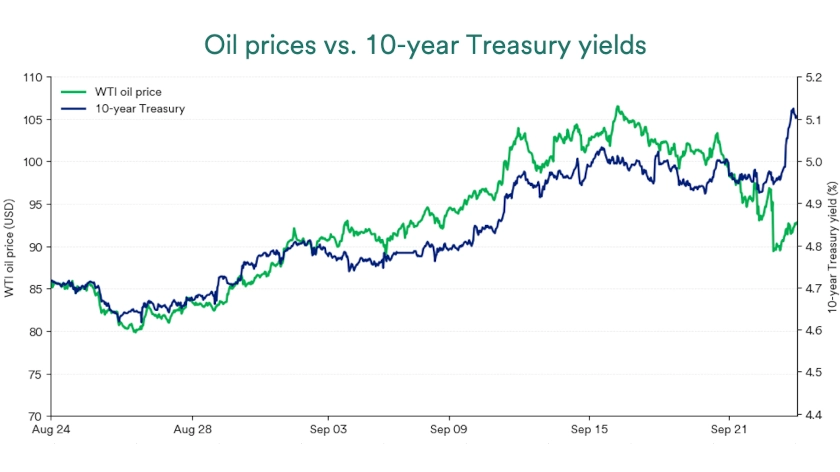
Treasuries can provide income, liquidity and diversification without the risk that a corporation may miss required payments. “Treasuries offer reliable, high-quality income and a distinctive source of portfolio diversification,” says Bill Merz, head of capital markets research with U.S. Bank Asset Management Group. “Investors should balance those benefits against the possibility that inflation, policy changes or growing bond supply keep long-term yields elevated. This year, oil prices drove policy-rate expectations higher, which in turn drove short- and long-term bond yields higher. We see that playing out across U.S. and foreign developed bond markets.”
Treasury yields range from about 4.0% on very short maturities to more than 5.4% on longer maturities as of September 23, offering meaningful income compared with much of the past 20 years. U.S. government backing supports repayment of principal and interest, but Treasury prices can still change before maturity as interest rates, growth expectations, inflation and supply shift. Longer-term bonds usually move more than shorter-term bonds when yields change, so investors should align maturities with spending needs and their tolerance for price volatility.
“Treasuries offer reliable, high-quality income and a distinctive source of portfolio diversification. Investors should balance those benefits against the possibility that inflation, policy changes or growing bond supply keep long-term yields elevated.”
Bill Merz, head of capital markets research for U.S. Bank Asset Management Group
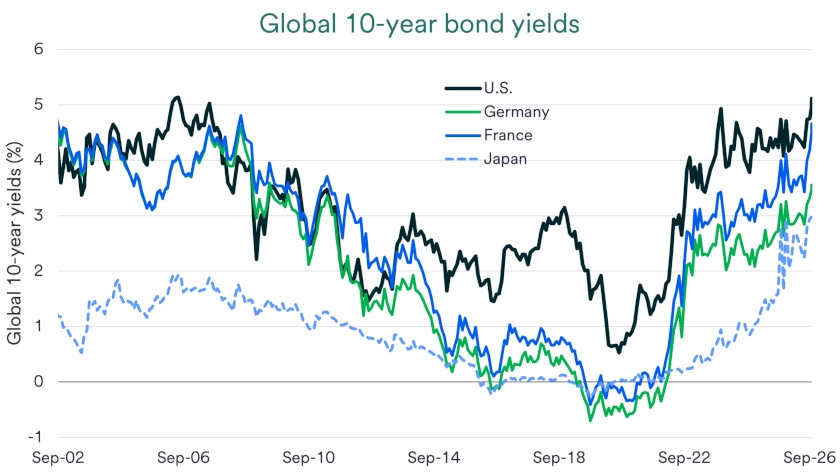
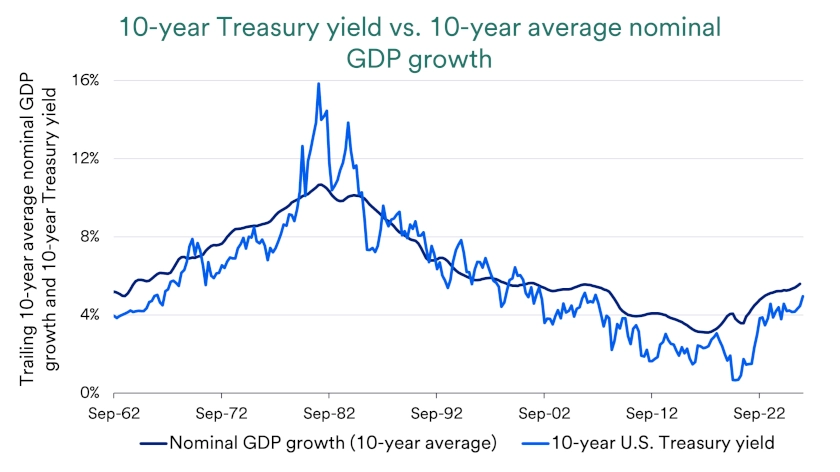
Our fair value model estimates a reasonable range for Treasury yields using expected interest rates, new bond supply and the diversification benefits Treasuries may provide. Market yields stand above that estimate, which suggests investors also seek compensation for persistent inflation, firm economic growth and uncertainty about federal finances. Long-term government bond yields have also reached multi-year highs in Germany, France and Japan, so the trend extends beyond the United States.
High-quality corporate bond issuance has also increased substantially in 2026, creating more competition for investor demand. Companies have borrowed heavily to build artificial intelligence infrastructure, which has added to the volume of longer-term debt available in the market. In response, investors have required higher income to absorb growing issuance from both corporations and the federal government, contributing to higher Treasury yields.
The Fed influences Treasury yields through its policy rate and securities holdings. The federal funds rate, the overnight rate banks charge one another, most directly affects short-term borrowing costs and short-term Treasury yields. Longer-term yields respond to expectations for future Fed policy, inflation and economic growth, as well as the relative income available from short- and long-term bonds.
The Fed raised its target rate by 0.25 percentage point in September 2026 to a range of 3.75%–4.00%, its first increase in more than three years, after reducing rates by 1.75 percentage points across 2024 and 2025. Currently, rising oil prices are driving expectations for future rate increases higher, which is translating to higher short- and long-term Treasury bond yields. The median Fed policymaker projection points to another increase in 2026, while market prices reflect expectations for three additional increases by mid-2027 as inflation remains elevated. This relationship highlights the sensitivity of the current Treasury bond market and broader interest rate environment to oil prices, which can change rapidly.
The U.S. Treasury Department also shapes the mix of securities available to investors. Treasury Secretary Scott Bessent has kept issuance of longer-term notes and bonds relatively stable since mid-2024 while using more short-term Treasury bills to finance growing deficits, limiting the rise in longer-term supply. Expanded buybacks of older securities may improve market liquidity, or the ease of trading without sharply moving prices, but any proposal to fund direct purchases from the Treasury General Account could affect bond supply, financial-system cash and inflation in different ways.
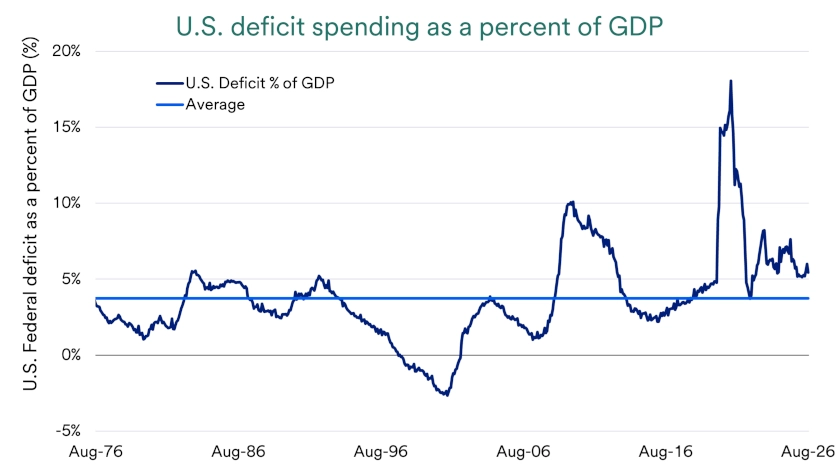
The U.S. federal deficit exceeds 5% of gross domestic product, increasing the debt the government must finance. Ratings agencies have highlighted this fiscal challenge, including Moody’s 2025 downgrade of U.S. debt after Fitch lowered its rating in 2023 and S&P did so in 2011. Financial markets reacted modestly, and market performance shows that investors continue to weigh U.S. fiscal policy alongside inflation, economic growth and global interest-rate trends.
“Historically, the U.S. fiscal situation has not exerted a strong influence on bond yields, but rising government bond yields around the world may signal greater attention to budget deficits,” says Merz. “We are watching fiscal policy, economic data and market demand for evidence that the relationship is changing.” Tax policy, tariffs and spending decisions can change the deficit outlook, while the Congressional Budget Office projects elevated deficits over the next decade because federal spending continues to exceed revenue.
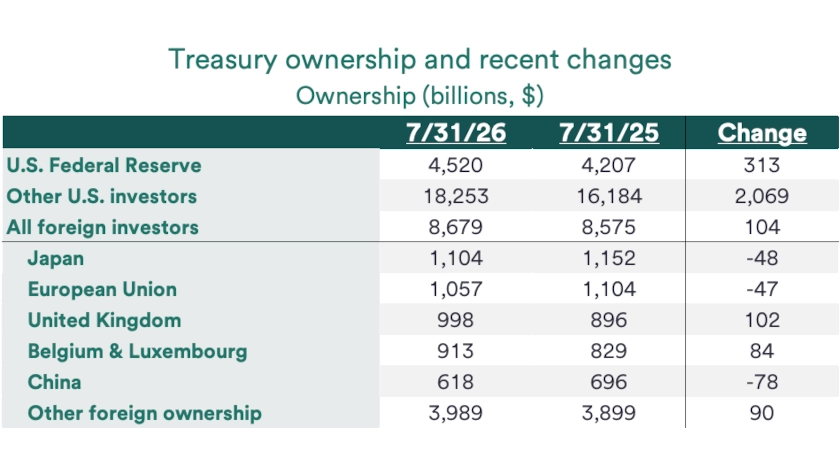
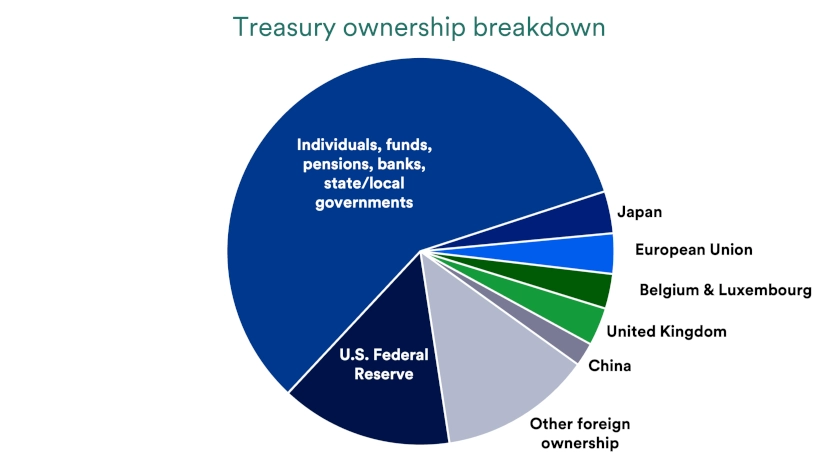
A broad mix of U.S. and international investors supports the Treasury market. U.S. investors remain the largest source of demand, while international buyers increased their holdings by more than $100 billion during the 12 months through July 2026. This diverse ownership base helps the market absorb new issuance even when individual countries adjust their holdings.
Recent data show no broad “foreign buyers’ strike,” or sharp pullback in demand that could force yields higher. “We do not see strong evidence that foreign investors are withdrawing from the Treasury market,” says Merz. Some countries reduced their positions, but total foreign holdings increased over the past year.
Treasury auctions offer another timely measure of investor demand. Recent results, measured by the volume of bids and the yields needed to attract buyers, have run only slightly below long-term averages and continue to signal orderly market conditions. “Domestic demand has fluctuated with inflation and deficit concerns, but Treasury auction results remain near normal,” says Merz, adding that recent regulatory changes could increase financial institutions’ capacity to hold Treasuries.
Treasuries can provide portfolio income and help offset volatility from stocks and other higher-risk assets. Investors who prioritize stability may hold more high-quality bonds, while investors with greater tolerance for price changes may use Treasuries as a counterweight to growth-oriented holdings. Diversification cannot prevent losses, but combining assets that respond differently to economic and market conditions can reduce reliance on a single source of return.
Higher Treasury yields also increase the starting income available across much of the fixed-income market. Corporate, municipal and securitized bonds, which pool loans or other financial assets, may offer additional income and different diversification benefits, but each carries distinct credit, liquidity and interest-rate risks. Investors can assess these opportunities alongside Treasuries instead of concentrating their fixed-income allocation in one market segment.
Treasury yields and bond prices will continue to respond as Fed policy, legislation, debt issuance and inflation expectations evolve. Major market developments can change the balance between income opportunity and price risk, so investors should review their exposure when conditions shift. Discuss your portfolio positioning with a U.S. Bank wealth professional to determine how Treasuries and other fixed-income investments may fit alongside your income needs, risk tolerance and long-term investment objectives.
Treasury securities are debt instruments issued by the U.S. government to fund current operations or major capital investments. In essence, investors who purchase these securities are loaning money to the federal government. Depending on the type of security, the government makes regular interest payments to the investor. When the security matures, the investor receives from the government the full (par) value of the loan (bond purchase price).
As funding needs arise, the U.S. government offers new U.S. Treasury bonds and notes through a public auction system. The government specifies the securities offered in each auction. Large Wall Street institutions bid competitively, specifying the yields they are willing to accept. This process helps establish yields for specific securities that individual investors who participate in a non-competitive bidding process will receive.
Investors find the Treasury market attractive for a number of reasons, perhaps foremost because Treasuries are backed by the “full faith and credit” of the U.S. government. That means Treasuries enjoy a de facto “risk-free” status, with investors able to rely on timely interest payments and full repayment of their initial investment when the security matures. Other features include the Treasury market’s healthy liquidity, making it easy to trade Treasury securities on a timely basis; interest payments that are completely exempt from state and local income taxes; and the ability to generate investment gains should a favorable interest rate environment occur after purchasing a Treasury security.
The U.S. Treasury market is unique among financial instruments. U.S. Treasuries shape the broader financial system. Because investors generally consider U.S. Treasuries a “risk-free” asset, backed by the U.S. government’s “full faith and credit,” other fixed-income market instruments are benchmarked against them. Rates on other debt securities generally exceed those of Treasuries because they carry more risk. Many global institutions use U.S. Treasuries as collateral to finance large investments. The Federal Reserve (Fed) may use purchases or sales of its Treasury holdings to help shape economic trends. The reliability of Treasuries helps give the U.S. dollar global reserve currency status.
A variety of factors influence Treasury supply and demand. When demand is high, interest rates tend to moderate. If demand declines, the federal government must pay higher yields to attract investors. The federal government’s deficit spending is the primary driver of supply. The more spending not covered by current revenue (tax receipts), the larger the Treasury supply. Congress frequently must raise the government’s debt ceiling, allowing the U.S. Department of the Treasury to issue additional securities to fund spending. In some cases, supply increases because the government must refinance existing debt as it matures. On the demand side, investors may rush to buy Treasuries in advance of anticipated Federal Reserve (Fed) interest rate cuts. In periods of stock market weakness, investors may engage in a “flight to safety” into Treasuries, also boosting demand. On the other hand, if interest rates are expected to rise, investors may delay locking in long-term debt securities. Likewise, higher inflation tends to make Treasury yields less attractive, as rising living costs erode Treasury bonds’ real (after-inflation) interest rate.
Treasury trends can signal broader economic trends. Over the long term, Treasury yields tend to move along a normal curve. This means that the shorter the Treasury security’s maturity, the lower its yield compared with long-term Treasury yields. This reflects investors’ willingness to accept lower yields on shorter-term “loans” to the government while expecting higher yields on longer-term financial commitments. The normal yield curve typically signals investor expectations of a healthy, growing economy. An inverted yield curve occurs when shorter-term securities’ yields exceed those of longer-term securities. This is often considered a recession warning signal, though it doesn’t always lead to a recession. If yields are generally flat across the maturity spectrum, it may mean the economy is in a transitional period, either moving from more rapid growth to slower growth or even a recession, or vice versa.
Treasury bonds can offer higher income when yields are elevated, but prices can still fluctuate before maturity. Investors should match maturities and allocation size to income needs, risk tolerance and time horizon.
Treasury yields respond to Federal Reserve policy, inflation expectations, economic growth, Treasury supply and investor demand. Short-term yields tend to track Fed policy more closely, while longer-term yields also reflect inflation, growth and fiscal expectations.
Treasuries can provide high-quality income and may help offset volatility from riskier assets. Their role depends on the investor’s goals, liquidity needs and broader asset allocation.
Municipal bonds currently offer tax-sensitive investors compelling return opportunities.
We can partner with you to design an investment strategy that aligns with your goals and is able to weather all types of market cycles.


 Equal Housing Lender. Deposit products are offered by U.S. Bank National Association. Member FDIC. Mortgage, Home Equity and Credit products are offered by U.S. Bank National Association. Loan approval is subject to credit approval and program guidelines. Not all loan programs are available in all states for all loan amounts. Interest rates and program terms are subject to change without notice.