
Monthly Economic Outlook
Economic forecast: October 2026 trends and analysis
Macroeconomic insights and outlook from the U.S. Bank Economic Research Group to help guide your business strategy
October 2026

Economic outlook at a glance
Higher for longer... and long-term
Our October 2026 U.S. economic outlook continues to point to an economy that has proven remarkably resilient despite still-elevated price pressures, higher interest rates, and a range of geopolitical challenges. Consumer spending remains healthy, business investment continues to benefit from strong AI-related activity, and labor market conditions remain consistent with ongoing economic expansion. At the same time, inflation has become increasingly influenced by rising energy costs and other supply-related pressures, raising the risk that progress toward price stability becomes slower and more uneven than anticipated. Many of the same forces supporting growth and complicating the inflation outlook are also contributing to higher long-term borrowing costs. Fiscal borrowing, duration risk, and stronger economic activity have pushed real rates and term premiums higher, suggesting borrowing costs may remain elevated even as inflation gradually improves.
Looking ahead, our baseline forecast continues to call for growth near its long-run potential pace. The central question is no longer whether higher interest rates will materially slow activity, but whether inflation can return sustainably to target while demand and investment remain strong. Although inflation has eased significantly from its peak, recent developments suggest the final stretch back to the Federal Reserve's objective may prove more challenging. As a result, we now expect the Fed to continue gradually tightening policy through early 2027, bringing the cumulative increase in the federal funds rate to 75 basis points between October 2026 and March 2027.
Key takeaways:
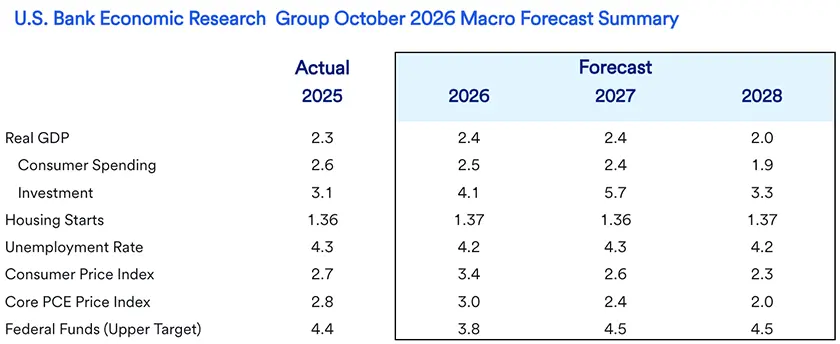
Growth: Real GDP growth is forecast to be 2.8% fourth-quarter-over-fourth-quarter (Q4/Q4) in 2026 (2.4% annual average) and 2.1% Q4/Q4 in 2027 (2.4% annual average). While tighter monetary policy and higher interest rates continue to present headwinds, resilient consumer demand, strong AI-related investment, and improving productivity look to keep economic growth near its long-run potential.
Labor market: We expect the unemployment rate to average 4.2% in 2026 and 4.3% in 2027, reflecting a broadly balanced labor market despite slower hiring. Historically low layoffs and slower labor-force growth should help keep unemployment relatively stable.
Inflation: Rising energy costs and other supply-related pressures threaten to slow progress toward the Fed’s 2% objective. We expect core personal consumption expenditures (PCE) inflation to average 3.0% year-over-year in the second half of 2026 before moderating to 2.2% by the end of 2027.
Federal Reserve: The combination of resilient demand, persistent inflation pressures, and a more challenging path back to price stability has strengthened the case for additional policy tightening. We now expect a cumulative 75 basis points of rate increases between October 2026 and March 2027, bringing the federal funds rate to a peak range of 4.25% to 4.50%.
Risks
We maintain a 25% probability of recession over the next 12 months. While economic activity remains resilient, persistent inflation pressures, additional monetary-policy tightening, elevated long-term interest rates, and a retrenchment in AI-related investment remain the primary risks to the outlook.
Macroeconomics forecast at a glance
Produced by the U.S. Bank Economic Research Group, our in-depth economic forecast examines the trends and economic indicators shaping business decisions this year and into the future.
October 2026 Report
Go beyond the highlights. Download the full monthly forecast for a comprehensive view of the economy, including all supporting data tables, charts and insights from the U.S. Bank Economic Research Group.
Get more business-focused economic analysis
For additional insights, see our weekly economic highlights and Chief Economist Beth Ann Bovino’s latest economic commentary.
If you have questions about any of the topics above or want to learn more, please contact us to connect with a U.S. Bank corporate and commercial banking expert.
Not currently a subscriber? Sign up to get our economic insights delivered to your inbox weekly.
Sources: U.S. Bank Economics, Bloomberg, Yale Budget Lab, U.S. Bank Economics calculation
Tags:
U.S. Bank Economic Research Group
Beth Ann Bovino
Chief Economist
Ana Luisa Araujo
Senior Economist
Matt Schoeppner
Senior Economist
Adam Check
Economist
Andrea Sorensen
Economist
Past monthly forecasts
Visit the archive to read previous monthly forecasts from the U.S. Bank Economic Research Group.
Learn more
If you have any questions about any of these topics or want to learn more, please contact us to connect with a U.S. Bank Corporate and Commercial banking expert.