

Beth Ann Bovino, chief economist, U.S. Bank
Who’s really setting interest rates?
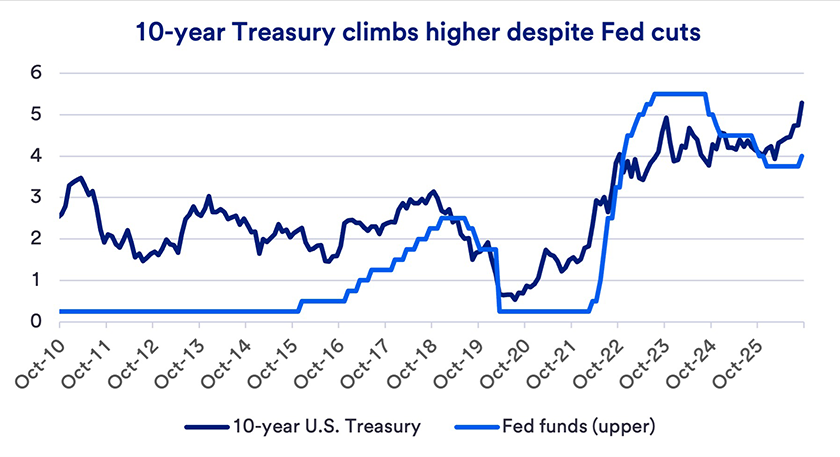
The markets have spoken. Fear of persistently high inflation has caused investors to demand more yield to hold longer duration. One big driver is the heavy Treasury issuance to finance persistent deficits and the large supply of government debt. This requires higher yields to attract investors who are now demanding more to hold longer duration.
This also acts as a break on U.S. economic activity and inflation, regardless of Fed rate action. That may help them today, given their focus on too-high inflation. But is the Fed happy that markets pushed up long-term rates and ‘did the job for them?’
The short answer is ‘no.’ Why would they want volatile market whims to be in control of monetary policy? Today’s market actions correspond to a hawkish Fed. But market actions could act against Fed policy, pushing rates higher when the Fed is providing accommodation. That is what happened in the recent easing cycle, making the Fed’s job even harder.
“Government borrowing and AI investment have pushed up the absolute cost of capital, but not the relative cost of corporate borrowing.”
Beth Ann Bovino, chief economist, U.S. Bank
Large-scale AI investment is also drawing on the same pool of capital to a lesser degree, adding to overall financing demand. But, if these investments live up to expectations, the growth generated from increased productivity would be a win for economic activity. It would also help offset the lost productivity from an aging workforce.
Because corporate borrowing costs are built on top of Treasury rates, higher government yields raise the cost of capital across the economy. So far, credit investors are not demanding extra compensation for holding corporate bonds over Treasuries. Default risk, refinancing risk, and liquidity risk are all still being priced benignly. But, rising long-term interest rates reflect higher real rates, and term risk premiums on the Treasury issuance for the same pool of capital.
In theory, both forces could crowd out private borrowers and push corporate borrowing costs higher. In private credit markets, there are some signs of it (direct lending capital that might have gone to another option is increasingly being diverted to AI-related products). But private credit assets under management has grown fast enough to not yet produce visible stress for non-AI borrowers
Seen in the chart below, as of October 2026, high-yield option-adjusted spreads (OAS) are 323 basis points and investment-grade spreads are 84 basis points, both near post-Global Financial Crisis lows. Investors are not demanding significantly more compensation to own corporate bonds relative to Treasuries, suggesting confidence in the credit outlook
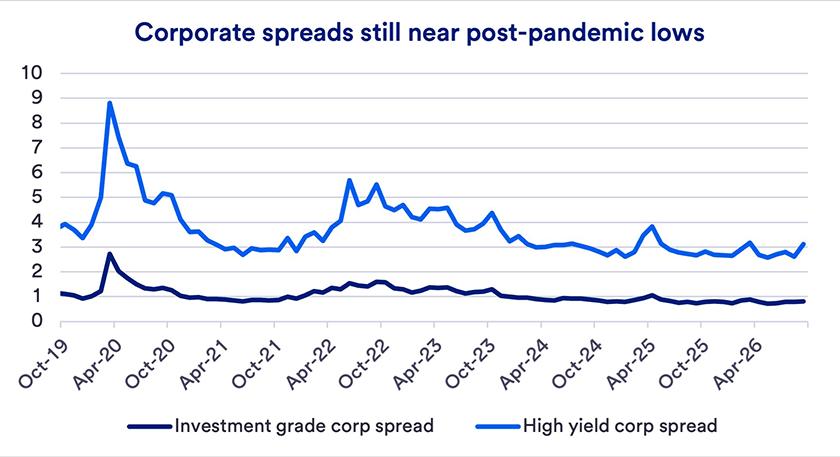
Bottom Line: Government borrowing and AI investment have pushed up the absolute cost of capital, but not the relative cost of corporate borrowing. Corporate credit spreads remain near an historic low, despite Treasury rates lifting borrowing costs across the economy. Finally, while this may support the Fed’s quest to cool the economy this time, the Fed doesn’t want the help.
Get more business-focused economic analysis
For additional insights, see our weekly economic highlights and monthly economic forecast.
If you have questions about any of the topics above or want to learn more, please contact us to connect with a U.S. Bank corporate and commercial banking expert.
Not currently a subscriber? Sign up to get our economic insights delivered to your inbox weekly.
Tags:
Explore more

Weekly economic highlights
Read the latest weekly update from the U.S. Bank Economic Research Group.

Monthly economic outlook
See the U.S. Bank Economic Research Group’s forecast for the upcoming month.
Past economic views
Visit the archive to read previous commentaries from U.S. Bank Chief Economist Beth Ann Bovino.