
Want retirement help or a second opinion on your plan?
Connect with a wealth specialist for a free no-obligation consultation.
Social Security retirement benefits are calculated based on your work history, earnings, and the age you claim benefits, with full retirement age currently at 67 for those born in 1960 or later.
You can claim benefits as early as age 62 but will receive reduced payments (as little as 75%), while delaying until age 70 can increase your monthly benefit to 124% of your full retirement amount.
Social Security provides various benefit options including spousal benefits, survivor benefits, and benefits for divorced spouses, with specific eligibility requirements.
Social Security is a cornerstone of retirement income for millions of Americans, yet navigating the complexities of receiving benefits raises many questions.
Understanding eligibility requirements, how to calculate benefits, and timing for taking benefits can help you make more informed decisions.
Here are some commonly asked questions about Social Security benefits and its role in your overall retirement plan.
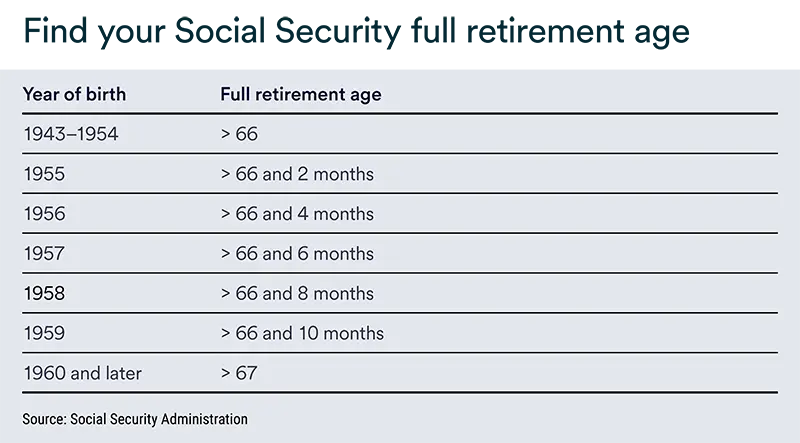
Your full retirement age is the age in which you’re entitled to your full Social Security benefit and depends on the year you were born. It’s currently 67 for anyone born in 1960 or later.
In short, you’ll receive less Social Security income. If you start collecting Social Security before reaching your full retirement age, your monthly benefit could be reduced to as little as 75% of what you would receive by waiting just a few more years.
For example, if you qualify for a $1,000 monthly benefit at your full retirement age of 67 but decide to start claiming at 62, you will only get $700 a month. On the other hand, if you wait until you turn 70 to claim Social Security, you will receive $1,240 a month. 1 Delaying Social Security can have a substantial financial impact over your lifetime.
You should consider many factors when deciding to file for Social Security such as your current health, family longevity, additional available financial resources, and if applicable, when your spouse will file.
There are several factors in determining your Social Security benefits. They include:
Visit ssa.gov/planners/calculators to help you estimate your benefits.
Social Security was not intended to be the sole source of income in retirement, as it only replaces a percentage of your pre-retirement income based on your actual lifetime earnings. For example, if you start receiving benefits in 2026 at full retirement age, the percentage ranges from about 28% for high earners to as much as 79% for low earners. 2
It’s important to factor in other sources of income as you plan for retirement.
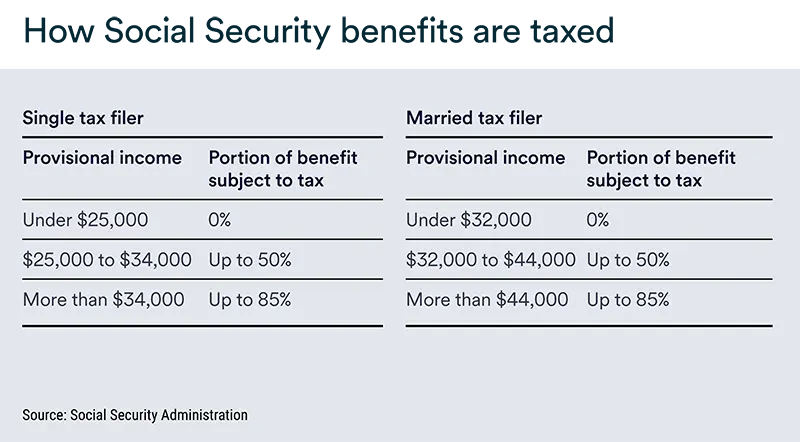
Whether your Social Security benefits are taxed depends on what state you live in and what your combined income is while claiming Social Security benefits.
If your combined income is $25,000 or more per year (for individual filers) or $32,000 per year (for joint filers), you could be taxed on at least 50%—and up to 85%—of your benefits. However, if your combined income is less than $25,000 (for individual filers) or $32,000 (for joint filers), you won’t pay tax on your Social Security benefits.
To figure out your provisional income, you’ll add your adjusted gross income, any nontaxable interest and half of your Social Security benefits together.
Consult a tax professional for questions about Social Security taxation.
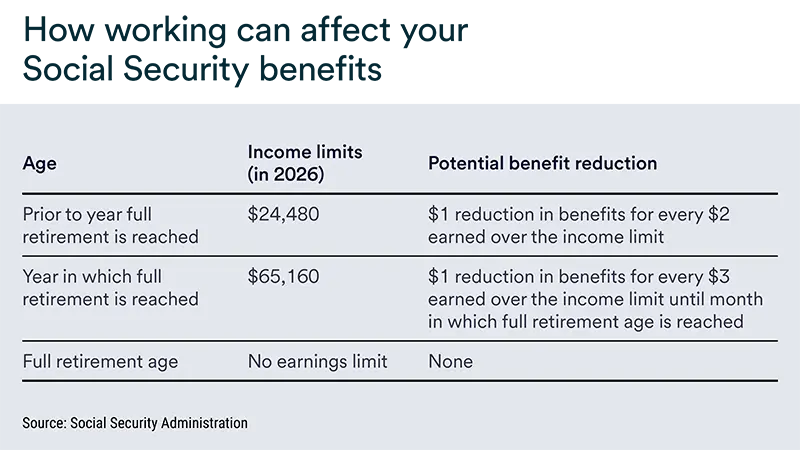
This is a common Social Security benefits question; yes, you can receive benefits while working, with some stipulations. If you expect to keep working right up until your full retirement age but would like to supplement your income with Social Security, you can—if you don’t exceed the income limits.
Once you hit your full retirement age, there is no limit to what you can earn from other sources.
Yes, with some qualifications. If your spouse is a qualified worker, you’ll be able to collect one-half the amount that they do, as long as you wait until you hit your full retirement age. If you claim before that, your benefits will be reduced.
There are no delayed credits for individuals claiming a spousal benefit past their full retirement age.
Yes, if:
The rules are slightly different if you are disabled or caring for a child under age 16. In these cases, you can claim for spousal benefits no matter how long you were married to that ex-spouse.
It’s worth noting that if you claim for spousal benefits, your ex-spouse will not be notified to protect your confidentiality. It also won’t affect their own benefits.
The answer to this Social Security benefits question depends on several factors.
If you’re married when you die, your spouse could begin receiving benefits once they turn 60, or once they turn 50 if they are disabled. If you were divorced at the time of your death, your ex-spouse could still claim benefits if:
As far as how much of your Social Security benefit your surviving spouse would receive, the rules are as follows:
For more information, see the Social Security Administration’s page for survivor’s benefits.
You may be asked for the following documents while applying:
This checklist can help you gather information and documents you may need to apply. If you don’t have all the documents, don’t worry. In many cases, your local Social Security office can help you find the information.
You can initiate the process with whichever of the following options you prefer.
For personalized guidance, consider consulting with a financial professional who can address your Social Security benefit questions and help determine the proper role for Social Security in your retirement.
You probably have big dreams for retirement. That’s why comprehensive retirement income planning – for the short, medium and long term – is so important.
Our planning services and professional guidance can help you work toward a more secure and fulfilling retirement.



 Equal Housing Lender. Deposit products are offered by U.S. Bank National Association. Member FDIC. Mortgage, Home Equity and Credit products are offered by U.S. Bank National Association. Loan approval is subject to credit approval and program guidelines. Not all loan programs are available in all states for all loan amounts. Interest rates and program terms are subject to change without notice.