
Capitalize on today's evolving market dynamics.
With changes to taxes and interest rates, it's a good time to meet with a wealth advisor.
AI investing increasingly rests on measurable earnings, business adoption and capital spending, while high expectations can amplify volatility when results or returns disappoint investors quickly.
AI investment opportunities extend beyond technology stocks to semiconductors, cloud computing, data centers, power, networking, cybersecurity, software and emerging-markets companies within the global supply chain.
Diversification and individual-security research can help investors balance opportunity and risk by emphasizing durable demand, financial strength, valuations and credible paths from spending to profits.
Artificial intelligence (AI) has moved from a promising idea to a major force in corporate strategy, capital spending and investment markets. Companies use AI to build products, automate workflows and improve decisions, while technology providers invest heavily in the computing capacity behind those tools. The opportunities to now extends beyond a narrow group of companies building AI models to stocks of semiconductor, cloud, data center, power, networking, cybersecurity and software companies.
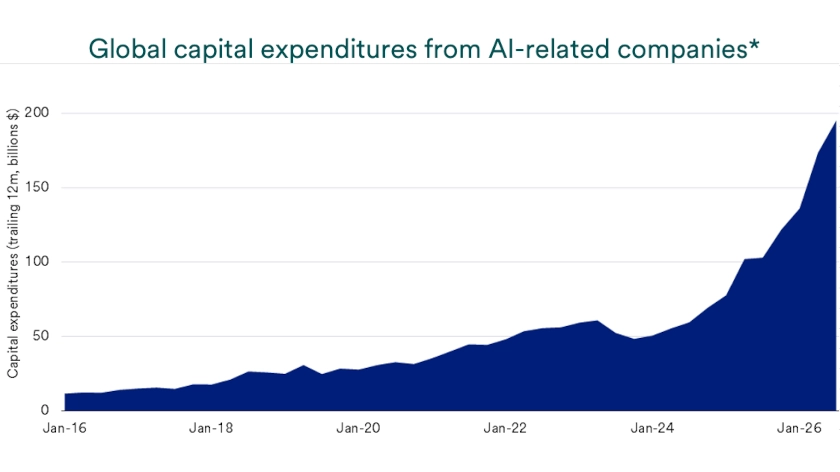
The scale of the buildout creates opportunity and raises the standard for success. AI-related companies increased capital expenditures 120% over the 12 months through July 2026, and investment-grade technology companies are on pace to issue $162 billion of bonds in 2026 to help finance expansion. These commitments support revenue across many industries, but sustained customer demand, productivity gains and earnings must ultimately justify the spending.
Rapid technological change rarely follows a smooth path. Investors need to compare the durability of demand with valuations, financing needs, competitive pressure and the time until they earn a return on new infrastructure. Diversification across the AI ecosystem can provide exposure to the opportunity while reducing dependence on one company, product or phase of the AI investment cycle.
Artificial intelligence describes computer systems that perform tasks associated with human intelligence, including recognizing patterns, making predictions and generating content. For most of the computer age, software followed fixed instructions, while machine learning allowed systems to improve as they analyzed data. Machine learning now supports familiar tools such as credit scoring, fraud detection and recommendations from streaming and shopping services, while deep learning uses more complex models for capabilities such as facial recognition, meeting transcription and language translation.
Generative AI creates new text, code, images, audio or video rather than only sorting or analyzing existing information. These tools use patterns learned from large data sets to predict and produce relevant output. Agentic AI extends that capability by starting with a goal, then planning a sequence of tasks and completing multiple steps with limited human direction.
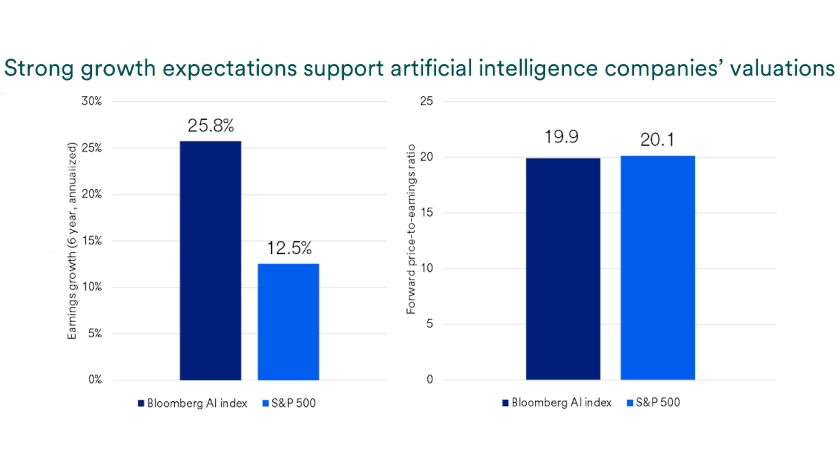
AI-focused companies have supported their rising valuations with strong profit growth rather than promise alone. Companies in the Bloomberg AI Index generated annualized earnings growth of about 26% over the six years through August 4, 2026. That record distinguishes the current market from the late-1990s technology boom, when many leading companies had limited profits and weaker balance sheets.
Strong results do not eliminate short-term risk. When share prices already reflect ambitious growth, a new competitor, delayed product or weaker guidance can quickly change expectations. Volatility can rise even when the long-term outlook for artificial intelligence remains constructive.
Investors also continue to distinguish among stronger and weaker businesses rather than rewarding every company associated with AI. Companies with growing revenue, durable margins and the financial capacity to grow capital investments generally attract capital on better terms than riskier borrowers. This selectivity supports company-level research rather than treating AI as a uniform investment theme.
The AI buildout begins with computing power, but the investment chain extends much further. Large cloud and data center operators, often called hyperscalers, buy advanced semiconductors, servers, networking equipment, cooling systems and electricity at extraordinary scale. Their spending becomes revenue for suppliers across technology, industrials, materials, utilities and energy, creating more ways to access AI investment opportunities than selecting a model developer alone.
Corporate cash flow remains an important funding source, and large technology companies have redirected money from share repurchases toward infrastructure. Debt now plays a larger role, although current borrowing costs still indicate investor confidence in these companies’ balance sheets. Credit spreads, or the extra yield investors demand above comparable U.S. Treasury bonds remain relatively low for investment-grade technology issuers even as bond supply increases.
Some AI financing arrangements link an investor, supplier and customer in the same transaction. A semiconductor or cloud company may invest in an AI developer that then uses part of the funding to buy the provider’s chips or computing services. This structure can accelerate construction and align incentives when customer demand and pricing remain strong.
The arrangement also increases interdependence. If an AI developer cannot generate enough revenue to meet large hardware or data center commitments, the supplier could lose both a customer and record a decline in the value of its investment. Debt financing adds risk because higher interest costs or weaker cash flow can strain companies before the expected returns arrive.
Competition raises the hurdle further. Lower-cost models could reduce the prices customers will pay for AI services and weaken returns on expensive infrastructure. Private and newly public AI companies add another challenge because short operating histories can make future financial performance harder to project. Investors should assess demand, pricing, cash generation, competitive advantages, financial disclosures and valuation rather than solely relying on announced spending or market attention.
AI is changing how software companies build products, serve customers and protect competitive advantages. New tools can automate contract analysis, coding, document creation and customer service, improving productivity while replacing some features that once supported premium prices. Investors are evaluating which businesses can convert AI capabilities into durable revenue rather than simply adding AI features to existing products.
The transition will not affect every software company in the same way. Products embedded in essential workflows may retain pricing power because customers value trusted data, security, regulatory controls and integration with existing systems. Less differentiated products may face greater pressure if customers can switch providers easily or reproduce important functions at a lower cost.
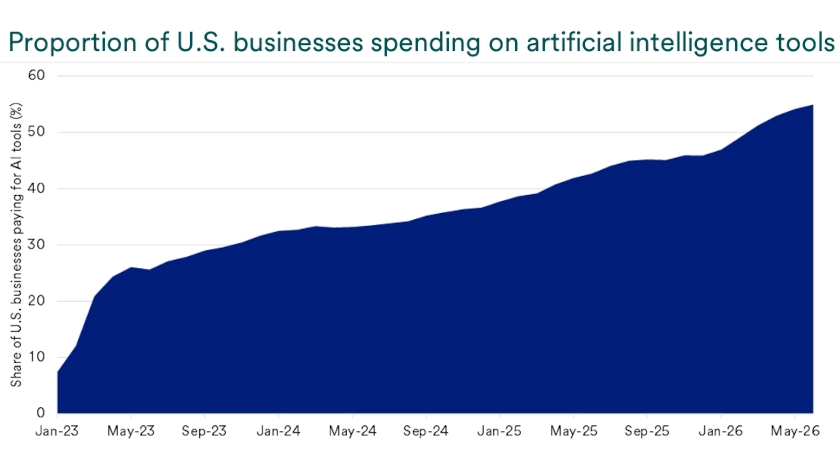
Business adoption provides the clearest test of the AI investment cycle. Data from corporate spending platform Ramp show that the share of U.S. businesses paying for AI tools continued to rise through June 2026. Continued adoption can help convert today’s infrastructure spending into recurring revenue, while slower adoption would extend the time suppliers need to earn acceptable returns.
The next phase will depend less on companies announcing AI initiatives and more on measurable business results. Organizations will need to show that AI can improve productivity, serve customers more effectively, reduce operating costs or create new sources of revenue. Those outcomes could broaden spending from semiconductors and cloud capacity toward software, cybersecurity, data management and workflow automation.
Broader enterprise adoption also extends the infrastructure cycle rather than replacing it. More applications require additional computing capacity, data centers, networking equipment, cooling systems and reliable power, while location and construction constraints can limit how quickly capacity expands. Investors must therefore monitor both sides of the cycle: the infrastructure that enables adoption and the business demand that determines whether the spending produces durable returns.
Investors do not need to identify one AI company or product to gain exposure to the investment cycle. U.S. large-cap stocks include leading semiconductor, cloud and technology companies, along with businesses in other sectors that may use AI to improve productivity and profitability. Emerging-markets exposure can add semiconductor manufacturers and other suppliers within the global technology chain, although country, currency, geopolitical and company-specific risks require careful consideration.
Investors can evaluate whether a company has durable customer demand, proprietary capabilities, financial strength and a credible path from AI spending to earnings rather than assuming every company associated with AI will benefit.
Broad exposure does not eliminate the value of individual-security research. AI adoption will affect companies unevenly across semiconductors, networking equipment, cooling systems, software and cybersecurity, creating potential differences in revenue growth, profit margins, competitive advantages and capital requirements. Investors can evaluate whether a company has durable customer demand, proprietary capabilities, financial strength and a credible path from AI spending to earnings rather than assuming every company associated with AI will benefit.
Listed infrastructure provides a complementary way to participate in the physical demands associated with AI growth. Global infrastructure strategies may invest in utilities, energy transportation, railroads, communications infrastructure and data centers, which can support the power, connectivity and physical capacity required by a growing digital economy. These companies have different revenue drivers and risks than semiconductor or software businesses, so investors should still assess regulation, financing costs, construction requirements, valuations and the durability of demand.
Finally, private markets, where appropriate, offer selective access to AI companies, power and data center projects not available through public markets. Opportunities include smaller projects with manageable power needs, fewer approvals and uses beyond AI, which can reduce the risk that one delay derails the investment. Specialist venture capital managers can also target AI-native software and services rather than broadly investing in companies associated with the theme, while investors may also find opportunities in power generation and related inputs that support growth in AI demand.
Talk with a wealth professional if you have questions about technology sector investments, your personal financial circumstances or investment portfolio.
When prices are already high, markets can react sharply because investors have less patience for uncertainty. In that environment, new headlines can trigger a “sell first, analyze later” move as people reduce risk quickly and reassess once more details emerge. Elevated valuations can add to that sensitivity, especially when the payoff from large AI spending remains hard to measure in real time.
A bubble typically lifts nearly anything connected to a theme regardless of fundamental merits, and recent market performance has not reflected that phenomenon. Instead, investors have separated stronger business models from riskier ones and borrowing costs reflect that differentiation for lower-quality technology borrowers. You can interpret this as repricing and sorting, not a blanket rejection of AI’s longer-term potential.
AI adoption depends on dependable building blocks – trusted data, secure systems, and reliable infrastructure – not just one product or one company. Data capture, storage, processing, analytics, security and electrification support many AI outcomes because they make tools usable at scale. Privacy, governance, and compliance also matter because many organizations require clear guardrails before they expand new technology across sensitive workflows.
Technology stocks have helped drive market returns in recent years, supported by innovation, productivity gains, and strong earnings growth.
We can partner with you to design an investment strategy that aligns with your goals and is able to weather all types of market cycles.


 Equal Housing Lender. Deposit products are offered by U.S. Bank National Association. Member FDIC. Mortgage, Home Equity and Credit products are offered by U.S. Bank National Association. Loan approval is subject to credit approval and program guidelines. Not all loan programs are available in all states for all loan amounts. Interest rates and program terms are subject to change without notice.