

How to stop impulse buying

How to economize money and cut your monthly spending


4-min. read
Lifestyle creep happens when your spending quietly rises along with your income, often without you noticing.
Watching for subtle red flags can help you catch lifestyle creep early before it derails long-term goals.
Small mindset shifts and intentional habits can keep your lifestyle in check while still letting you enjoy what you earn.
It’s easy to let spending rise along with your salary. This is lifestyle creep. A nicer apartment here, a few upgrades there, some extra weekend trips with your friends.
And, yes, you deserve those indulgences. You put in the hard work to get where you are professionally and financially. But after a while, your bank balance stops growing as fast as your paycheck. It can’t keep up with your new normal.
The goal is to use a raise to finally get ahead — on your bills, savings, investing and debts — not to set yourself back even further.
Here’s how to recognize lifestyle creep and what to do once it starts sneaking into your spending.
Simply put, lifestyle creep is when your spending grows with your income, often without you realizing it.
This phenomenon has deep, psychological roots. “Our brains are wired to find both the hunt and the purchase rewarding,” says Annie Wright, LMFT, an executive coach and licensed psychotherapist. To put it simply: Spending feels good.
A concept known as hedonic adaptation is another culprit — the tendency to quickly normalize upgrades. “You get the luxury car with the heated seats, and for a month, it feels amazing, but pretty soon it’s just ‘your car’ and your happiness drifts back toward its usual level, so your brains starts looking for the next upgrade,” Wright says.
There’s also a social element: Once you upgrade one part of your life, the rest starts to look like it needs an upgrade, too. That’s called the Diderot Effect — when one shiny new purchase triggers a domino line of other purchases. “You buy the nice linen sheets, and suddenly your old duvet cover looks tragic, so you replace that, and then the nightstands look cheap … and on and on it goes,” she says.
And woven through all of this is reward mentality — the idea that every tough week, milestone or inconvenience deserves a treat. There’s nothing wrong with rewarding yourself, but when rewards become the default instead of the exception, they quietly shift what feels “normal” to spend.
Lifestyle creep isn’t always dramatic; it often shows up in small, repeatable habits. Here are a few red flags that suggest your spending has started rising faster than your income.
Celebrating a raise or bonus with a little prize is perfectly reasonable. But if extra income consistently vanishes into day-to-day spending, it may mean your saving habits haven’t scaled with your salary. A helpful strategy: Automatically direct a percentage of every raise or bonus into a savings account before deciding what — if anything — to splurge on.
A framework like the 50/30/20 budgeting rule can help keep priorities balanced. This calls for putting 50 percent of your income toward “needs,” 30 percent toward “wants” and 20 percent toward savings and future goals. If your income has grown but your savings percentage has stayed flat — or dipped — a lifestyle creep is probably in play.
Upgrades can be motivating, but they shouldn’t outpace your financial safety net. If big purchases are happening faster than your emergency fund grows, it may be time to rebalance. A simple approach: Tie any major upgrade to a parallel contribution to your emergency fund, even if it’s small.
“Treat yourself” culture is everywhere — and sometimes deserved. But when daily takeout, constant upgrades or high-ticket splurges become routine because you’ve “earned” them, your future goals quietly get squeezed out. Future you deserves comfort, too.
You subscribe to a new streaming service to watch one show. You try a yoga class and end up with a full membership. You join friends for weekly dinners because it’s easier than cooking. These changes feel small, but they add up quickly. “If you can’t remember what you bought last month but you know you’re stressed about bills, that’s the creep talking,” says Wright.
Putting a flight or sofa on a credit card isn’t necessarily a problem — but when your income could cover the bill and the balance still grows, it suggests expenses have quietly outpaced your budget. Credit card creep is often one of the earliest measurable signs that lifestyle creep is starting to take hold.
Use the spending tracker in the U.S. Bank Mobile App to stay in control.
The tricky thing about lifestyle creep is that it doesn’t feel harmful in the moment. But over time, it can chip away at the financial flexibility you need to build the future you want.
Many adults are delaying major life milestones — buying a home, having children, switching careers — because they feel financially stretched. The 2025 American Family Survey, for example, revealed that 43 percent of adults cited “insufficient money” as their primary barrier to having kids. And the average age of first-time homebuyers rose to an all-time high of 40 in 2025, according to the National Association of Realtors’ 2025 Profile of Home Buyers and Sellers survey.
Cutting a few subscriptions won’t magically allow you to buy your dream home at 28, but staying mindful of lifestyle creep will certainly put you on firmer footing — and keep future goals within reach.
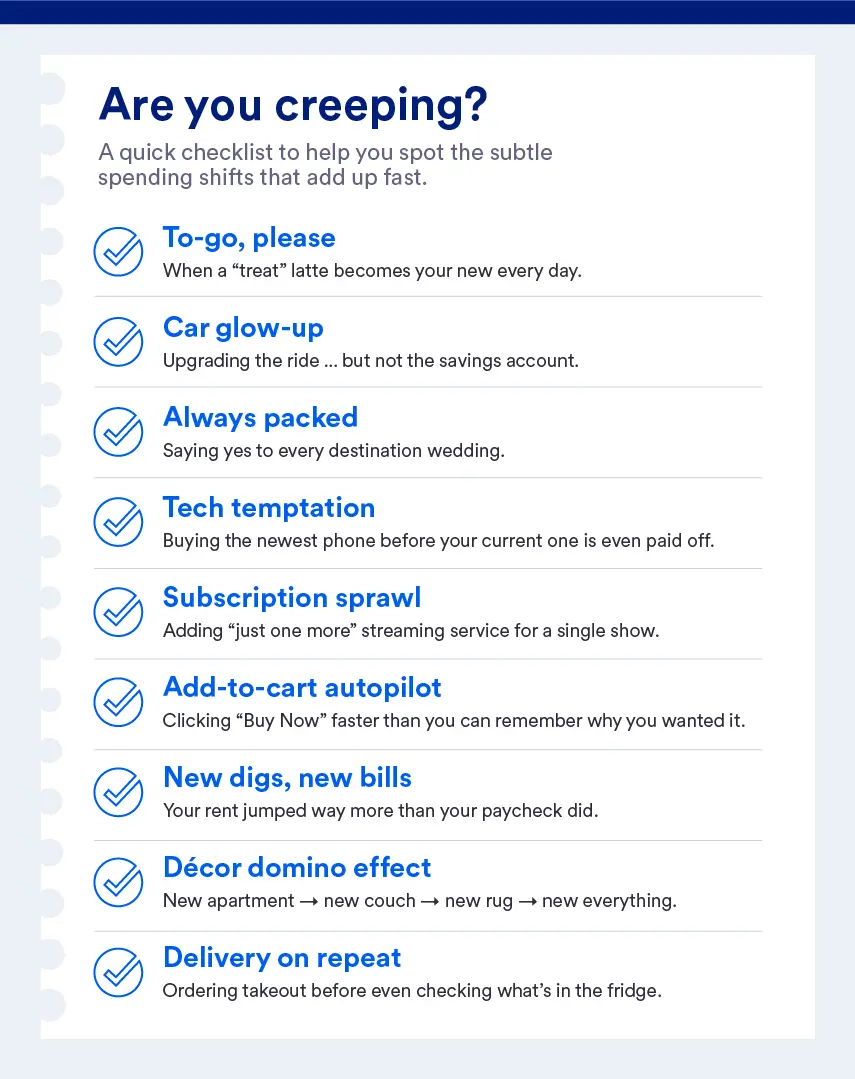
The good news? You don’t need to overhaul your lifestyle. You just need to reframe how you use the money you earn. Here are a few ways to do that without feeling deprived:
A budget review doesn’t need to feel like a root canal. In fact, it’s one of the fastest ways to get lifestyle creep under control.
Pick a monthly or quarterly check-in and make it as pleasant as possible: Bring a favorite snack, loop in a partner or friend or do it at a time of day when you’re relaxed and clear-headed.
If you’ve recently received a raise, wait one or two pay cycles to see how your income actually lands, then reallocate using a structure like 50/30/20. This ensures your savings grow alongside your salary, not just your spending.
It can also help to map your budget to your values. Maybe you care most about financial security, new experiences, creative hobbies or spending more time with family. Naming your categories after those priorities makes them easier to commit to — and easier to stick with.
If you’re unsure where to start, try a few small shifts that deliver momentum:
These small moves build discipline without feeling like deprivation — and they help make sure your rising income translates into rising financial stability.
Lifestyle creep FAQ:
Q: How often should I check for lifestyle creep?
A: A quick monthly review works for most people, especially right after payday when you can easily see how money is flowing in and out. A deeper check-in every quarter can help you catch patterns you might otherwise miss.
Q: How do I know the difference between lifestyle creep and healthy upgrades?
A: A good rule of thumb is whether your savings rate is growing alongside your income. If you’re upgrading intentionally within a set budget and still meeting your goals, that’s not creep — that’s alignment. Creep happens when upgrades become automatic and start squeezing out long-term priorities.
Q: Is lifestyle creep always bad?
A: Not necessarily. Some upgrades genuinely improve your quality of life, like a shorter commute or a safer apartment. The problem arises when spending grows faster than your income or when it keeps you from saving for goals that matter.
Q: Can lifestyle creep happen at any income level?
A: Yes. Even high earners fall into the trap — sometimes more easily — because their increased earning power makes incremental upgrades feel harmless. That’s why keeping an eye on trends, not just totals, is important.
Related content
 Equal Housing Lender