

Delivering strong results
Given the CEO leadership transition, we believed it was important to reaffirm the targets we shared at our Investor Day in 2024. We mobilized around them, and we are proud to report that by the third quarter of 2025, we were operating fully within our medium-term target ranges, and that performance drove solid earnings per share growth of 16%1 on an adjusted basis in 2025. For instance:
Accelerating growth
We delivered record full-year net revenue of $28.7 billion, representing 4% growth over 2024. Our fees grew 6.7%, which was above our medium-term targets.
Productivity
2025 was a strong year for productivity. We maintained nearly flat expenses and achieved full-year positive operating leverage of 370 basis points on an adjusted basis.1
High returns
We achieved a return on tangible common equity of 18.1%2 for the full year and improved our return on assets to 1.19% during the fourth quarter. Our strong returns are particularly notable given that we have grown our common equity tier 1 capital ratio (CET1) by 1.9% in 2025 as we prepare for our transition to a Category II banking organization.
Credit and capital
We remained true to our core risk management principles and had net charge-offs of 57 basis points as a percentage of average loans outstanding for the year, and our CET1 capital ratio strengthened to 10.8%.
Although we are proud of the early progress against our financial commitments, we have higher aspirations and remain focused on delivering consistent industry-leading financial results going forward.
Executing with urgency
We aligned behind three priorities to focus our execution and drive our results in 2025: organic growth, productivity, and payments transformation. We also invested to extend our competitive advantages in key foundational areas.
Organic growth
I have long held the strong conviction that sustainable organic growth comes from delighting clients. As such, our strategy has focused on delivering more interconnected products that create unique value and deeper relationships with our 15 million clients. We have an attractive mix of fee-based products that complement core banking in beautiful ways. For our consumer segment, we introduced Bank Smartly®, which enriched card rewards based on deposits. For small businesses, we introduced U.S. Bank Business Essentials®, which interconnects banking, card and merchant solutions. We also streamlined credit underwriting and introduced cash flow management capabilities tailored for this segment. For our institutional clients, we integrated delivery of all services for the healthcare and private capital industry segments and accelerated growth in treasury management, payments and investment services. We introduced a broad array of capital markets products and in early 2026 announced a definitive agreement to buy BTIG, LLC, which will augment our fixed income, foreign exchange and derivatives capabilities with equity trading and investment banking.
Further supporting organic growth, client centricity and interconnected products improved our loan book mix with commercial and credit card loans making up 48% of loans at year-end vs. 45% at the end of 2024. These loans drive multi-product client relationships that tend to deliver three times the revenue per client compared with single-product clients. A similar focus on consumers improved our funding mix, and we achieved record consumer deposits in the fourth quarter. These business strategies, along with select balance sheet repositioning actions, grew net interest income and strengthened net interest margin to 2.77%.

Productivity
During the past six years, we undertook an ambitious effort to elevate our digital capabilities from customer experiences to production systems across custody, loan underwriting, foreign exchange, mortgage, card, merchant gateways, broker dealer and more. These legacy investments – augmented by our cloud migration and rapid deployment of artificial intelligence (AI) capabilities – helped us achieve meaningful cost savings within our core operations and essentially maintain flat expenses, even as we invested more than $2.5 billion in 2025 to drive organic growth. Early in 2025, we organized our efforts around four signature productivity programs: AI and automation, location optimization, real estate rationalization, and organizational simplicity. These programs have further runway and will continue into 2026.
Payments transformation
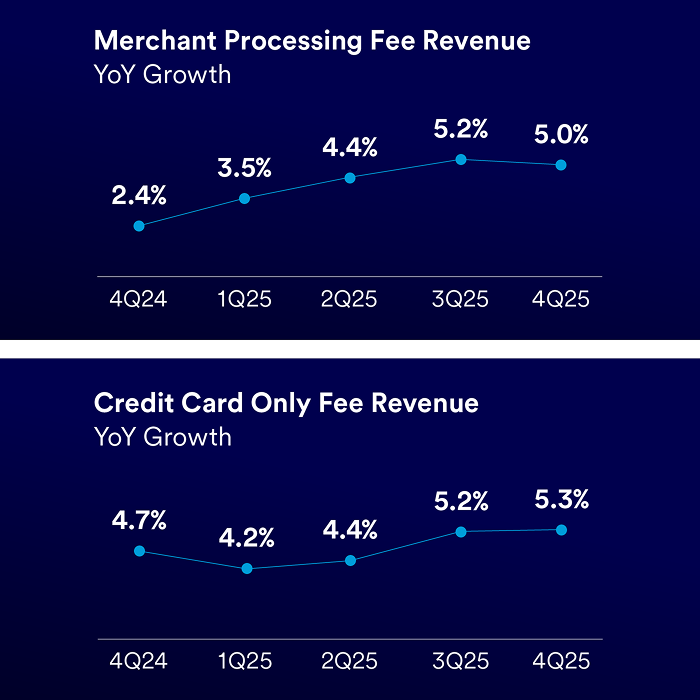
I often observe kids and their first experiences with money. It’s mostly about paying for something. Today, a payments product is often the first and the most frequent interaction clients have with banks, especially Gen Z customers. Our payments transformation is a strategic, long-term priority for the company and fundamental to growing, deepening and delighting future generations of clients. Card issuing – more than two thirds of our payments business – is augmenting our legacy strength with new and creative products tailored to attract affluent clients. Further, our 2022 MUFG Union Bank acquisition introduced an attractive, affluent customer base; access to this important segment has helped us deepen our California franchise and extend our relationships, which have been important growth drivers. We also are executing a multi-year transformation within our merchant business aimed at embedded payments, a defined focus on five key verticals, and direct distribution. As the transformation has hit its stride, we have seen steadily strengthening growth rates for both businesses through 2025.
Strong foundations
We are the largest non-GSIB commercial bank in the United States, and we are close to becoming a Category II banking organization. While we are building capital toward this transition, we are committed to our long-term capital distribution target of 75% through dividends and our share repurchase program, which is designed to support sustainable growth for our clients, protect the bank throughout economic cycles and ensure our ability to deliver regular and predictable shareholder returns. We are proud to often be called best-in-class underwriters, and we have reinforced our credit and risk management disciplines as we scale and grow. We will strengthen existing roots as we grow new ones. In 2025, we built out in-house capabilities in artificial intelligence, data management, and digital assets, which will allow us to leverage the potential of these imperatives and be ready to reach new heights.
Reorienting the organization for performance
Strong, positive cultures support long-term differentiation and success for companies. I am fortunate to inherit a culture steeped in integrity, community investment, prudent stewardship, and deep care for our people. It is my intention to safeguard these strengths for the benefit of future generations of U.S. Bankers.
Within that overall context, we are reshaping the organization to have a sharper performance edge. We intentionally shifted resources to the company’s most important opportunities. We aligned the organizational structure to consolidate and elevate client-facing groups. We eliminated duplication, simplified decision-making, and replaced outdated or redundant processes. This helped us achieve both greater speed and expense reduction.
We infused new talent into the organization, as well. For instance, nearly a quarter of our top 150 leaders are new-to-bank or new-to-role. We refreshed incentives – creating tighter alignment between individual rewards and company priorities – and drove higher performance differentiation. Most importantly, we rearticulated leadership expectations, augmenting our traditional strengths in stewardship, ethics, care and collaboration with new expectations for urgency, ambition, accountability, transparency and interconnectivity.
Our leaders and teams have deep love and respect for this organization. They accepted the call to action and delivered strong momentum and results in 2025. They will continue to lead the charge into 2026 with care and resolve.
Looking ahead
Throughout our history, U.S. Bank's pivotal strategic shifts and outperformance have come during times of significant change in the industry. In the 1990s, we grew scale through bank acquisitions. In the deregulatory era of 2000s, we acquired then-unusual capabilities in payments, corporate trust and asset management, which created a highly attractive diversified fee portfolio. During and after the financial crisis, we leveraged our strengths in risk management to grow through a flight to quality, and a decade ago, we emphasized a digital-first strategy in response to significant shifts in customer behavior.
Today, banking is at the precipice of consequential change with broad re-examination of our regulatory and supervisory constructs, the rapid rise of artificial intelligence and digital currency, and potential shifts in industry composition with novel charters and consolidation. We have deep confidence in our strength and our ability to be successful amid these winds of change. As we look ahead to 2026 and beyond, our strategy will be shaped by the core principles that define and differentiate us. We will keep clients at the center of everything we do and meet them where they are – in branches, offices or online, with a human touch or AI agents, directly or through partners. We will be known for a broad array of compelling products that support the full cycle of life events and diversify our business model. We will invest and innovate around our strengths in capital markets, payments and investment services to capture the potential of digital assets and AI. We will run our company efficiently, fully embracing technology and simplicity. We will lead with enduring values and ultimately deliver strong, consistent, leading performance.
Our strategy is clear, our team is energized, and our momentum is building. We have a renewed commitment to you and deeply appreciate not only your interest in us, but also your investment. We honor it as our own. We expect a lot from ourselves – and so should you.
My best to you with sincere thanks,

Gunjan Kedia
Chief Executive Officer and President
U.S. Bancorp
February 2026