

How to choose the right savings account for your goals

Helping Gen Z build financial literacy


8-min. read
Starting early gives your baby’s savings more time to grow through consistent contributions and compounding interest.
Different account types offer different benefits, so choose the option that best fits your family’s needs and goals.
A savings account can grow with your newborn and help introduce core money skills over time.
There is so much to do when you have a newborn in your life. The early-morning feedings, the constant laundry, the bedtime routines and all the millions of things to do in between.
Opening a savings account for your little one? It may not be No. 1 on your to-do list. But there are many reasons why it should be near the top.
A savings account for your baby is a great way to set money aside for their needs. Whether it’s for future education or those emergencies that will inevitably pop up, a dedicated savings account can help you build a layer of financial security for your child over time.
Here’s when it makes sense to open an account, what the benefits are and how to get started.
There are many clear benefits to starting a savings account for your newborn. One of the biggest ones has to do with time. Compounding — when your money earns money — can be surprisingly powerful over the long haul.
It works like this: You start with a certain amount of money in a savings account, let’s say $1,000. If it’s an interest-bearing account, that value will grow over time even if you don’t put another penny into it. For example, at a 3.50% Annual Percentage Yield (APY), that $1,000 could grow to roughly $2,000 after 20 years (the exact amount depends on the account and the interest structure).
Now imagine adding just a few dollars a month or week to the account — the growth would be even more substantial. And if you receive monetary gifts from family for your kid’s birthdays or holidays, you’ll have an easy, purposeful place to put them.
Beyond the financial upside, an early account sets the stage for healthy money habits later. When your child reaches the age when it’s appropriate for them to start learning about money, you’ll have a real-world example to work with. Think of how exciting it might be for a six-year-old to add some of their allowance to the balance of a bank account with their own name on it.
There are a few key types of accounts you’ll want to consider. Each has different benefits and perks.
These accounts are straightforward, flexible and easy to use. They’re ideal for short- and long-term goals alike. Many banks allow parents to open an account for a minor, and the U.S. Bank Smartly® Savings account is one option available for children of any age.
As your child grows, a joint account or custodial account may make more sense. The U.S. Bank Smartly® Checking account, for example, can be opened jointly with teens ages 13–17 and offers features like spending limits and activity monitoring.
Custodial accounts, available for minors under 18, allow children to have assets held on their behalf until they reach adulthood.
You may also want to consider alternatives like a certificate of deposit (CD) or a money market account. These accounts typically have different rules for accessing funds but may offer other higher interest rates or additional features that support long-term savings.
Set your child up for future success by opening a bank account for them today.
To open an account for a child, most banks require a parent or guardian to be listed on the account and will need to verify your identity and your child’s. That typically means providing your ID (such as a driver’s license, state ID or passport) and an ID for your child, such as a birth certificate or Social Security card.
Depending on the bank, you may be able to open the account online, in person or over the phone, though many institutions still require at least one quick in-person visit to verify documents — especially for accounts with minors.
Other steps may include choosing the account type, linking your existing bank account for contributions and setting initial permissions or alerts.
If you’re unsure about requirements, a quick call to your bank can help you understand exactly what’s needed.
As with any savings strategy, consistency is key. A few ways to build momentum include:
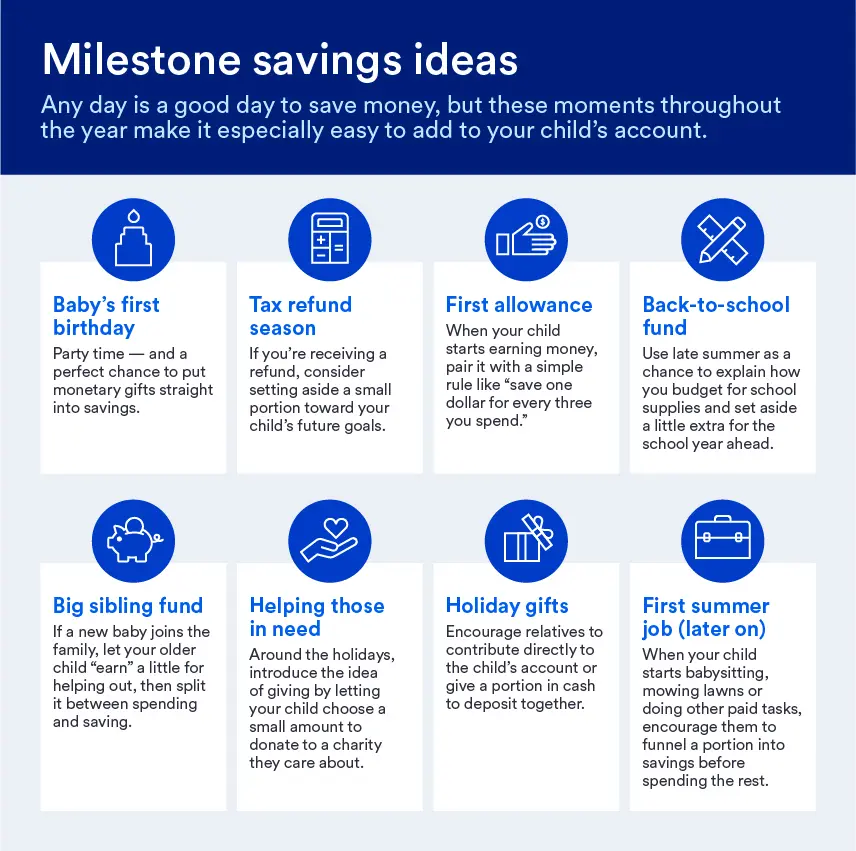
The account you open now will evolve as your child does. Here are a few ways to guide that progression.
In other words, the account isn’t just a place to stash cash. It becomes part of their financial education, confidence and independence.
Most banks require a Social Security number to officially open an account for a minor. While you wait for that number to arrive, park initial gifts or contributions in your own savings account, and transfer the funds once the newborn’s account is open.
There’s no minimum “right” amount — many parents begin with a small deposit and build from there. What matters more is setting up a habit you can maintain, whether that’s $10 a month or making deposits when holiday or birthday money comes in.
Generally, the money you contribute isn’t tax deductible, but the interest the account earns may count as your newborn’s unearned income. That typically isn’t an issue for small balances, but if you approach IRS kiddie-tax thresholds, it’s worth checking with a tax professional.
Each newborn will need their own account since minors can’t jointly share a custodial account. Many families simply repeat the setup process, so each newborn has a designated place for savings, gifts and goal-setting.
Most newborns aren’t ready for a checking account until their early teens, when they’re earning an allowance or doing small jobs. A checking account becomes more appropriate once they need access to a debit card, recurring payments or budgeting tools.
Many banks waive monthly maintenance fees for minors or offer newborn-specific accounts with no fees at all, but requirements vary. It’s worth reviewing minimum balance rules, withdrawal limits and any fees that apply once your newborn turns 18.
 Equal Housing Lender