
Key takeaways:
U.S. Bank is expanding its integrated payments strategy to help clients solve broader business challenges.
Peter Geronimo is fostering a client-focused sales culture centered on growth, collaboration and measurable outcomes.
The future of payments is simpler, smarter and more connected. As innovation accelerates, U.S. Bank is focused on reducing complexity for clients while partnering across the financial ecosystem to deliver seamless payment experiences.
The new head of sales for the bank’s PMI business is leading transformation in how U.S. Bank introduces payments to clients
When U.S. Bank announced Peter Geronimo's appointment as head of sales for its Payments: Merchant and Institutional (PMI) business earlier this year, it marked another investment in the bank's strategy to bring together its broad payments, treasury and merchant capabilities to better serve clients.
Geronimo joined U.S. Bank after 17 years at Citi, where he held leadership roles across treasury and trade solutions. He was drawn to U.S. Bank by what he calls the "three Ps": people, platform and potential.
Several months into the role, he's focused on helping clients take a more integrated approach to payments while building a sales culture designed to accelerate growth.
We recently sat down with Geronimo to discuss what he's learned since joining the bank, the future of payments innovation and why simplifying complexity may be the biggest opportunity of all.
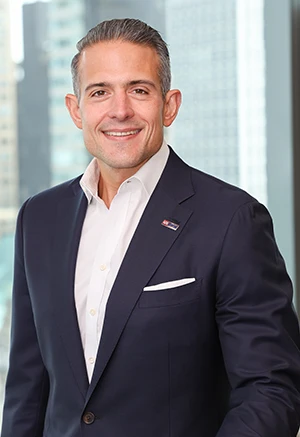
What made the opportunity at U.S. Bank compelling enough for you to make this move?
I describe it as the "three Ps": people, platform and potential.
The people stood out immediately. During the interview process, I met leaders across the organization who were passionate about the bank, passionate about clients and passionate about winning. What really resonated with me was the culture. There was a clear focus on helping one another succeed and elevating the organization together.
The platform was equally important. After spending 17 years at Citi, I wasn't looking to move unless I believed the capabilities could compete. I spent a lot of time learning about the business and asking questions.
What I discovered was a remarkably broad platform. Whether it's merchant acquiring, embedded payments, treasury management, lockbox, cash vault, prepaid solutions, freight, fleet or international capabilities, U.S. Bank brings together an impressive range of services that can solve real client challenges.
What's surprised you most since joining U.S. Bank?
The biggest surprise has been just how much opportunity exists. If we shift the intensity 1%, we’re going to be unstoppable.
Specifically from a sales standpoint, we were previously much more product-driven. There are times when that makes sense, but now that we’re in hyper-growth mode, we want to feel as close to the client as possible. We want to have one common vision, one set of goals.
How do you motivate and inspire a team? One of the first things I did was: I bought a gong. It’s a schtick, but it’s a schtick in the sense that I want people waking up every day and asking – how do I make an impact? How did I ring the gong today? It could be for winning a deal, great client satisfaction, delivering operational excellence – there are so many reasons to do it.
In my first days at U.S. Bank, I attended a sales conference and watched employees receive awards recognizing their achievements. People were emotional. They cared deeply about their teams, their clients and the bank. That tells you something important about the culture.
You've spent much of your career in payments. What have you learned about what clients value most?
The biggest lesson is that clients aren't looking to buy products. They're looking to solve business problems.
Before discussing a solution, you have to understand what they're trying to achieve.
Are they trying to improve working capital? Reduce costs? Increase revenue? Improve operational efficiency? Reduce fraud?
Once you understand the outcomes they're pursuing, the conversation changes. Instead of discussing individual products, you're helping clients solve broader business challenges. That's where integrated payments becomes especially powerful.
The biggest lesson is that clients aren't looking to buy products. They're looking to solve business problems.
Peter Geronimo, head of sales for Payments: Merchant and Institutional (PMI) at U.S. Bank
Can you share an example of how that approach helps clients achieve better outcomes?
One recent example involved a company looking to reduce payment fraud, digitize processes and improve working capital performance.
Rather than immediately recommending a product, we began by analyzing their accounts payable data to better understand their payment flows and opportunities for improvement.
That analysis revealed multiple strategies. Some payments were good candidates for virtual cards. Others could move from checks to ACH. There were opportunities to leverage faster payments in certain situations and improve payment timing in others.
Most importantly, we were able to quantify the impact.
We showed the client the potential value from rebates, fraud reduction and operational efficiencies. That data-driven approach helped them build a stronger business case internally and make decisions with confidence.
One other example I’ll give is for the past six or so months, we’ve become very focused on co-creation.
Sometimes clients come to us with needs that don't perfectly fit an existing solution. Instead of immediately focusing on limitations, we now spend time really understanding the challenge and exploring potential paths forward together.
Many business leaders feel overwhelmed by the pace of innovation. Which payment trends matter most today?
Payments innovation never stops, and that's part of what makes this industry so exciting.
New technologies and capabilities continue to emerge, whether it's artificial intelligence, real-time payments, blockchain applications or digital assets. The specific technologies will evolve, but the underlying client needs remain remarkably consistent.
Clients want to reduce friction. They want to digitize processes. They want better visibility into their cash positions and greater speed in moving money.
How can organizations modernize payments without creating more complexity?
Sometimes innovation is about subtracting, not adding.
One analogy I like comes from SpaceX. Over multiple generations of rocket engines, engineers continually simplified designs with the Raptor 3 engine by removing unnecessary components while improving performance. It’s not taking a look to save expenses, it’s to really interrogate if it’s truly needed to accomplish the end goal.
Organizations can take a similar approach.
The goal isn't to implement every new technology. The goal is to identify the outcomes you're trying to achieve and eliminate unnecessary complexity that gets in the way.
The best modernization efforts often create simpler experiences for employees and customers alike.
What industries are especially ripe for payments modernization?
One area where we're seeing significant opportunity is helping businesses create powerful direct-to-consumer experiences that deepen appreciation of and loyalty to their brands through payments and money movement.
Many companies that historically operated as business-to-business organizations are expanding direct relationships with consumers through digital platforms, marketplaces and online experiences.
As that happens, payments become more important than ever. Businesses need to make it easy for customers to pay, easy to move funds and easy to access information.
We're seeing similar dynamics across sectors ranging from hospitality and travel to retail and digital marketplaces.
Organizations are looking for more seamless ways to connect payment acceptance, treasury services, deposits and disbursements into one integrated experience.
What excites you most about the future of payments?
The future isn't about banks or fintechs succeeding independently. It's about how they work together.
Financial institutions bring trust, stability, regulatory expertise and longstanding client relationships. Fintechs bring innovation, speed and new ways of solving problems.
The most exciting opportunities come from combining those strengths.
U.S. Bank has been serving clients for more than 163 years, while continuing to invest in technology and innovation. When you can pair that foundation with modern capabilities, you create something powerful for clients.
That's what excites me most about where the industry is headed.


 Equal Housing Lender