

Key takeaways:
The new AI-powered Design Assistant helps designers create higher-quality digital experiences faster by automatically identifying issues and recommending compliant solutions.
By reducing repetitive work and helping ensure accessibility, design and content standards are met, the tool allows designers and engineers to focus more time on innovation and delivering better customer experiences.
The internally developed solution demonstrates how U.S. Bank is using AI to empower employees, improve productivity and accelerate the delivery of digital products and services.
Bank-built AI tool benefits designers, engineers and clients
A new AI solution – built in-house by U.S. Bank – is helping the company’s experience designers create better products faster.
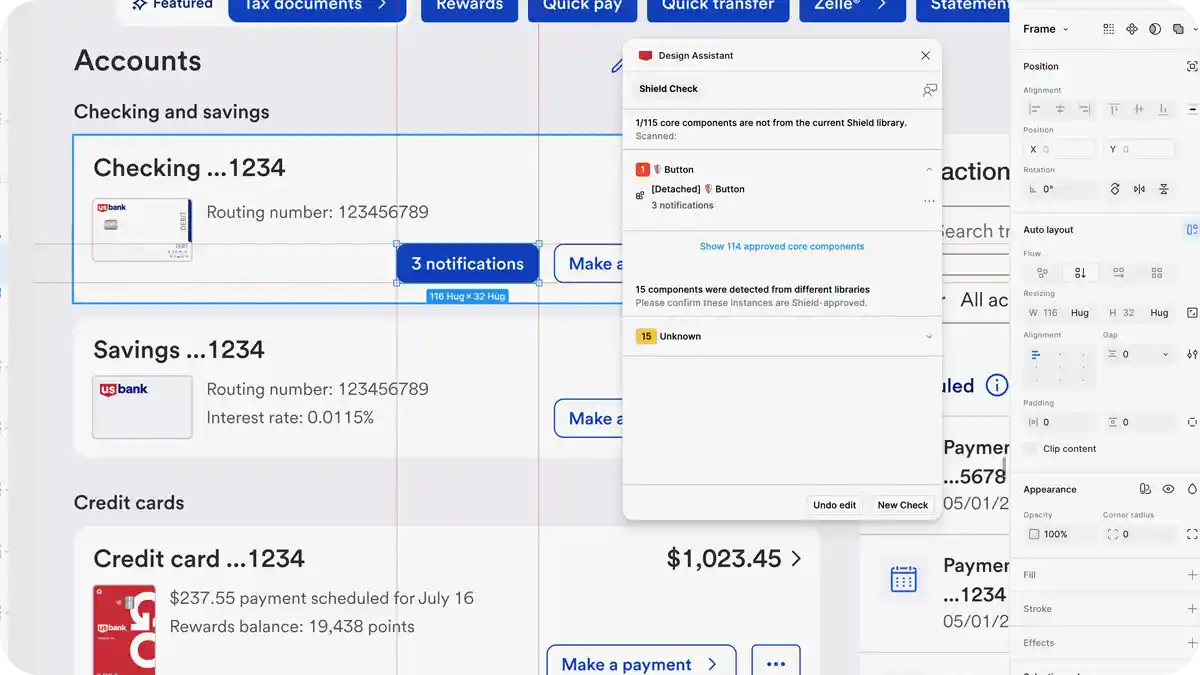
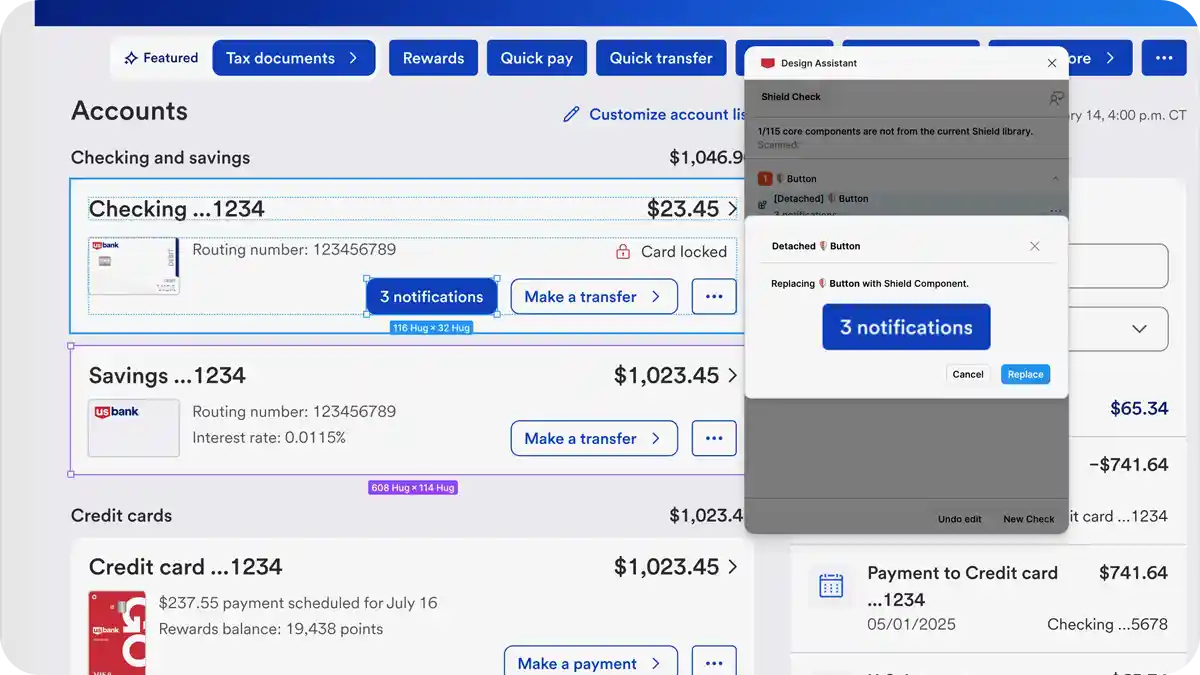
It’s called Design Assistant. Developed by the bank’s internal Experience Design team and AI Center of Excellence, it helps designers create the components of a user experience while ensuring accessibility, brand, design and content standards are met – by detecting issues and suggesting compliant replacements, then fixing them automatically with one click.
The new tool was rolled out to all experience designers at the company in December and has already been fully adopted as part of their daily routine – a reflection of just how useful and effective it has been.
“Delivering high-quality, compliant design specs is a critical part of the design process, but it’s often a tedious, error-prone task,” said Caleb Schmidt, head of experience design at U.S. Bank. “This new tool not only improves design quality but also saves designers time for higher-value work – allowing them to focus on creating industry-leading experiences that exceed our clients’ expectations and drive business outcomes.”
That is consistent with U.S. Bank’s AI strategy, which is to empower employees across the company with AI tools that augment their efforts to deliver a superior client experience. Design Assistant was built by designers for designers, reflecting a culture of innovation where employee ideas are embraced and put into action.
How it works
Design Assistant is embedded directly into the bank’s design system and the core tools designers use to create user interfaces, user experiences, wireframes and interactive prototypes – giving designers real-time guidance and support that automatically flags issues and recommends compliant fixes.
Design Assistant keeps humans in the loop, allowing designers to stay in control of all decisions, and the feedback they provide helps the tool get smarter over time. This AI-powered quality control for design specs also helps engineers by reducing rework, defects and risk.
“The result is measurable impact in terms of productivity gains, through real-time analysis of compliance with design, accessibility, content and brand standards,” Schmidt said.
Enhancing team member and client experiences
The new tool is not just about efficiency – it also enables scalable personalization and brand rollouts with significantly less effort and greater confidence. And when the design specs are built in compliance with standards, that helps engineering teams too – enabling them to develop reliable, safe and reusable code faster.
“The potential impact of our Design Assistant is huge, and everyone benefits from it,” Schmidt said. “For designers, it accelerates design and reduces repetitive tasks by offering intelligent solutions and automation – while supporting their creativity. For engineers, estimates show compliant specs take a third of the time to qualify and carry far less risk. And for our clients, it allows for faster releases and products that can be iterated on more frequently to create even better experiences.”
Building on the bank’s AI strategy
For designers, Design Assistant is an advanced tool that enables them to spend less time on mundane tasks and more time on creative and impactful work that utilizes their expertise. For the bank as a whole, it’s another component of a forward-thinking strategy to raise the bar for digital excellence, said Prashant Mehrotra, chief AI officer at U.S. Bank.
“This new tool is also another step further in our vision for product development – a future where humans set the product vision and AI helps orchestrate execution,” Mehrotra said. “By bringing together product, design, engineering, agile, risk and research teams under a unified, AI-powered framework, it reduces manual work and accelerates delivery.”


 Equal Housing Lender