
Key takeaways:
U.S. Bank’s Sports Finance Group has spent more than two decades helping NFL teams, leagues and venues navigate complex financial decisions, from stadium construction and ownership transactions to cash-flow management and risk mitigation.
The group’s long-standing relationships and industry expertise proved especially valuable during periods of uncertainty such as the 2008 financial crisis and the COVID-19 pandemic, when teams needed flexible financing and trusted strategic guidance.
With experience spanning more than 35 professional sports organizations and major projects including Levi’s® Stadium and U.S. Bank Stadium, the team continues to expand its capabilities to support clients through growth, disruption and evolving capital needs.
Tested in moments like the 2008 financial crisis and strengthened through COVID-19, U.S. Bank sports industry work supports teams, leagues and venues across professional sports
Behind the scenes, football is a capital-intensive business. It depends on reliable liquidity, thoughtful risk management and financing structures that can hold up through changing economic conditions.
For more than two decades, the U.S. Bank Sports Finance Group has worked alongside NFL clubs on the financial decisions fans rarely see. That can mean helping a team manage seasonal cash needs, financing a new stadium or renovation, or arranging capital for an ownership transaction. And because pro sports is a complex business, support can extend beyond lending. This includes short-term investments, interest-rate risk management, foreign exchange and treasury management.
At the league level, the work can include supporting league-wide credit facilities — centrally coordinated lending programs that help teams access funding when timing and flexibility matter.
“From the beginning, we made a commitment to be a close partner to teams and the league, not just a capital provider,” said Steve Vogel, head of the U.S. Bank Sports Finance Group. “That meant doing the work to fully understand how they operate, what pressures teams face over a season and which financial tools help them run effectively. When the pieces come together, it supports stability off the field, and that helps teams deliver the kind of experience fans expect on it.”
U.S. Bank brings that same approach to clients across other major U.S. professional sports leagues. The group’s roots trace to 1999, when U.S. Bank participated in a financing for the Cincinnati Reds. In recent years, U.S. Bank has worked with more than 35 professional sports teams, stadium and league-level clients.
That track record shows up in the syndicated loan market that powers many team and league financings. U.S. Bank is regularly among the top two syndicated loan bookrunners by number of deals for pro sports teams and leagues.
The group’s consistency proved especially important during periods of disruption. In the wake of the financial crisis — and again during COVID — teams and leagues faced real uncertainty about revenues and cash flow. Those moments reinforced an idea that is simple but hard to deliver: trust is built by showing up when conditions are hardest, not only when conditions feel stable.
“You earn trust in this business by showing up when things get hard. This means staying close to clients, working through scenarios and being consistent when there’s uncertainty,” Vogel said.
Vogel joined U.S. Bancorp in 2012 after holding a similar position at Bank of America. He has structured and arranged more than $25 billion in debt issuance for the sports and sports media industry, with experience across all five major U.S. leagues and the English Premier League.
In the NFL, that expertise also means understanding the league’s financing policies. The league sets parameters for team capital structures, including limits on how much team and stadium indebtedness is permitted. Financing terms can vary from deal to deal, but the league’s strong governance promotes stable access to capital.
That’s why experience matters as much as knowing the rulebook.
“Sports finance is somewhat similar to financing corporations on paper, but league governance and policy shape everything,” said Greg Taylor, who's been a key member of the U.S. Bank Sports Finance Group since 2016. “You need people who have done it before — who understand how the pieces fit together — to structure the right solution.”
One milestone for the U.S. Bank team came early in its NFL trajectory: helping finance the San Francisco 49ers’ Levi’s® Stadium project — work Vogel has described as a foundational NFL deal for U.S. Bank and a credibility-builder with league and team stakeholders.
“Building a new, state-of-the-art venue in Levi’s® Stadium was a major milestone for our organization that required a dedicated, trustworthy partner in U.S. Bank,” said Peter Wilhelm, 49ers CFO. “Since opening the stadium in 2014, we’ve built a reputation as a premier sports and entertainment venue, hosting the world’s biggest events. Our partnership with U.S. Bank has been a vital part of our building’s growth, success and generation of local economic impact.”
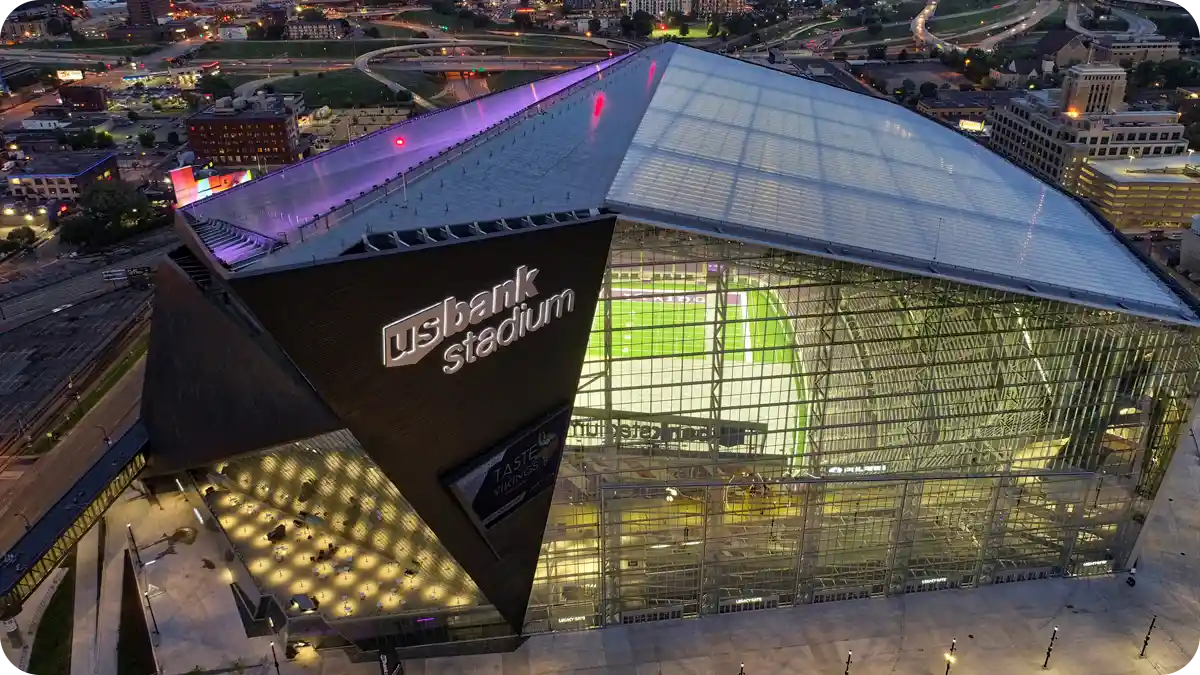
That financing experience has carried into other high-profile assignments over the years, including lead roles on stadium and franchise-related transactions across the major leagues. U.S. Bank was the lead bank for financing the private funding for the construction of U.S. Bank Stadium in Minneapolis.
COVID provided another defining test. With uncertainty around schedules and attendance, teams prepared for downside scenarios while still needing to meet obligations. The U.S. Bank Sports Finance Group stayed close to clients through that period — helping them evaluate options, preserve flexibility and plan for recovery as conditions changed.
“During COVID, the priority was simple: stay close to clients, run the scenarios, and make sure they had flexibility as conditions changed,” Vogel said.
Looking ahead, the announced acquisition of BTIG by U.S. Bancorp is intended to add capabilities such as equity capital markets and M&A advisory, complementing the debt capital markets, corporate banking and risk-management solutions that have long supported sports clients.
The goal is straightforward: help NFL clients make decisions with confidence — through growth cycles, disruption and everything in between.

 Equal Housing Lender