
Your gateway to organizational growth
Explore related insights or solutions.
A survey of 2,400 finance leaders found that payment innovation can streamline operations and boost growth.
Reported benefits include increased profitability, better customer experience, and greater productivity.
Fraud prevention is a top priority but fraud concerns are slowing change.
Executives overestimate risk in modern payment methods and underestimate the higher risk and potential cost impact of legacy methods like checks and wires.
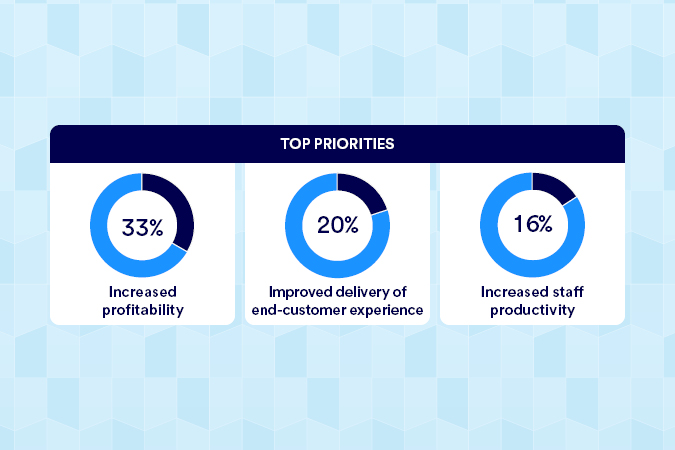
A recent survey of 2,400 finance leaders conducted by Visa in collaboration with U.S. Bank,1 found that key outcomes of payment transformation include increased profitability (33%), improved customer experience (20%) and increased staff productivity (16%).
Our new report explores how modern payment technologies can help companies streamline operations and fuel growth, helping leaders advance their top strategic priorities.
One challenge is balancing security and innovation. Of those surveyed, 86% of executives say preventing fraud and strengthening payment security is very or extremely important, and nearly four in 10 executives (38%) say improving risk identification and mitigation is their top priority driving their payment transformation.
However, roughly half of respondents say challenges with fraud prevention are hindering innovation in payments technology:
The good news is that fraud risk for advanced payment technologies is lower than finance leaders believe.
The report found that many executives overestimate fraud risk among modern, more secure payment methods while underestimating the risk of legacy methods.
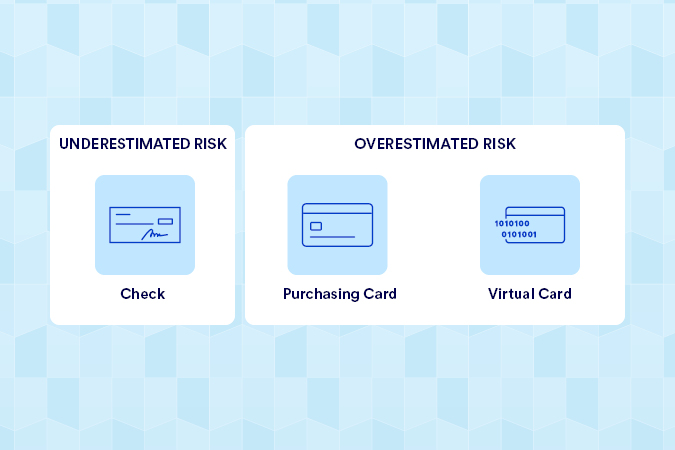
On a scale of 0 to 100, executives perceive the fraud risk for virtual cards at 48.7, while 5% of organizations report actual fraud in the 2025 AFP Payments Fraud and Control Survey Report.2 Similarly, purchasing cards have a perceived risk of 45.6 out of 100, while 22% of organizations report actual fraud according to AFP.
On the other hand, legacy payment methods have a higher actual risk. Finance leaders perceive checks to share a similar fraud risk (48.7 out of 100), but 63% of organizations report actual fraud according to AFP. Additionally, while perceived wire fraud risk is lower (42.6 out of 100), wire fraud incidents are more costly than those involving advanced payment technologies, with an average loss of $24,000 per incident.
Misperceptions about risk across payment methods may hinder the adoption of commercial payment solutions. However, the data shows that adopting modern, more secure payment systems such as virtual cards can help strengthen your payment security strategy.
Download the full report to learn more about Payment modernization: understanding the gap between perception and reality.
Uncover misperceptions about fraud, cost and payment types and how data can drive smarter decisions.
Explore emerging payment trends and strategies to enhance security, speed and customer experience.