
Your gateway to organizational growth
Explore related insights or solutions.
Finance leaders view payments transformation as a growth lever, prioritizing revenue, cash flow and efficiency gains.
As legacy payment usage declines (such as checks), organizations are diversifying their payment mix, with ACH widely used and card-based options (corporate, purchasing and virtual cards) representing a growing share of payments.
Companies cite faster payments and better experiences as key drivers for virtual cards, alongside lower costs, reduced fraud risk, and improved working capital.
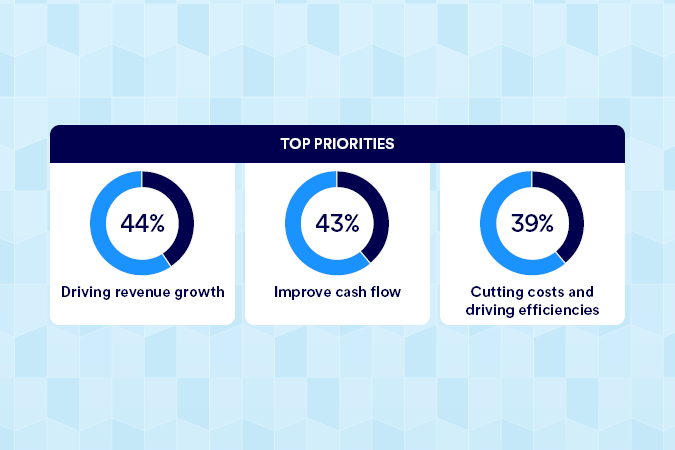
A recent survey of finance leaders conducted by Visa in collaboration with U.S. Bank found that top priorities for payment transformation include driving revenue growth (44%), improving cash flow (43%), and reducing costs and improving efficiencies (39%).1
Our new report explores how today’s leaders can look to payments to support growth and build resilience.
Legacy payment methods remain deeply embedded in purchasing habits, but their dominance is waning. While 62% of companies surveyed still use checks, 26% expect to decrease their check use year over year – and this increases to 48% among large market companies. Additionally, 57% still use wires, with 11% expecting to decrease wire use year over year.
Continued check use is largely driven by external payment requirements, not internal payment preferences. In the survey, executives cite meeting customer and vendor payment requirements (33%) as the primary benefit of using checks.
As check use declines, organizations are modernizing payments and embracing a broader mix of solutions.

Preferences appear to be shifting toward paperless payment methods. Our report finds that of the companies surveyed, 64% report using ACH, and 42% of large market companies rank ACH as their most used payment method. In addition, about half of the companies surveyed use corporate cards (49%), purchasing cards (48%) and virtual cards (47%). Collectively, these three methods make up 25% of total payments. This shift reflects a broader payments transformation strategy focused on efficiency, flexibility and growth.
Virtual card usage is growing faster than any other payment method, particularly in hospitality and retail, and 78% of the companies surveyed plan to expand their virtual card program by 2027.
This share is higher in certain industries and segments:
Additionally, companies surveyed report an average anticipated increase of 28% in payment allocation to virtual cards by 2027.
Companies also plan to increase their use of other modern payment methods, including digital wallets (85%), peer-to-peer payments (80%) and instant payments such as the FedNow® Service (79%).
Companies say they are turning to virtual cards to improve payment speed (30%) and enhance the employee and customer payment experience (25%). The survey also found that virtual cards provided lower payment costs, reduced fraud risk and extended working capital. These benefits are often overlooked due to misconceptions about modern payment technologies.
Download the full report to learn more about Payment modernization: understanding the gap between perception and reality.
Uncover misperceptions about fraud, cost and payment types and how data can drive smarter decisions.
Explore emerging payment trends and strategies to enhance security, speed and customer experience.