
Economists and policymakers often consider forward-looking economic data measures that may serve as early signs of a recession or signal when the broader economy could face a slowdown. Historically, these indicators have included the shape of the Treasury yield curve, equity bear markets, and labor market measures.
Article
Recession indicators: Adjusting to evolving signals
August 5, 2026

Key takeaways
Normally reliable recession indicators – often interpreted as early signs of a recession – have, in recent times, delivered false signals about a pending economic downturn.
This highlights the need to consider additional indicators before predicting economic downturns.
Tracking a broader range of economic measures for this cycle can help better forecast the economy’s direction.
For decades, economists and Federal Reserve (Fed) policymakers closely tracked a narrow set of what had been reliable recession indicators to gauge the economy’s direction. When specific data points emerged, they were treated as signs of a recession, making it easier to anticipate a pending downturn.
While economic developments are not always predictable, there’s historically been a strong link between Fed policy and the risk of a recession. When the Fed tightened monetary policy (raising interest rates), it often led to a credit contraction and, ultimately, a recession, reflecting Gross Domestic Product (GDP) contraction. This even inspired the adage, “U.S. expansions don’t die of old age; they’re killed. The prime suspect is the Federal Reserve.”
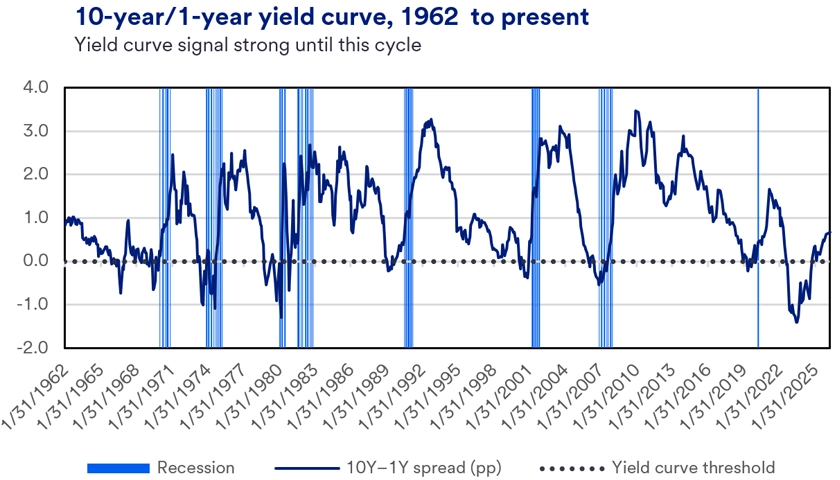
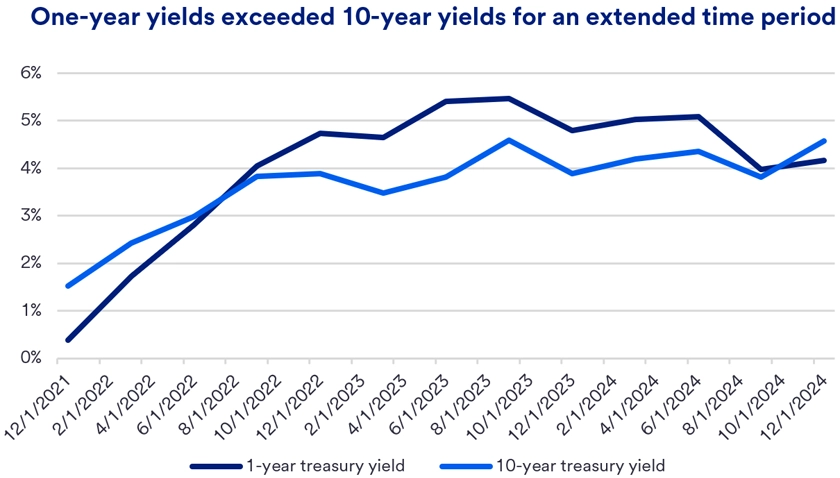
Historically, one of the most reliable recession indicators was an inverted yield curve. When 1-year Treasury yields exceeded 10-year yields for two months, the inverted curve signaled recession. “I was a card-carrying member of the yield curve society,” says Beth Ann Bovino, chief economist at U.S. Bank. “Going back to the early 1960s, an inverted yield curve always presaged a recession.” Beginning in mid-2022, yields on one-year Treasury securities outpaced 10-year yields for nearly 27 months.
“We see value in putting more weight on how well the ‘real economy’ is absorbing or resisting Fed policy tightening.”
-
Beth Ann Bovino, chief economist, U.S. Bank
Why recession indicators sent false signals
In 2022, COVID-related supply-and-demand pressures pushed prices higher, and Russia’s invasion of Ukraine triggered an oil price spike that further fueled inflation. One of the Fed’s mandates is to keep inflation in check, and rate hikes are the typical response. In 2022, the Fed aggressively raised the fed funds rate it controls, which tends to have the most direct impact on shorter-term bond yields. As a result, one-year Treasury yields rose sharply, and the yield curve inverted. “Typically, such Fed action transmits into the broader economy,” says Bovino. “Borrowing is reduced and the economy slows, often to recessionary levels.” Yet in 2022, while the economy grew more slowly, a recession was avoided, despite many economists forecasting a different outcome.
Other signals flashed as well. A bear market in equities occurred in 2022, signaling that investors also anticipated a recession on the horizon. In 2024, another normally reliable recession indicator, the so-called “Sahm rule,” kicked in. This rule, attributed to former Fed economist Claudia Sahm, states that when the three-month moving average of the national unemployment rate is 0.5% or more above its lowest three-month average over the prior 12 months, we’re in the early months of a recession. Again, in this case, no recession followed.
Read this Economic Commentary as a PDF
Recession indicators: Adjusting to evolving signals
Why have a variety of previously reliable recession indicators produced false signals in recent times? “A key factor, going back to 2022 as the Fed began dramatically raising interest rates, was that most homeowners enjoyed extremely low long-term mortgage rates,” says Bovino. “The Fed’s rate hikes had no immediate impact on this major household expense.” Bovino further notes, “A number of businesses were also well-insulated from the Fed's 2022 rate action because they had earlier locked in ultra-low fixed-rate debt during 2020–2021.”
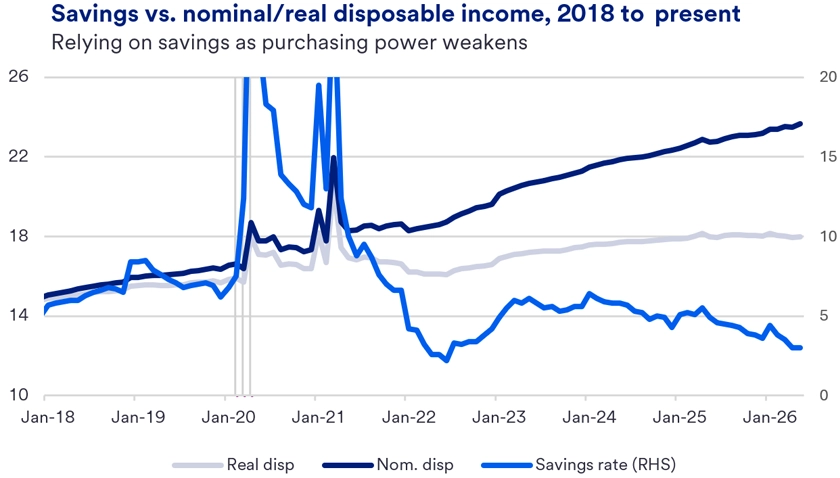
COVID-19’s economic impact was an additional factor. It caused major, short-term disruption. For a time, COVID-19 virtually shut down normal activities. Consumers curtailed spending on services, such as attending sporting events and concerts and eating out. Many households tucked away more money, resulting in a savings rate surge. In addition, federal stimulus through stimulus checks and larger unemployment benefit checks provided more spending support.
7 leading economic indicators to watch
While exceptional economic circumstances may, in part, explain why normal recession indicators were off the mark, Bovino says it’s beneficial to expand the scope of indicators to obtain clearer signals.
While the standard indicators remain relevant, Bovino says they may be better used as confirmation tools. In addition, she suggests that “business, household, labor market, and inflation measures should become the primary gauges.” In essence, Bovino says this places less emphasis on financial market conditions. “Instead, we see value in putting more weight on how well the ‘real economy’ is absorbing or resisting Fed policy tightening.”
She points to six specific indicators that may help forecasters distinguish meaningful signs of a recession from false signals going forward.
- Initial jobless claims
This data point offers a near real-time read on labor market conditions. “It’s a weekly indicator,” notes Bovino, “and the first sign that workers are being let go, which is a leading recession indicator.” - Real disposable personal income
This provides a sense of consumers’ spending power, reflecting after-inflation disposable income. “Since the start of the pandemic, inflation has reduced household spending power by 24%,” says Bovino “That’s why this data point is so significant and explains why consumers express inflation concerns.” - Real and nominal control group retail sales
“This is a good proxy for consumer spending and GDP at the household level,” says Bovino. “With consumer spending making up at least two-thirds of economic activity, this number provides a good read on where the economy stands.” Looking at nominal retail sales alongside real data indicates inflation’s impact on spending. - Mortgage applications and the average outstanding mortgage rate
Mortgage applications reflect the impact of Fed policy and the current interest rate environment. Housing market activity tends to slow as rates rise, as potential homebuyers find monthly mortgage payments less affordable. However, the average outstanding mortgage rate is an important indicator of the net economic impact of higher mortgage rates. “Average new mortgage rates in mid-summer 2026 exceed 6.5%, but the average outstanding mortgage rate is much lower, at about 4.5%,” says Bovino. “It’s an example of how outstanding lower-rate mortgages are providing a bit of an economic cushion against the challenges of an elevated interest rate environment.” - Wholesale prices
With today’s heavy focus on inflation and its potential economic impact, wholesale prices offer insights into input costs. “These costs could be passed on to consumers, so higher wholesale prices may indicate spiraling consumer inflation in future reports,” says Bovino. “If higher wholesale costs eventually pass through to consumers, household budgets get squeezed, which could weaken spending and slow economic growth.” - Market-based long-term inflation expectations
This data does not reflect consumer expectations but rather those of private forecasters. “If expectations are that inflation becomes de-anchored from the Fed’s 2% annual inflation target, this could be a potential impetus for the Fed to impose additional monetary tightening,” says Bovino. - Artificial intelligence (AI) investment activity metrics
Given the huge business investment in AI, and wealth dependence in AI-related equity, the emerging sector is now closely tied to the stock market and GDP growth. A correction would mean that many dominos could fall.
In the current cycle, some often-cited economic indicators appear to have less recession-predicting value. According to Bovino, these include financial indicators, which don’t appear to provide strong business cycle signals. She also cites consumer sentiment as a historically unreliable recession indicator. New orders sentiment and capital goods orders, according to Bovino, have some value in signaling business momentum and near-term activity. Each of these indicators appears to have limited value in providing accurate, long-term economic forecasts.
What to watch going forward
In Bovino’s view, indicators such as an inverted yield curve or a bear market in equities may offer some confirmation of the economy’s path, but the other factors outlined above also need to be considered. Here are key economic trends Bovino is closely watching:
Households – Still providing a cushion?
The household sector’s health helped overcome what appeared to be 2022’s ripe recessionary conditions. Bovino will be watching to see whether household health remains sufficient to offset potential Fed monetary tightening. “Purchasing power now is 24% lower than at the start of 2022,” notes Bovino. Is that an indication of potential challenges to household spending patterns?
Labor – A soft-landing backbone
Labor market health is always critical as an offset to the effects of higher prices and borrowing costs – and may be one reason the economy has remained closer to a soft landing than a recession. Along with monitoring initial jobless claims, Bovino also tracks the “quits” rate. “That number is a good indicator of worker bargaining power,” says Bovino. In 2022, the quits rate was high, indicating significant worker leverage to seek better-paying work. If it was tracked in 2022, it would have indicated that a recession wasn’t in the works. “Today, that leverage has faded in recent months as more workers become ‘job huggers,’ choosing to stay in their current positions to ensure their household cash flow remains steady,” says Bovino.
Judging recession indicators
It may be important to remain flexible when determining which leading economic indicators provide the most useful recession signals. “I suspect changing conditions may require that we be more careful in identifying key data points,” says Bovino. “Today, inflation remains a critical threat to overall economic health.” In this environment, consumer measures such as real disposable income, a measure of affordability, have become more important. As does watching that monthly debt payments buffer as interest rates rise. “Other signals related to housing activity will remain key regardless of the environment, as housing has such a wide-ranging impact on the broader economy,” says Bovino. She notes that "the 'new kid in town,' AI, now dominates business investment activity" and claims the lion's large share of gains in household wealth, saying, "If investment activity in AI stumbles, the U.S. economy would get a large bruise."
Notably, aside from a deep, two-month recession during the earliest weeks of 2020’s COVID-19 outbreak, the U.S. economy has not experienced a recession since 2009. Bovino notes that the National Bureau of Economic Research determines official recession start and end dates. “They assess a number of indicators, but this work is all done in hindsight, and recession dating is only made official long after the fact.”
Bovino and the U.S. Bank Economics team remain focused on leading indicators that may signal the economic path ahead.
FAQ
Until 2022, a number of traditional indicators such as an inverted Treasury yield curve were considered nearly flawless recession signals. However, that was not the case in recent years. Additional measures related to inflation, household income, and the labor market are additional data points that may provide more complete guidance about the economy’s direction.
This economic indicator, developed by economist Claudia Sahm, focuses on labor market data. Specifically, the Sahm rule is a recession indicator that theorizes the economy is in the early stages of a recession when the three-month moving average of the U.S. unemployment rate rises by 0.50% or more relative to its lowest three-month averages from the previous 12 months. This rule has typically proved accurate, except in the latest instance, when it occurred in mid-2024, with no recession to follow.
Tags:
U.S. Bank Economic Research Group
Beth Ann Bovino
Chief Economist
Ana Luisa Araujo
Senior Economist
Matt Schoeppner
Senior Economist
Adam Check
Economist
Andrea Sorensen
Economist
Subscribe to our economic insights newsletter
Not currently a subscriber? Sign up to get our economic insights delivered to your inbox weekly.
Learn more
If you have any questions about any of these topics or want to learn more, please contact us to connect with a U.S. Bank Corporate and Commercial banking expert.
Start of disclosure content
Disclosures