

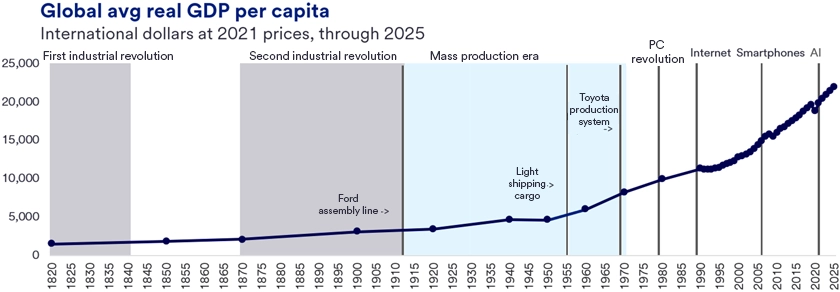
The greatest excitement about AI centers on its potential to boost productivity (the amount of output generated by labor) and economic growth. “AI is already delivering productivity gains in knowledge-intensive businesses,” says Beth Ann Bovino, chief economist at U.S. Bank. Many believe AI is the key driver of future economic prosperity. But Bovino warns that significant investment “in everything from data centers to new energy sources, as well as in financing and training” is required before AI’s full economic potential can be realized.
Article
AI bubble or the next industrial revolution?
October 1, 2026
Key takeaways
Massive AI business investment has fueled U.S. economic growth in recent years, but also contributed to elevated inflation.
Fears of the AI “bubble” bursting linger despite ongoing growth in AI utilization.
Organizations that focus on training workers to effectively incorporate AI to achieve key objectives are best positioned to prosper from AI’s potential.
Today’s most prominent economic story centers on rapid artificial intelligence (AI) advancements. Daily headlines are peppered with fresh speculation about AI’s potential to transform the global economy. Business leaders, consumers, and investors are assessing the best ways to prepare for AI’s impact. A major question is the extent to which AI will shape the economy’s future and how disruptive, and ultimately beneficial, the change will be.
Is AI a bubble? Heavy investment in AI has fueled growth and boosted optimism, but markets may be pricing in benefits that will take longer to materialize. While this raises the risk of a market correction, AI is widely viewed as a transformative technology with long-term economic implications.
“AI may be able to write the recipe for more productivity, stronger growth, and new kinds of work. The economy must still buy the ingredients, build the kitchen, and decide who gets served.”
-
Beth Ann Bovino, chief economist, U.S. Bank
“There’s little doubt that AI is already having an economic and, to some extent, societal impact,” says Beth Ann Bovino, chief economist, U.S. Bank. “In this way, it’s not unlike the Industrial Revolution, the PC revolution, or the rise of the Internet.” Bovino notes that every major innovation wave has historically created disruption and job fears, but new industries and occupations have also emerged. “AI should be viewed as the next productivity platform rather than a one-off technology,” says Bovino.
Bovino notes that AI’s full economic impact will depend on how effectively businesses incorporate the emerging technology. “AI may be able to write the recipe for more productivity, stronger growth, and new kinds of work,” says Bovino. “The economy must still buy the ingredients, build the kitchen, and decide who gets served.”
Will the AI “bubble” burst?
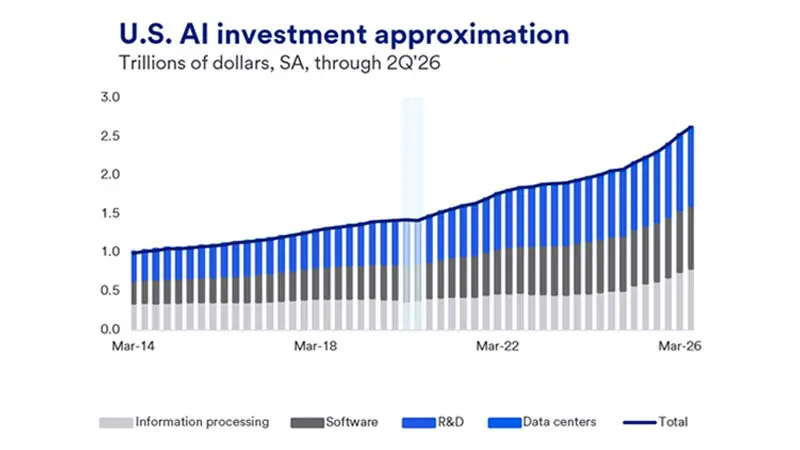
Much of the fuel behind broad economic growth in recent years stems from trillions of dollars spent in an AI buildout, particularly by so-called “hyperscalers,” large technology firms investing in AI infrastructure. These companies continue to make massive AI capital commitments, in data centers, chips, power, cooling, networks, and worker training. “Such large investments mean that demand for specific products has outstripped supply, contributing to today’s elevated inflation environment,” says Ana Luisa Araujo, senior economist, U.S. Bank. “When supply rises to meet demand, we should see inflation subside.”
Significant spending creates potential AI bubble conditions and, if the investment bubble bursts, the subsequent fallout. “A question today is, ‘Has the level of spending gone too far?’” says Bovino. “It raises concerns that the marketplace may anticipate more near-term productivity improvements than businesses can deliver.”
At this point, markets seem to be pricing in the expectation that once AI adoption is more widespread, it will boost productivity and reduce inflation. “We’re starting to see productivity gains, but more is expected to come,” says Araujo. “As in any period of change, some companies will be more successful at adapting AI, while others will fail.”
Achieving effective AI utilization is challenging, according to Bovino. “The catch is that the bill arrives before the meal in the form of massive investment, higher near-term costs, an uncertain payoff, and plenty of anxiety over who benefits most.” Bovino says marketplace expectations for near-term productivity growth may exceed what many businesses are positioned to deliver. “The payoff only comes after AI adoption reaches scale.”
Read the Economic Commentary
The AI revolution: How big is the pie and how many slices?
How disruptive will AI be?
Like every major technology shift, this one will create winners, losers, and a potentially messy transition period in between. Today’s heavy level of AI spending is likely to remain inflationary in the near term until more significant productivity gains become apparent. In the meantime, AI’s growing presence will likely lead to economic disruption.
Questions have been raised about the job market’s impact. “To this point, we’re not seeing much disruption in the labor force,” says Bovino. “The most common scenario today is that businesses aren’t laying off people because of AI, but they may be cutting back on hiring new workers.”
A challenge for many businesses is determining the level of workforce required to maintain and grow operations while incorporating AI. “We think the trend will be to retrain the workforce to leverage the new technology,” says Bovino. “The costs are steep, particularly for smaller businesses.” Bovino says employers need to partner with their workforce to fully leverage the new technology. The goal is to improve efficiency, increase productivity, and achieve faster growth.
Bovino also notes that AI’s economic payoff is far from certain. “We know that AI can do a lot of things, but if it’s not economically useful for a business to invest in, it will sit on the shelf and contribute nothing to an organization’s future.”
AI and jobs: Job losses or job changes
Worker anxiety about AI’s potential impact on the job market is increasingly visible. A common fear is that AI tools will eliminate jobs, creating an employment nightmare for workers. Bovino and Araujo believe these fears are overblown and that the more likely scenario is that certain jobs will take on a new look.
In some workplaces, AI is already redistributing tasks within jobs, increasing productivity and reducing the time spent on more routine tasks. “While it’s true that AI agents will replace some jobs,” says Bovino, “it’s also true that we’ve seen this happen before during other transition periods.” She notes that the Industrial Revolution, the automobile, automated teller machines (ATMs), and the rise of the internet often altered workplaces. “What also happened is that new jobs and new industries were created,” says Bovino. “Ultimately, AI is positioned to create more wealth, with more income opportunities spread across the economy. This is similar to what happened during other periods of economic disruption as new technologies emerged.”
While some fear job elimination, Bovino points out that this doesn’t always happen. “In the case of ATMs, bank tellers weren’t replaced, but their jobs changed, increasingly focused on complex transactions and relationship management rather than simply handling routine transactions.” There were nearly 9% more bank tellers in 2022 than in 1985, when ATMs began to proliferate.
“At this point, it’s impossible to know what all the potential new jobs might be that will emerge as AI continues to evolve,” says Araujo. “As with past revolutions, it is often the work that changes, not the worker who is replaced.”
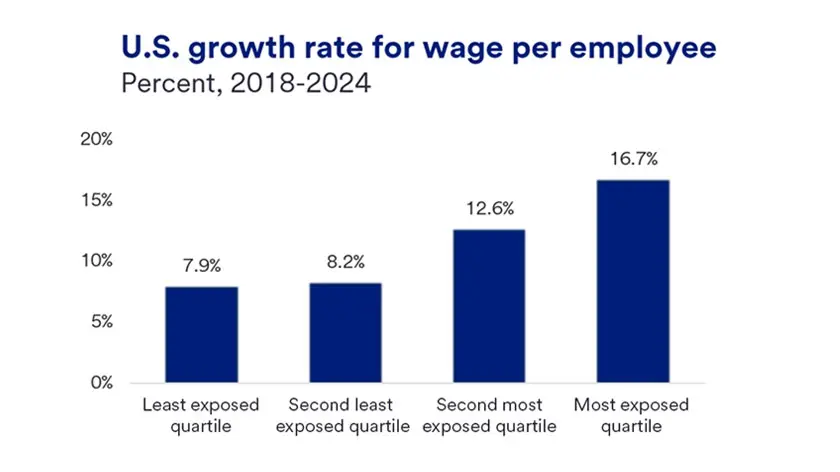
Economic theory suggests that exposed workers may face lower labor demand and wages. By contrast, those working in jobs that can incorporate AI to enhance productivity are likely to earn higher wages. AI may replace knowledge typically applied to entry-level work. But organizations that focus on training a labor force to adapt to a changing work environment are more likely to benefit.
According to PwC, between 2018 and 2024, wages for employees in industries “most exposed” to AI grew by 16.7%, doubling the wage growth rate for workers in industries “least exposed” to AI. This suggests that employers are rewarding workers who successfully leverage AI to enhance productivity.
Combining the power of humans and machines
“AI is already delivering productivity gains in knowledge-intensive industries such as analytics, finance, information technology, and professional services,” says Bovino. “By contrast, roles requiring a physical presence, dexterity, or human interaction are difficult to automate.” These include positions in hospitality, cleaning services, food preparation, and personal care. “We might see upward pressure on wages for these jobs as labor may become scarcer,” says Bovino.
According to Bovino, the real divide resulting from AI isn’t between humans and machines but between those who learn to work with AI and those who don’t. “Employers need to focus on letting the machines do what they do well, letting people do what they do well, and training the workforce to connect the two,” says Bovino.
Turning AI’s promise into reality
The base expectation is that AI is the key driver to future economic prosperity. If it leads to significant productivity growth while still creating opportunities for workers to prosper, the dreams of AI advocates will be realized. This would mean the economic pie grows, ideally benefiting most segments of society.
“But first comes the bill,” says Bovino. “Investments in everything from data centers to new energy sources, as well as in financing and training, are needed before AI’s full potential can be realized.”
While some jobs may disappear, Bovino expects AI to redefine what work entails. “New jobs will be created, and many more will be rebuilt from the inside out,” says Bovino. “The workers and businesses that learn where human judgment ends and machine efficiency begins will enjoy the greatest success.”
Labor market trends to date indicate that while AI-induced unemployment appears limited, new-hire activity may be lower as a result of AI’s emergence. Nevertheless, employers seem to be holding onto workers as they try to determine the extent to which AI may contribute to their organization’s output.
In addition, smaller businesses could find the investment in AI burdensome, which may limit the benefits they achieve. “It raises a question of whether we’ll see fewer small businesses, with greater concentration on large businesses that can afford AI investments,” says Bovino. “Or, will we see the present balance between small and large businesses maintained near current levels?”
History offers encouraging signals, according to Bovino. “Innovations from the past led to a multiplier effect for the economy in subsequent years.” She finds that track record encouraging and anticipates that, over the long run, AI will have a similarly positive economic impact. However, companies need to be prepared to make major investments and focus on training to get the human-machine partnership right and create a more prosperous future.
FAQ
Is AI a bubble? Heavy investment in AI has fueled growth and boosted optimism, but markets may be pricing in benefits that will take longer to materialize. While this raises the risk of a market correction, AI is widely viewed as a transformative technology with long-term economic implications. Another concern is that massive AI spending “means that demand for specific products has outstripped supply, contributing to today’s elevated inflation environment,” says Ana Luisa Araujo, senior economist, U.S. Bank. If AI spending should suddenly falter, it could have negative economic ramifications.
A common fear is that AI tools will eliminate jobs, creating an employment nightmare for workers. “While it’s true that AI agents will replace some jobs,” says Beth Ann Bovino, chief economist, U.S. Bank, “it’s also true that we’ve seen this happen before during other transition periods.” She notes that the Industrial Revolution, the automobile, automated teller machines (ATMs), and the rise of the internet often altered workplaces. “Ultimately, AI is positioned to create more wealth, with more income opportunities spread across the economy,” says Bovino. “This is similar to what happened during other periods of economic disruption as new technologies emerged.”
U.S. Bank Economic Research Group
Beth Ann Bovino
Chief Economist
Ana Luisa Araujo
Senior Economist
Matt Schoeppner
Senior Economist
Adam Check
Economist
Andrea Sorensen
Economist
Subscribe to our economic insights newsletter
Not currently a subscriber? Sign up to get our economic insights delivered to your inbox weekly.
Learn more
If you have any questions about any of these topics or want to learn more, please contact us to connect with a U.S. Bank Corporate and Commercial banking expert.
Start of disclosure content
Disclosures