
Capitalize on today's evolving market dynamics.
With changes to taxes and interest rates, it's a good time to meet with a wealth advisor.

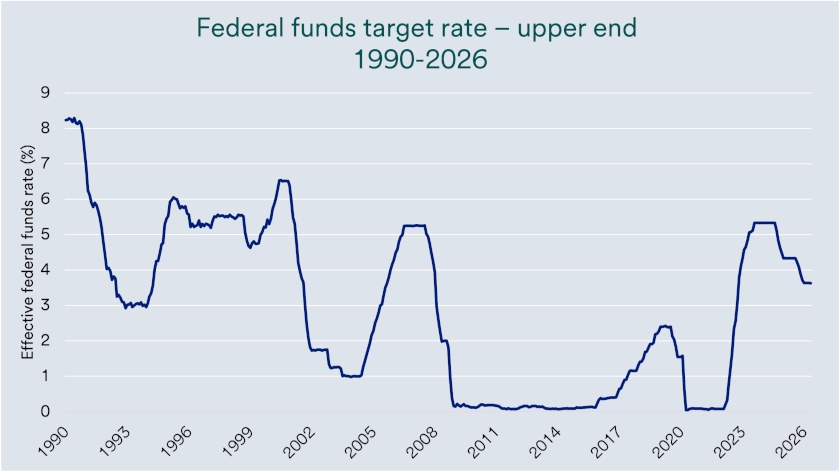
Federal Reserve (Fed) policy stayed restrictive as they kept interest rates at 3.50% to 3.75% while inflation and energy prices shaped rate expectations.
Chair Kevin Warsh’s first meeting signaled less forward guidance and a broader review of Fed communications, balance sheet policy and inflation framework.
Diversified portfolios can help investors manage Fed policy uncertainty, liquidity shifts and market volatility.
The Federal Reserve (Fed) influences borrowing costs, savings returns, and overall financial conditions across the economy. At its June 17 meeting, the Federal Open Market Committee (FOMC) held its target federal funds interest rate in the 3.50%-3.75% range, a decision investors broadly expected. The federal funds rate is the short-term rate banks use when they lend reserves to each other overnight, and it helps shape interest rates on mortgages, credit cards, business loans and bond yields.
The decision kept the Fed in a patient but inflation-focused policy stance. Elevated energy prices have increased investor expectations for higher policy rates later this year, a sharp change from earlier expectations for one to two rate cuts in 2026. Investors looked beyond the rate decision itself and focused on new Chair Kevin Warsh’s first meeting, the Fed’s shorter statement, the removal of prior forward guidance and the updated Summary of Economic Projections.
Warsh used his first press conference as chair to reinforce the Fed’s commitment to price stability. In his opening statement, he said the committee was “unanimous and unambiguous” in its commitment to fighting inflation, and he mentioned “price stability” 12 times during the press conference. Bond yields rose as investors interpreted those comments as a sign that Warsh may support rate hikes if inflation remains persistent.
Warsh also signaled a broader review of Fed practices. He announced five task forces focused on Fed communications, balance sheet policy, data sources, productivity and jobs in an era of transformation, and the Fed’s inflation framework. Those priorities fit his reputation as a reformer and suggest the Fed may reassess how it communicates policy, manages liquidity and explains its role in the economy.
Warsh also restated his view that forward guidance from the Fed may be inappropriate. Forward guidance means the Fed’s public signals about where interest rates or the economy may move next, and investors have used those signals to anticipate policy decisions. The shorter Fed statement and Warsh’s decision not to submit an expectation for future policy rates in the “dot plot” reinforced his preference for current data over detailed forecasts.
Inflation is much lower than it was in 2022, but the path back to the Fed’s 2% goal looks less certain today. The Fed’s preferred inflation measure, the core Personal Consumption Expenditures (PCE) Price Index, rose 3.3% in the 12 months through April. Core PCE excludes food and energy prices, which can move sharply from month to month, and it helps policymakers assess underlying inflation trends.
Energy prices have made the inflation outlook harder to assess. Elevated energy costs tied to the closure of the Strait of Hormuz are pushing prices higher in categories that affect consumers and businesses. “The Federal Reserve held rates steady in June because inflation is still above target and higher oil prices complicate the path back to 2%,” says Rob Haworth, senior investment strategy director with U.S. Bank Asset Management Group.
That does not mean inflation is returning to 2022 levels. It does mean the final move toward the Fed’s 2% goal could take longer and may not move in a straight line. “Inflation may temporarily accelerate,” says Bill Merz, head of capital markets research for U.S. Bank Asset Management Group. “But factors beyond energy costs are likely to determine inflation over the medium-term.”
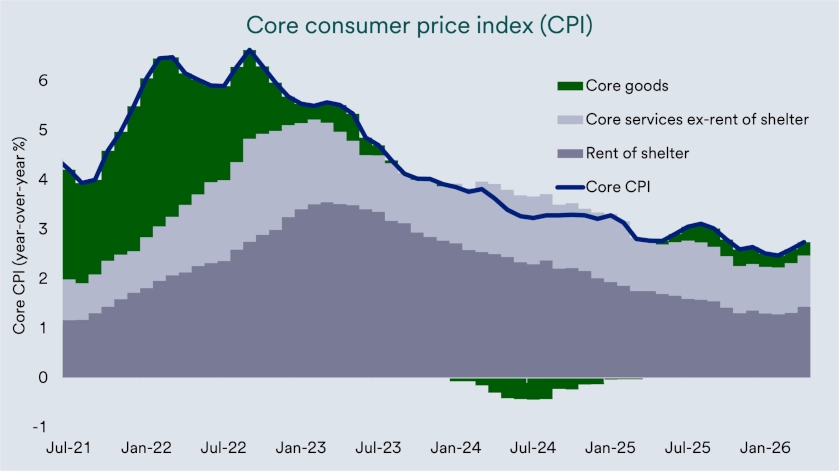
Some areas of inflation may still improve from here. The May Consumer Price Index (CPI) increased 4.2% from a year earlier, while core CPI excluding food and energy rose 2.9%. Shelter costs increased 3.4% over the year, but slower home-price and rent growth may still help cool official inflation readings over time. 1
Housing costs may continue easing with a lag, because rent trends usually move into official inflation data gradually. Slower rent growth can offset some pressure from higher goods, fuel and transportation costs later this year. The inflation backdrop looks far better than it did in 2022, but it looks less predictable than it did earlier this year.
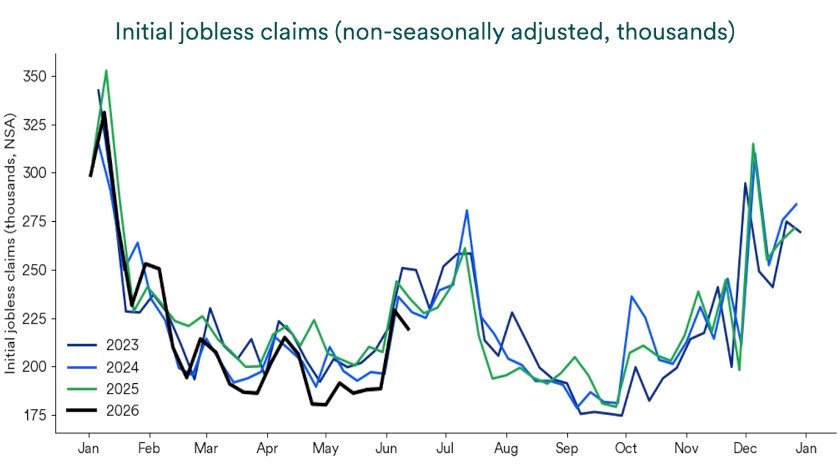
The labor market has also stabilized after weakening in 2025. Private employers added an average of 117,000 jobs per month through May this year, compared with an average of 10,000 per month in 2025. The unemployment rate stood at 4.3% in May, and weekly initial jobless claims remained low at 228,000 in the week ending June 5. 2
The stabilizing labor market reduces pressure on the Fed to cut rates quickly. It also allows policymakers to focus more heavily on inflation, especially if energy prices keep near-term price pressures elevated. Warsh’s comments on price stability prompted investors to increase expectations for rate hikes during his June 17 press conference.
“Markets now lean toward the Fed increasing rates this year, but inflation, oil prices, and labor market conditions can shift the outlook.”
Tom Hainlin, national investment strategist with U.S. Bank Asset Management Group
The Fed’s June Summary of Economic Projections showed a more complicated outlook. Officials raised median inflation projections slightly while lowering 2026 economic growth expectations slightly, even as consumer spending, corporate activity and the labor market remained resilient. Core PCE inflation rose from 3.0% in December 2025 to 3.3% in April 2026, giving policymakers less confidence that inflation is moving steadily toward target.
Oil prices explain part of that shift. West Texas Intermediate front-month futures prices rose from near $57 per barrel at the beginning of the year to a peak of $113 in April before recently falling to $76. Higher energy prices have lifted several inflation readings and complicated the Fed’s outlook as it balances its dual mandate of maximum employment and price stability. “Markets now lean toward the Fed increasing rates this year, but inflation, oil prices, and labor market conditions can shift the outlook,” says Tom Hainlin, national investment strategist with U.S. Bank Asset Management Group.
Interest rate decisions are only one part of Fed policy. The Fed also influences markets through its balance sheet, which includes bond holdings and Treasury bill purchases. These tools affect liquidity, which means the money readily available to buy goods, services and financial assets.
The Fed began buying short-term Treasury bills in December 2025 to maintain ample reserves in the banking system and keep short-term rates close to its intended policy range. Treasury bills are short-term U.S. government debt securities, and Fed purchases can absorb part of the new supply entering the market. The Fed recently announced it would reduce regular purchases, and its bond holdings now stand near $6.7 trillion after peaking near $9 trillion in 2022. 3
Liquidity remains constructive, but it does not eliminate investment risk. A stable liquidity backdrop can help markets absorb unexpected shocks, but energy prices, geopolitics and policy uncertainty can still create volatility. Investors should watch liquidity alongside inflation, employment and rate expectations rather than rely on a single forecast for the Fed’s next move.
For investors, this environment rewards discipline more than prediction. Higher energy prices could lift inflation and slow economic activity, but consumer spending and corporate earnings have remained resilient. As Tom Hainlin notes, “Investors do not need to predict every rate move to make progress. They need a portfolio built for more than one outcome.”
Diversification becomes more valuable when inflation, interest rates and geopolitics move at the same time. A mix of assets such as globally diversified stocks, global infrastructure and structured credit can help broaden return sources when traditional stock and bond holdings face the same macroeconomic pressure. A diversified plan can also help investors stay anchored when short-term headlines move faster than long-term fundamentals.
A nation’s central bank, which in the United States, is the Federal Reserve, typically controls monetary policy. The Fed’s management of monetary policy can have a significant impact on the shape of the nation’s economy. Congress’ mandate for the Fed is to maintain price stability (manage inflation); promote maximum sustainable employment (low unemployment); and provide for moderate, long-term interest rates. Fed monetary policy influences the cost of many forms of consumer debt such as mortgages, credit cards and automobile loans.
The Fed is the nation’s central bank, and perhaps the most influential financial institution in the world. The central governing board of the Federal Reserve reports to Congress, while the President appoints the chair of the Federal Reserve. There are also 12 regional federal reserve banks that are set up like private corporations.
The Federal Reserve’s Federal Open Market Committee sets a target interest rate policy for the federal funds rate. This is the rate at which commercial banks borrow and lend excess reserves to other banks on an overnight basis. The Fed raises or lowers the rate to impact underlying economic conditions. For example, in 2022, as inflation surged, the FOMC began raising interest rates to make borrowing more expensive and slow economic activity. The Fed designed that strategy to ease pricing pressures and reduce the inflation rate. In periods when the economy is slow or in a recession, the Fed tends to lower rates to try to stimulate economic activity and help the economy expand again.
Review your portfolio positioning with your financial professional and confirm that your investment mix still reflects current conditions and future expectations. The Fed may hold rates steady for longer if inflation remains elevated, but the outlook can change if energy prices, labor market data or financial conditions shift. A disciplined plan can help you respond thoughtfully rather than react emotionally.
The Federal Reserve held rates steady as expected at its March policy meeting, citing inflation uncertainty and energy prices, while officials’ projections continue to point to one rate cut in 2026.
We can partner with you to design an investment strategy that aligns with your goals and is able to weather all types of market cycles.

 Equal Housing Lender. Deposit products are offered by U.S. Bank National Association. Member FDIC. Mortgage, Home Equity and Credit products are offered by U.S. Bank National Association. Loan approval is subject to credit approval and program guidelines. Not all loan programs are available in all states for all loan amounts. Interest rates and program terms are subject to change without notice.