
Capitalize on today's evolving market dynamics.
With changes to taxes and interest rates, it's a good time to meet with a wealth advisor.

Higher bond yields can strengthen diversified investing strategies and create better income opportunities than investors have seen in years.
Federal Reserve policy, inflation, and Treasury supply continue to shape bond market trends and interest rate expectations.
A diversified bond portfolio can help investors pursue income, manage risk, and support long-term investing goals.
Bonds can strengthen a diversified portfolio, and today’s market gives investors a clearer chance to lock-in income than they have had in years. Investors no longer need to rely only on U.S. Treasuries to pursue yield, but moving into other bond market sectors can mean taking on more credit risk, less trading flexibility, or greater sensitivity to interest rate changes. Those tradeoffs can make sense when they support a portfolio’s goals instead of reflecting a forecast about where rates go next.
Federal Reserve (Fed) policy often has the strongest influence on short-term rates, while longer-term yields respond to growth expectations, inflation trends, fiscal policy, Treasury supply, and investor confidence. That split helps explain why bonds with different maturities can move in different directions at the same time. When investors focus on the main force driving the market in a given period, they can make steadier choices about bond maturity and sector exposure.
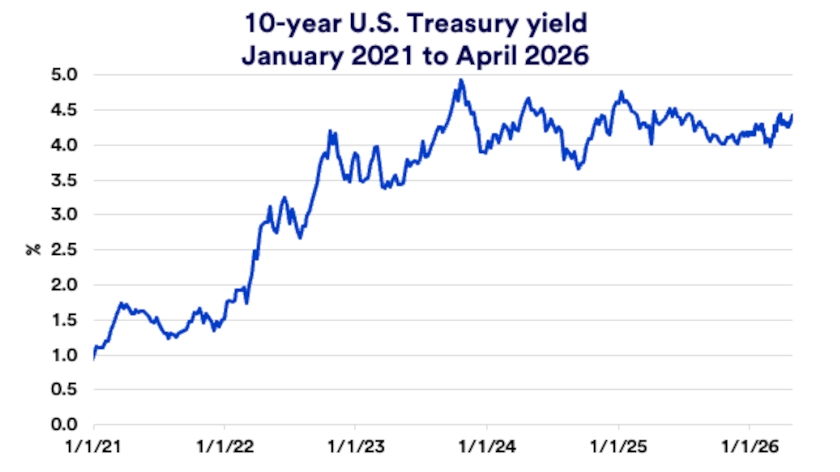
Many bond investors want dependable income, but they also want flexibility if market conditions change. With 10-year Treasury yields mostly holding near the 4.00% to 4.50% range in the past year, investors can earn more income than they could for much of the prior decade while still emphasizing high-quality bonds. 1 A higher starting yield can improve a portfolio’s long-term income potential, even when prices move unevenly from day-to-day.
The search for yield tends to work best when it stays tied to the investor’s purpose instead of prediction. Income needs, time horizon, and risk tolerance shape how much price movement a portfolio can absorb, so these factors deserve as much attention as any market call. When investors match bond exposures to portfolio goals, they can pursue income with a clearer plan and a steadier risk profile.
A diversified bond allocation can also reduce reliance on any single outcome. Some areas of the bond market can emphasize stability and income, while others can add yield in exchange for more risk. The practical goal is to earn durable income while keeping the overall portfolio aligned with your comfort level and timeframe.
Short-term yields usually respond most directly to central bank policy because the Fed influences overnight financing conditions and signals the likely path of near-term rates. Longer-term yields also reflect expected Fed policy expectations, but they also incorporate a broader mix of inflation expectations, economic growth, Treasury issuance, and the additional return investors demand for owning longer maturities. Bond sectors can behave differently even within the same rate environment.
“Federal Reserve rate cuts pulled short-term bond yields lower last year, but shifting expectations for steady rather than lower future policy rates pushed short-term yields higher in recent months.”
Bill Merz, head of capital markets research for U.S. Bank Asset Management Group
Today’s bond market reflects several competing forces. “Federal Reserve rate cuts pulled short-term bond yields lower last year, but shifting expectations for steady rather than lower future policy rates pushed short-term yields higher in recent months,” notes Bill Merz, head of capital markets research for U.S. Bank Asset Management Group. “The combination of shifting policy forecasts, higher anticipated inflation and stable growth expectations nudged 10-year Treasury yields close to the high end of their recent range.”
Inflation remains central to the outlook. Recent data and business surveys suggest price pressures eased from earlier peaks before the conflict in the Middle East, but inflation still sits above the Fed’s target and recent energy price increases introduces additional uncertainty. Investors are therefore watching energy supply developments closely for signals around inflation, growth and policy.
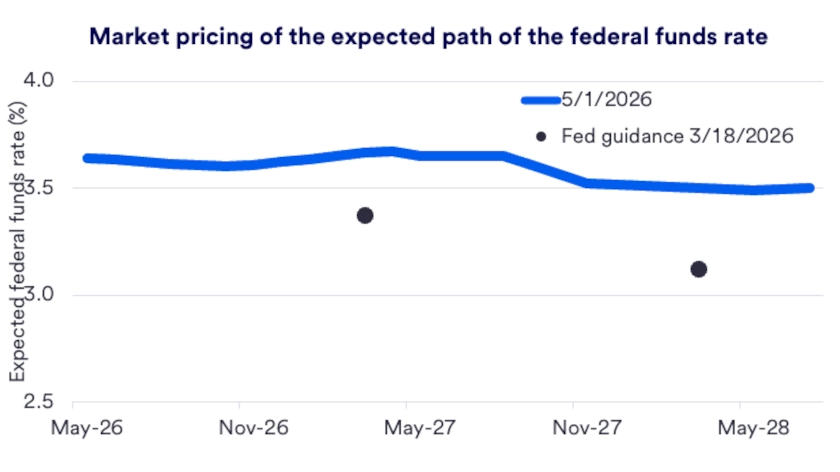
At its April meeting, the Federal Open Market Committee (FOMC) kept the federal funds target rate in a 3.50 to 3.75% range for a third straight meeting after 0.25% cuts at each of the Fed’s final three meetings of 2025. The pause highlights a difficult balancing act between inflation that remains above target, uncertainty around energy prices tied to the Middle East conflict, a slow but stable labor market, and solid economic growth. Investors no longer anticipate Fed rate cuts later in 2026, a notable shift from earlier in the year when markets anticipated two cuts.
Median Fed projections point to one additional cut in 2026, 2 but recent comments from Fed members show how much uncertainty remains while energy supply remains constrained by the Iran conflict. That leaves bond investors weighing not only whether rates move lower, but also how long inflation pressure and geopolitical disruption may keep policy on hold.
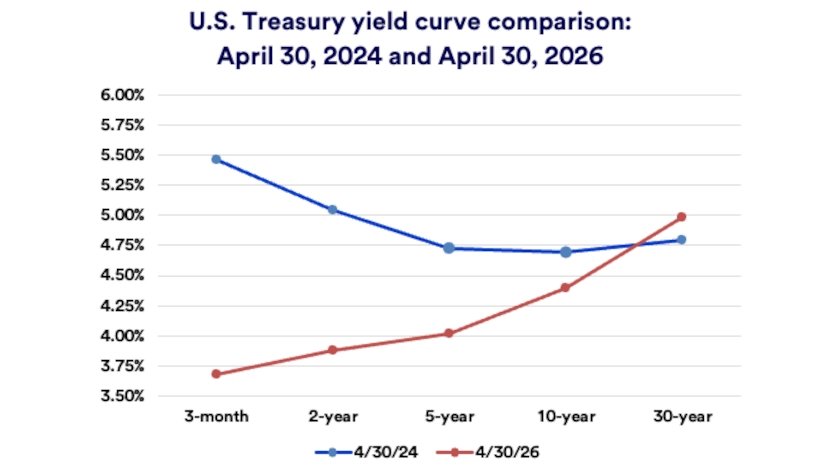
The 10-year Treasury yield remains a useful barometer for the broader bond market, holding in a range of 4.0% - 4.5% for most of the past year. The yield curve, which measures Treasury yields across maturities, has also moved toward a more normal shape. On April 30, 2026, the 10-year Treasury yielded 0.52% more than the 2-year Treasury, modestly below the long-run average spread of nearly 0.80% since 1977. 1
A more typical curve can improve what investors earn for extending maturities, although longer-term bonds can still experience larger price swings when rates change. Fiscal conditions also influence yields because they shape expectations for Treasury supply. “Treasury Secretary Scott Bessent does not plan to increase auction sizes for longer maturities,” says Merz, adding that Treasury indicates it will issue more short-term bills, where heavy issuance is less likely to disrupt broad pricing in the near term.
Congressional policy adds another layer because deficits and borrowing needs can increase Treasury issuance over time. The “One Big Beautiful Bill Act” extends current tax rates, adds new tax cuts, and trims spending only modestly, which the Congressional Budget Office estimates could increase the federal debt by $3.4 trillion by 2034. Tariff increases partially offset additional spending, but higher borrowing could still pressure yields if investors demand more compensation for growing Treasury supply and rising uncertainty. 3
“Over the long run, bond buyers want to see federal cash flow support bond principal and interest payments, which would suggest lower spending or higher taxes,” says Merz. When investors worry that cash flows will not keep pace with borrowing, they may demand higher yields (and therefore lower prices) to compensate for those risks. That dynamic can create opportunity for income-focused investors, but it also argues for balance across maturities and sectors.
Geopolitical conflict can complicate the bond outlook by pushing energy prices higher and reviving inflation concerns. Higher energy costs can flow through transportation, manufacturing, and consumer prices, which can keep inflation elevated even when broader trends are improving. When inflation uncertainty rises, longer-term yields can stay higher because investors want more compensation for that risk.
This environment can reward investors who treat fixed income as a toolkit rather than a single bet on rates. A disciplined approach spreads exposure across maturities and sectors, avoids concentrating too heavily in cash or only very short-term bonds, and uses higher-yielding areas selectively while staying alert to credit quality and liquidity needs. The goal is to pursue income while avoiding risks that do not offer enough return in exchange.
Investors can also use a more normal yield curve to reassess maturity exposure. Short-term bonds may still offer attractive income with lower day-to-day price movement, while intermediate and longer maturities can add yield and may help diversify a portfolio if growth slows. The right mix depends on cash-flow needs, time horizon, tax considerations, and how much portfolio volatility an investor can reasonably tolerate.
While rising interest rates offer investors the chance to earn higher yields on fixed income investments, they negatively affect existing bondholders. When interest rates increase, the prices of existing bonds drop. As a result, existing bondholders may see their total returns decrease, depending on how much interest rates rise.
The impact is more significant on those who hold longer-term bonds. Bonds with a longer duration pay a fixed amount of interest regardless of ongoing market trends. Therefore, when interest rates increase, these bonds can decrease in value more sharply. Shorter-term bonds that are maturing sooner experience less price volatility as interest rates fluctuate.
Investors in bond mutual funds should evaluate the fund’s duration as a key factor in understanding the price risk associated with the fund’s fixed income holdings. Conversely, if interest rates fall, longer-term bonds tend to be much more appealing and can increase in value more significantly than shorter-term bonds.
Bond yields mirror the market’s interest rate expectations. When yields rise, it signals that markets expect higher interest rates which could reflect a Federal Reserve (Fed) increase in the federal funds rate, or higher inflation or economic growth expectations. Conversely, when bond yields fall, it indicates anticipation of upcoming Fed rate cuts or slower growth and inflation.
Today’s bond market offers real opportunity, but it does not eliminate tradeoffs. Attractive yields give income-focused investors more room than they have had in years, yet policy uncertainty, inflation risk, and fiscal pressure still support a balanced approach. Investors who spread exposure thoughtfully and keep fixed income aligned with broader portfolio goals can improve their chances of earning durable income without taking uncompensated risk.
Talk to your wealth professional for more information about how to position your fixed income investments consistent with your goals, investment time horizon, risk tolerance and tax profile. A conversation can help translate rate headlines into practical choices about maturity, credit quality, and diversification.
Investments in fixed income securities are subject to various risks, including changes in interest rates, credit quality, market valuations, liquidity, prepayments, early redemption, corporate events, tax ramifications and other factors. Investment in fixed income securities typically decrease in value when interest rates rise. This risk is usually greater for longer-term securities. Investments in lower-rated and non-rated securities present a greater risk of loss to principal and interest than higher-rated securities.
The municipal bond market is volatile and can be significantly affected by adverse tax, legislative or political changes and the financial condition of the issues of municipal securities. Interest rate increases can cause the price of a bond to decrease. Income on municipal bonds is generally free from federal taxes but may be subject to the federal alternative minimum tax (AMT), state and local taxes.
Bond yields change as investors react to economic growth, inflation trends, and Federal Reserve policy decisions. When inflation looks higher or the Fed signals tighter policy, investors often demand higher yields to hold bonds. When inflation cools or growth slows, yields can fall as investors accept a lower return in exchange for stability.
Bond prices and interest rates typically move in opposite directions. When rates rise, existing bonds with lower interest payments become less attractive, so their prices often fall; when rates fall, those existing bonds can rise in value. If you hold a bond to maturity, you generally get face value back (assuming no default), but the market price can fluctuate along the way.
Higher yields can improve the income a bond portfolio generates and raise the starting point for longer-term returns compared with low-yield periods. However, bonds can still help diversify a portfolio and support steadier cash flow even when rates are lower. Many investors focus less on timing and more on building a bond mix that matches their time horizon and comfort with price swings. long
The U.S. Treasury market continues to reflect the interplay between monetary and fiscal policy, along with inflation and growth trends.
We can partner with you to design an investment strategy that aligns with your goals and is able to weather all types of market cycles.


 Equal Housing Lender. Deposit products are offered by U.S. Bank National Association. Member FDIC. Mortgage, Home Equity and Credit products are offered by U.S. Bank National Association. Loan approval is subject to credit approval and program guidelines. Not all loan programs are available in all states for all loan amounts. Interest rates and program terms are subject to change without notice.