
Capitalize on today's evolving market dynamics.
With changes to taxes and interest rates, it's a good time to meet with a wealth advisor.

Iran conflict and oil prices: Restricted Strait of Hormuz shipping keeps global oil, natural gas, freight and inflation risks in focus.
Geopolitical risks and global markets: The Russia-Ukraine war and Middle East conflict continue to influence trade, energy flows and investor confidence.
Geopolitical market volatility: Diversification and a long-term plan can help investors respond to conflict-driven market swings without overreacting to headlines.
The Iran conflict and Russia-Ukraine war continue to shape global markets through oil prices, shipping routes, trade policy and inflation expectations. The most immediate risk runs through the Strait of Hormuz, a narrow waterway used to move large volumes of oil and liquefied natural gas. Investors should focus less on each headline and more on whether these conflicts cause lasting supply losses that change economic growth, inflation or corporate profits.
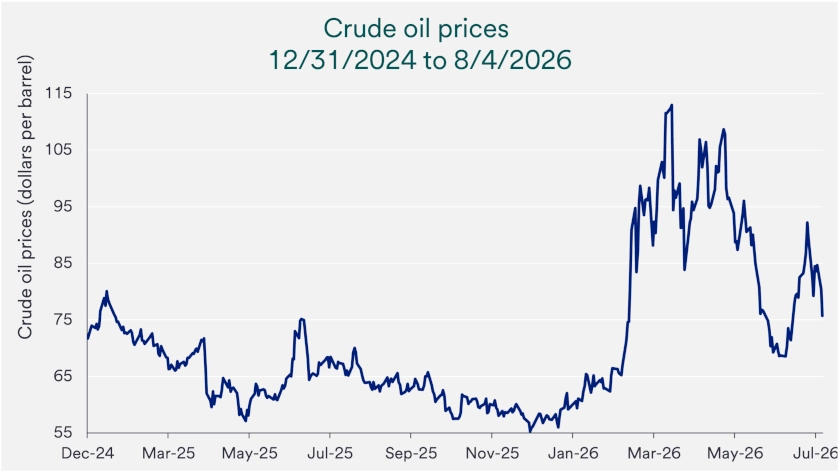
Iran moved to the center of investor attention after U.S. and Israeli military operations expanded in late February. A ceasefire announced in April briefly supported renewed tanker traffic, but later attacks and restrictions have kept Strait of Hormuz shipping well below normal. When fighting began, the S&P 500 fell 9% from its January peak, while developed international and emerging market stocks declined 8% to 12%, before markets rebounded and reached new all-time highs as investors refocused on consumer spending, corporate earnings and changing Gulf energy flows. 1
“Investors are navigating a lot of moving parts in 2026, adding geopolitical conflict to a change in Federal Reserve leadership and midterm elections.”
Terry Sandven, chief equity strategist with U.S. Bank Asset Management Group
International markets face greater potential pressure because many European and Asian economies import a larger share of the energy they consume. The United States produces more of its own energy, but higher global prices still raise costs for American households and businesses. Recent market resilience does not eliminate geopolitical risk; it shows that investors continue to weigh conflict against the economy’s ability to absorb disruption.
Energy markets provide the clearest link between the Iran conflict and global markets because few routes can replace the Strait of Hormuz at similar scale. The U.S. Energy Information Administration estimates that about 20 million barrels of oil per day moved through the strait in 2024, equal to roughly 20% of global petroleum liquids consumption. About 20% of global liquefied natural gas trade also used this route, leaving major importers in Europe and Asia especially sensitive to slower traffic. 2
The International Energy Agency describes the Strait of Hormuz as a pivotal bottleneck for oil shipped by sea. The threat of slower traffic can lift prices before a physical shortage develops because energy markets quickly account for tighter supply, longer routes and higher shipping costs. If those increases persist, they can raise transportation and production expenses, strain household budgets and reduce corporate profit margins.
The economic effects extend beyond oil and natural gas. The Fertilizer Institute estimates that countries west of the strait produce nearly half of global exports of urea, the most widely used nitrogen fertilizer, and typically ship it through Hormuz. 3 Disrupted fertilizer shipments can raise farming and food costs, especially in countries that depend heavily on imported energy and agricultural products.
To assess the severity of oil-flow restrictions and the market's flexibility to adjust, it can be useful to apply a market adaptation framework. Those adjustments can include drawing from commercial inventories or strategic reserves, increasing production, using alternate suppliers and routes, or reducing demand. Because disruption and adaptation can change independently, a decline in shipping does not automatically produce a specific oil-price or stock-market outcome.
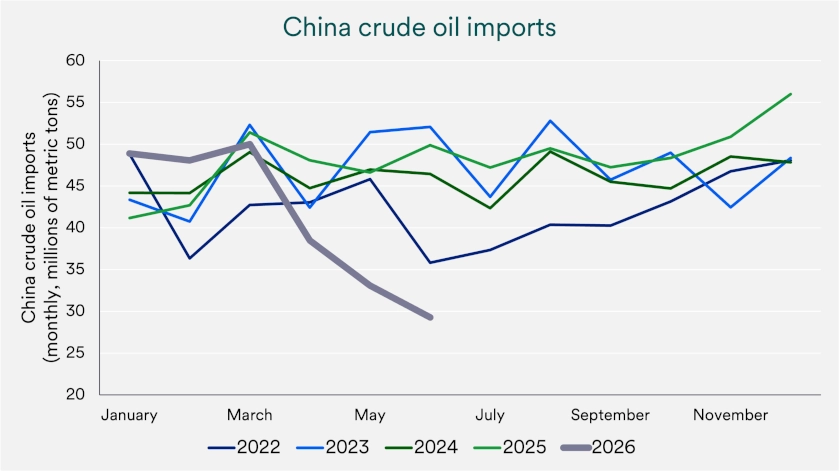
Current conditions fit a “disrupted but absorbing” scenario. Shipping remains constrained, including along the Bab el-Mandeb route near the Red Sea, while inventories, reserve releases, added production, alternate routes and demand reductions continue to cushion the loss of supply. China in particular reduced crude oil imports this year, mitigating some demand pressure. Oil prices remain elevated but contained because these adjustments have limited the gap between available supply and demand.
A more severe supply shock would require persistent restrictions and weaker offsets at the same time. Falling inventories, less spare production capacity or damage to additional transportation routes could move conditions in that direction. This framework keeps attention on the duration of lost supply and the strength of available alternatives rather than on day-to-day conflict headlines alone.
The Russia-Ukraine war remains an important backdrop for global markets more than four years after Russia invaded Ukraine. The conflict continues to influence trade policy, energy flows and economic sanctions, which governments use to limit financial activity and commerce. Markets have adapted to recurring developments, but changes in fighting, negotiations or sanctions can still influence business decisions, government spending and investor confidence.
Oil prices surged after Russia’s 2022 invasion as Western governments imposed sanctions on a major energy exporter. The initial spike faded as buyers found new suppliers, trade routes shifted and markets gained a clearer view of available supply. 4 Recent Ukraine strikes on Russian oil and refining infrastructure could add pressure to global energy costs if Strait of Hormuz shipping remains constrained.
“Investors are navigating a lot of moving parts in 2026, adding geopolitical conflict to a change in Federal Reserve leadership and midterm elections,” says Terry Sandven, chief equity strategist with U.S. Bank Asset Management Group. “Inflation is kryptonite to stock valuations. If energy prices rise and prices for other goods follow, higher borrowing costs could temper corporate earnings.” His comments highlight the risk that a prolonged energy shock could spread to broader inflation, interest rates and company profits.
Markets often react most strongly when conflict threatens supply routes, production capacity or infrastructure that cannot be replaced quickly. Investors may reduce exposure to stocks and favor bonds, gold or other assets they view as more stable, a shift commonly called a “flight to quality.” These initial moves can reverse when inventories, alternate routes or new suppliers keep goods moving and reduce the expected economic damage.
The U.S. military operation in Venezuela in early January generated dramatic headlines but limited market disruption. Investors treated the event as contained because it did not immediately threaten global energy supplies. The episode illustrates why the scale, duration and economic reach of a conflict often influence markets more than the initial surprise.
Geopolitical tensions can also influence markets without military conflict. New trade barriers, sanctions or alliances can alter supply chains, currency values and business investment. Investors can better distinguish temporary volatility from a lasting market risk by asking whether a development changes inflation, growth or corporate earnings.
Recent conflicts show that stock prices can recover after investors assess the likely economic impact, while oil prices can retreat after an initial surge if enough supply remains available. Steady economic data, resilient consumer spending and corporate earnings growth have helped support U.S. stock markets during periods of geopolitical volatility. Those fundamentals can absorb a temporary shock, although a prolonged energy disruption could weaken them over time.
Investors may benefit from reviewing whether their portfolios still match their goals, time horizon, liquidity needs and comfort with market swings. A wealth planning professional can help identify diversification gaps and evaluate whether changing market conditions warrant measured adjustments. A disciplined review can keep fast-moving geopolitical news from driving decisions that conflict with a long-term financial plan.
History does not guarantee a quick recovery from every geopolitical shock, and markets can remain volatile when conflict disrupts essential supplies or broadens into the economy. Still, investors have often moved past the first wave of selling once they could assess the likely effects on growth, inflation and profits. A diversified portfolio and a clear investment plan can help investors participate when markets recover from the early negative impacts of major geopolitical events.
Geopolitics refer to events that influence the global landscape, including political or trade tensions and military conflicts. Such events often create economic uncertainty, which can lead to fluctuations in stock prices, interest rates, and currencies. Geopolitical conflicts frequently impact supply chains, such as Iran’s threats to halt oil shipments through the Strait of Hormuz. Wars in agricultural regions can also affect crop yields and deliveries. Events like these can cause supply-demand disruptions, resulting in higher prices.
Geopolitical issues aren’t always related to military conflicts. Problems like new trade barriers or the formation of alliances among previously unfriendly nations can also impact markets.
The emergence of new geopolitical conflicts often causes an immediate market reaction, frequently a negative one. If events are seen as disruptive to the global economy, investors may suddenly reduce portfolio risk and pursue a so-called “flight to quality.” This approach often results in a sell-off in stocks, with increased interest in bonds or “safe haven” assets like gold.
It is common for investors to overreact to initial shocks from geopolitical conflicts. Market declines are expected, but history shows that markets usually recover from these early negative impacts caused by major geopolitical events.
Oil prices can move quickly when investors fear disruption to shipping routes near major producers, even before supply is physically interrupted. When energy prices rise, markets may worry about higher inflation and slower growth, which can pressure stock prices in the short run. The impact often depends on whether higher prices persist long enough to influence household budgets and business costs.
The Russia-Ukraine war remains a persistent source of uncertainty because it intersects with trade policy, energy flows, and economic sanctions. Markets have adjusted to the ongoing conflict, but changes in sanctions, negotiations, or energy conditions can still influence prices and confidence. Investors often focus on whether developments change real economic activity or remain primarily a source of headline-driven volatility.
Geopolitical headlines can move markets quickly, but short-term swings do not always translate into lasting changes in the economy. Investors may benefit from reviewing how much risk they are taking and whether their strategy still fits their goals and financial plan. Talking with an advisor can help connect current events to a plan and keep short-term headlines from driving long-term decisions.
Investors are increasingly focused on how the administration’s policy changes are impacting markets and the economy.
We can partner with you to design an investment strategy that aligns with your goals and is able to weather all types of market cycles.


 Equal Housing Lender. Deposit products are offered by U.S. Bank National Association. Member FDIC. Mortgage, Home Equity and Credit products are offered by U.S. Bank National Association. Loan approval is subject to credit approval and program guidelines. Not all loan programs are available in all states for all loan amounts. Interest rates and program terms are subject to change without notice.