
Want retirement help or a second opinion on your plan?
Connect with a wealth specialist for a free no-obligation consultation.

Early retirement requires both financial and emotional readiness, not just a savings target.
Preparing for early retirement often includes maxing out your retirement savings and planning for expected costs like healthcare plus unexpected ones.
A financial professional can help you build an early retirement strategy that accounts for longer lifespans, taxes and other factors.
Early retirement means leaving full-time work before the traditional retirement age of 65, often in your 40s, 50s or early 60s. To make it work, you need enough savings and income to cover living expenses before Social Security starts at 62 and Medicare begins at 65. You also need a tax-aware withdrawal strategy and a way to pay for healthcare in between.
That's the short answer.
Early retirement isn't only about your age or your account balance. It's about readiness on every front. You need the financial cushion, yes. But you also need a plan for how you'll spend your time, handle surprise expenses and stay fulfilled once the paychecks stop.
"I've seen people retire as early as age 40," says Ryan Peters, Senior Wealth Planner with U.S. Bank Private Wealth Management. "Ultimately, it depends on their lifestyle goals, financial readiness and whether they have a meaningful plan for what comes next."
“I've seen people retire as early as age 40. Ultimately, it depends on their lifestyle goals, financial readiness and whether they have a meaningful plan for what comes next."
Ryan Peters, Senior Wealth Planner, U.S. Bank Private Wealth Management
Early retirement means leaving full-time work before age 65. It doesn’t always mean stopping work entirely. Some people shift to part-time work, consulting or a second career. What matters most is having the financial flexibility to choose and a clear plan for what comes next.
The amount you need depends on how much you plan to spend each year and how long your retirement may last. A common starting point is the 4% rule, which involves taking your planned annual spending and dividing it by 4% (0.04).
Retiring early can stretch that number further. A traditional retirement might last 20 to 25 years. Retire at 55 and you could need income for 35 years or more. Longer timelines can mean more exposure to inflation, market swings and unexpected costs. Your appropriate withdrawal rate may vary depending on your retirement timeline, spending needs and investment strategy.
Peters offers a practical safeguard: overestimate.
"Being conservative and overestimating future retirement expenses can help," he says, "because many times people underestimate how much they're spending annually, whether it's their monthly expenditures or large purchases. Make sure you're accounting for those future goals and expenditures as well."
According to the U.S. Bank 2025 Wealth Report, 61% of Americans expect to be retired for more than 15 years, yet fewer than 6 in 10 feel confident their savings will last. A larger buffer can help you stay flexible if life changes.
Retiring early can give you more time for the things that matter most to you, whether that's travel, family, creative pursuits, or simply living on your own terms.
Early retirement can bring more freedom, but it can also introduce risks that a longer working life may absorb. Planning for these upfront can help you stay on course.
Early retirement often means drawing from a mix of account types. Some accounts offer tax advantages, while others provide flexibility. Using a blend can help you access money when you need it and manage taxes over time.
Withdraw from a traditional 401(k) or IRA before age 59½ and you'll typically owe an early withdrawal penalty plus ordinary income taxes. That can keep some retirement funds out of reach for several years.
This is where a taxable investment account can help. Money in a standard brokerage account has no age restriction on withdrawals, giving you flexibility to fund those early retirement years.
"If you're younger than 59½, for example, contributions to a taxable investment account would provide flexibility to your financial picture and be very beneficial when retiring early," Peters notes.
A few ways to bridge the gap:
Your withdrawal strategy often shifts across life stages. Here's how two scenarios might look in practice.
Scenario 1: Retire at 55
You retire with $1.6 million and plan to spend $64,000 a year.
Scenario 2: Retire at 60
You retire with $1.2 million and plan to spend $55,000 a year.
In both cases, sequencing your income sources can help you avoid drawing down retirement accounts too quickly.
If you retire before 65, you can use a Marketplace plan, COBRA, a spouse’s plan, or an HSA to pay for healthcare. Without a plan, this gap can expose you to high premiums and out-of-pocket costs.
Costs can vary widely, so it’s important to build a realistic estimate into your strategy.
Taxes don’t stop when your paycheck does. The accounts you draw from, and when, can affect how much you owe. Coordinating withdrawals across account types may help reduce taxes over time.
Lower-income years early in retirement may create planning opportunities. For example, you might consider a Roth conversion or capital gains planning. A coordinated withdrawal strategy can help you keep more of what you’ve saved. However, as you approach Medicare eligibility, it's also important to consider how income may affect Medicare premium surcharges.
"Plan for how taxes will affect your retirement finances," Peters advises.
FIRE stands for Financial Independence, Retire Early. It focuses on saving aggressively, often 50% to 70% of income, to reach financial independence sooner. While some followers aim to stop working early, others use FIRE principles to create more flexibility and choice in their careers.
The core principle is simple: build a portfolio that can support your spending over a long period of time. Most FIRE plans lean on the 4% rule as a starting point.
You don't need to embrace an extreme savings rate to borrow FIRE's best ideas. Living below your means, controlling spending and investing consistently are strategies that benefit any early retirement plan.
Early retirement changes more than your finances. It also changes how you spend your time and how you define purpose. Planning for that transition can help you feel more prepared.
“I've seen some early retirees struggle with the transition because their careers provided structure, identity and purpose,” Peters explains. “Without a plan for how they'll spend their time, retirement can feel less fulfilling than they expected.”
Planning what you're retiring to, not just what you're retiring from, is just as important as your savings target. Think through how you'll stay active, engaged and connected.
“I believe it’s never too early to begin planning for retirement,” he explains. “If you start budgeting now, you can set a trend for the future and better understand where you are and where you want to go.”
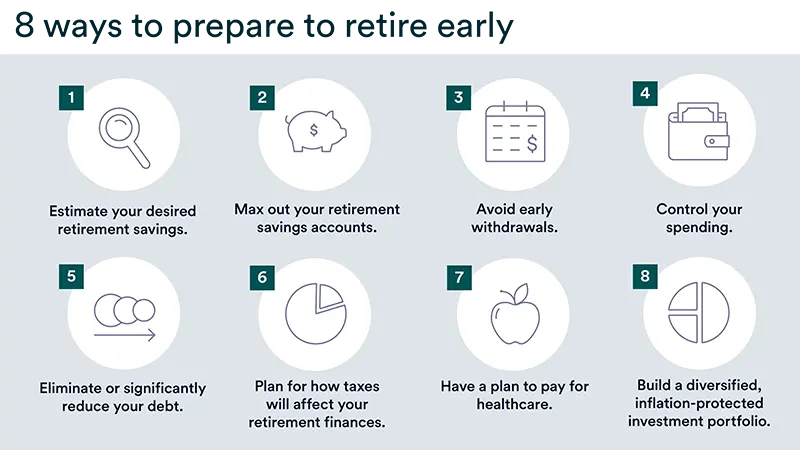
If you’re working toward early retirement, these steps can help you build a strategy that supports both your finances and your long-term goals.
Even a strong strategy needs flexibility. Life events, market changes and unexpected costs can affect your timeline in ways you can’t fully predict.
Stress testing can help. A financial professional can run what-if scenarios against your strategy, pressure-testing it for inflation, weak market returns and surprise expenses. This can help you know where your plan holds and where it needs reinforcing.
The research backs this up: people who work with a financial professional often feel more confident about retirement outcomes. Among those with an advisor, 78% say they feel confident they'll have enough savings to live comfortably in retirement, compared to 48% of those without one.
"The biggest return you can expect from good planning is peace of mind, and that's invaluable," Peters says. "Implementing your planning strategies can feel like a weight has been lifted off of your shoulders, knowing that you're well prepared no matter what the future holds."
Yes. Retiring at 55 means planning for a retirement that could last 35 years or more. You'll likely need a bridge strategy for the years before Social Security at 62 and Medicare at 65, plus a plan for healthcare costs and a withdrawal sequence that helps you avoid unnecessary penalties.
There’s no single number. Retiring early often means saving more aggressively than a traditional timeline. Increasing your savings rate over time, trimming expenses and investing consistently can help.
The Rule of 55 may allow you to withdraw money from a current employer’s 401(k) without the 10% early withdrawal penalty if you leave your job in the year you turn 55 or later. Ordinary income taxes still apply. Not all plans support this provision, so confirm eligibility with your plan administrator.
You can claim Social Security as early as age 62, but doing so typically reduces your monthly benefit. Waiting until full retirement age or longer can increase your monthly amount. Your claiming strategy should reflect your income needs, health outlook and broader financial picture.
There’s no minimum age to retire young. Some people leave their careers in their 40s. Retiring young means a high savings rate, low fixed expenses, and a portfolio large enough to cover spending during retirement. Many who retire young follow the FIRE principles, save aggressively, and build taxable accounts they can use before retirement age.
Are you on pace to retire on your terms? Track your progress with our retirement calculator and connect with a U.S. Bank wealth specialist for a no-obligation conversation about your retirement goals.
Sequence of returns is the risk that you’ll experience negative returns on your investments late in your working years and/or early in retirement. A retirement income strategy may help protect against the impact of market volatility.
Our planning services and professional guidance can help you work toward a more secure and fulfilling retirement.


 Equal Housing Lender. Deposit products are offered by U.S. Bank National Association. Member FDIC. Mortgage, Home Equity and Credit products are offered by U.S. Bank National Association. Loan approval is subject to credit approval and program guidelines. Not all loan programs are available in all states for all loan amounts. Interest rates and program terms are subject to change without notice.