
Capitalize on today’s evolving market dynamics.
With changes to taxes and interest rates, it's a good time to meet with a wealth advisor.
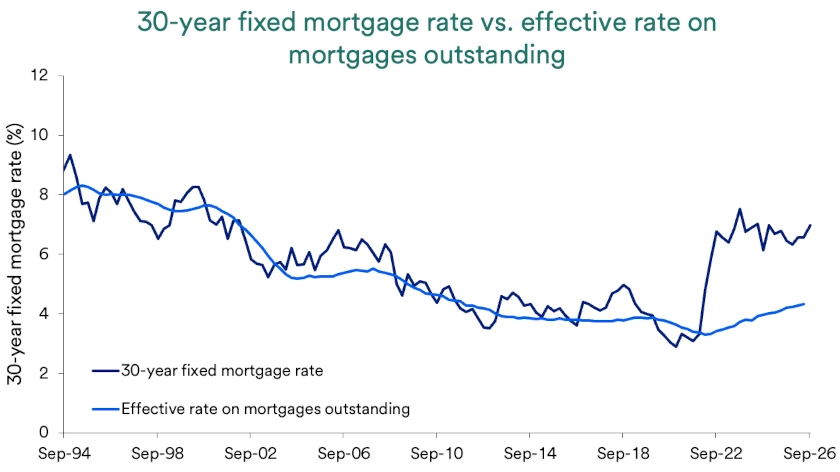
Housing market interest rates remain the largest affordability hurdle, with the average 30-year fixed mortgage rate at 6.95% in mid-September.
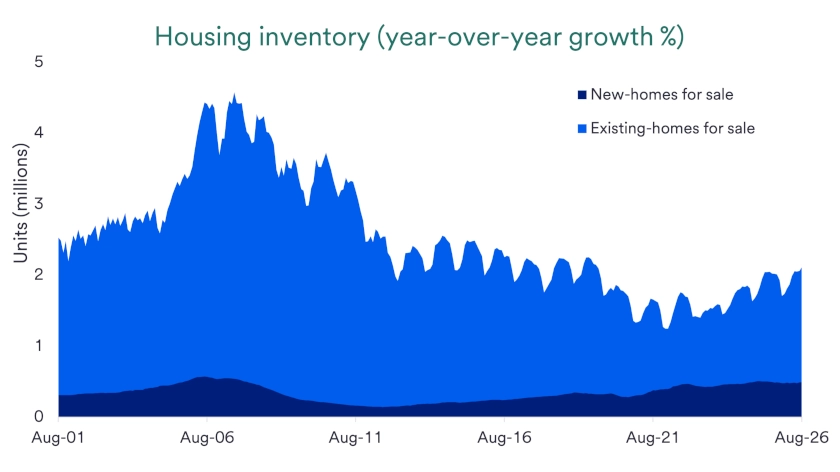
The real estate housing market gives buyers more negotiating leverage as existing-home inventory rises, although price trends vary widely by region.
The future of the housing market depends on mortgage costs, income growth and disciplined new-home supply, not another broad surge in home prices.
Housing provides more than shelter. Housing-related spending and investment account for about 15% to 18% of U.S. economic activity, while home equity represents a major source of household wealth. 1, 2 Home prices and mortgage rates also shape consumer spending, residential investment and the broader economic outlook.
The housing market has shifted from its rapid post-pandemic expansion into a slower, more selective phase. High borrowing costs, elevated prices and uneven local supply continue to constrain affordability and sales. Households and investors should look beyond a single national forecast and focus on markets where income growth, available inventory and underlying demand can sustain home values.
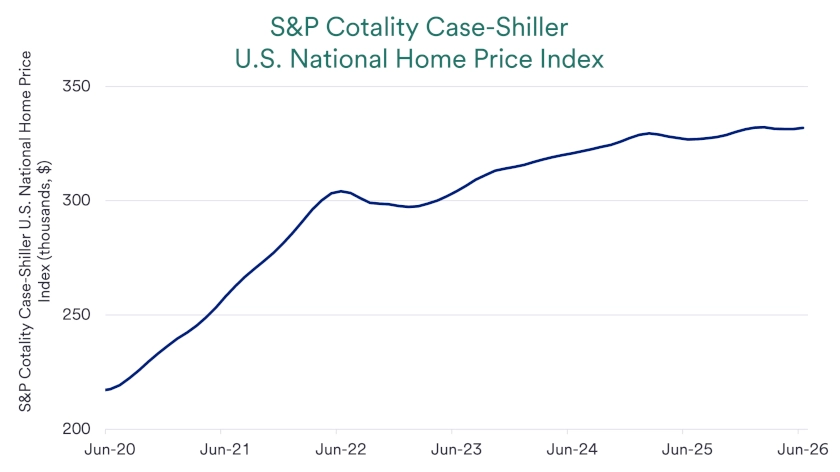
National home-price growth remains positive but modest. The S&P Cotality Case-Shiller U.S. National Home Price Index rose 1.5% in June from a year earlier, while the non-seasonally adjusted index increased 0.4% from May. 3 Those gains remain well below the rapid appreciation earlier in the decade, leaving the housing market with less support from broad price increases.
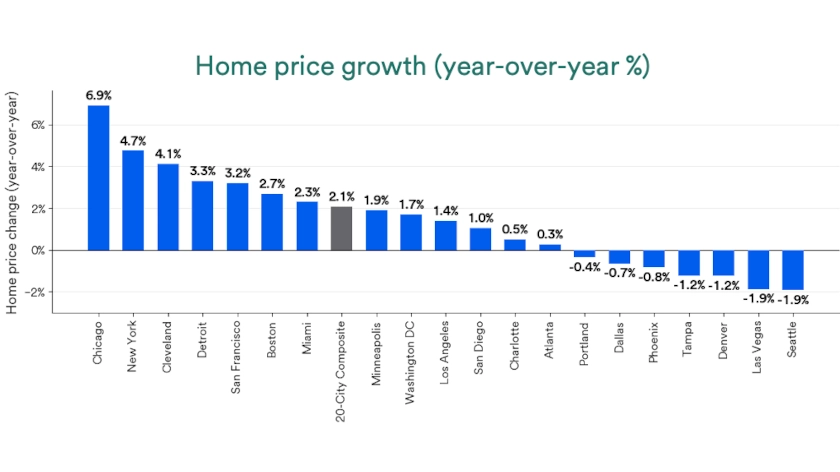
National averages conceal sharp differences across local housing markets. Many Midwest and Northeast markets continue to record firmer gains, while several Sun Belt and Western markets have softened after large pandemic-era increases. Location, property condition and nearby inventory now exert greater influence on a seller’s ability to hold the asking price.
A slower real estate housing market often adjusts through negotiation before prices fall sharply. Homes may remain listed longer, while sellers offer repairs, closing-cost assistance or other concessions to complete a sale. Buyers can gain leverage even when national home values remain stable or increase modestly.
Mortgage rates directly determine a buyer’s monthly principal-and-interest payment, so housing activity often responds quickly when long-term rates move. Freddie Mac reported an average 30-year fixed mortgage rate of 6.95% on September 17, up from 6.76% a week earlier and 6.65% on August 20. 4 Rising mortgage rates reduce purchasing power even when home prices change little, leading many households to lower their target price or postpone a purchase.
Higher mortgage rates also discourage some owners from listing existing homes because a move could replace a low-rate loan with much more expensive financing. “The supply of existing homes is gradually returning to more normal levels, partly because homes take longer to sell,” says Tom Hainlin, national investment strategist with U.S. Bank Asset Management Group. “However, some homeowners remain reluctant to exchange a lower-rate mortgage for a new loan at today’s higher rate.”
Affordability improved modestly in August but remains vulnerable to changes in interest rates. The National Association of Realtors’ Housing Affordability Index reached 104.7, up from 101.2 a year earlier; a reading of 100 means a median-income family earns enough to qualify for a mortgage on a median-priced home under the index’s assumptions. 5 First-time buyers remain at a disadvantage because they often have smaller down payments and no home equity from a prior sale, which leaves them more exposed to high prices and borrowing costs.
Existing-home sales fell 2.0% in August from July to a seasonally adjusted annual rate of 3.98 million and declined 1.2% from a year earlier. Inventory rose 3.2% during the month to 1.62 million homes, equal to 4.9 months of supply at the current sales pace and the highest reading in more than a decade. The median existing-home price increased 1.6% from a year earlier to $429,100, extending annual price gains even as transaction volume weakened. 5
The latest figures describe a housing market with more buyer choice but little sales momentum. Additional listings and longer selling times can improve negotiating conditions, yet high monthly payments still prevent many households from completing a purchase. A sustained recovery in existing-home sales requires lower mortgage rates, stronger income growth or further price adjustment.
New single-family home sales fell 10.5% in July to a seasonally adjusted annual rate of 607,000 and stood 6.3% below the July 2025 pace. Builders had 488,000 new homes available at month-end, equal to 9.6 months of supply at the current sales rate. The median new-home sales price declined to $393,800, down 2.3% from June and 0.9% from a year earlier. 6
Builders have responded to soft demand with price reductions and sales incentives, including mortgage-rate buydowns or help with closing costs. The NAHB/Wells Fargo Housing Market Index fell three points to 32 in September; readings below 50 indicate that more builders view conditions as poor than good. NAHB reported that 38% of builders cut prices, the average reduction held at 6%, and 66% used sales incentives. 7
Price flexibility and financing incentives can narrow part of the affordability gap, particularly when builders need to sell completed homes. These tools cannot fully offset high monthly payments, while 9.6 months of supply gives builders a strong reason to manage construction and pricing carefully. Qualified buyers may find more room to negotiate on new homes than during the tightest post-pandemic period, although conditions still vary by region and price point.
The next phase of the housing market depends on whether demand can absorb rising supply without broad price declines. Stable employment and wage growth help buyers qualify for mortgages, while lower borrowing costs would deliver the most direct affordability relief. Home prices, household income and monthly payments need a better balance across more local markets before sales can rise sustainably.
“The spring selling season did not produce a durable rebound. As fall approaches, elevated mortgage rates continue to restrain demand.”
Bill Merz, head of capital markets research for U.S. Bank Asset Management Group
“The spring selling season did not produce a durable rebound,” says Bill Merz, head of capital markets research for U.S. Bank Asset Management Group. “As fall approaches, elevated mortgage rates continue to restrain demand.” Rising existing-home inventory gives qualified buyers more negotiating leverage, but financing costs continue to limit how many households can act.
Housing remains relevant to investors because homeowners hold substantial equity, which strengthens household balance sheets even when transaction activity slows. Investment opportunities extend beyond homebuilders and residential real estate to bonds backed by pools of home loans. Home equity, lending standards and borrowers’ ability to make payments help determine the credit quality of those securities.
Investors primarily access housing-related opportunities through the bond market. Mortgage-backed bonds combine many home loans and pass portions of borrowers’ principal and interest payments to investors; non-agency bonds do not carry a federal agency guarantee, so investors should evaluate borrower quality, homeowner equity, property values and the durability of cash flows rather than assume another sharp rise in home prices will drive returns.
Interest rates help determine how expensive it is to finance a home purchase. When rates rise, monthly payments increase, and many buyers can afford less home than they could before. When rates fall, financing becomes more manageable for more households, which can support demand and improve activity across the housing market.
Higher mortgage rates raise the monthly cost of buying a home, even if the purchase price stays the same. That can force buyers to lower their price range, delay a purchase, or reconsider how much of their budget they want to commit to housing. Over time, higher borrowing costs also increase the total amount paid over the life of a loan.
Lower rates can support home prices by improving affordability and bringing more buyers into the market. Price gains, however, also depend on other factors such as housing supply, job growth, household income, and local market conditions. Lower rates often help demand, but they do not guarantee the same outcome in every market.
Many homeowners already hold mortgages with lower rates than what is available today. Selling a home and buying another one could mean taking on a much higher monthly payment, which discourages some owners from listing their homes. That dynamic can keep the supply of existing homes tight even when buyer demand slows.
The housing market usually adjusts over time rather than all at once. Mortgage rates may change quickly, but buyers and sellers often need longer to respond as they revisit budgets, pricing decisions, and moving plans. Because transactions take time to complete, the broader effect of a rate move often shows up gradually over several months.
The Federal Reserve does not directly set mortgage rates. It influences short-term interest rates and broader financial conditions, which can shape where mortgage rates move over time. Mortgage rates also reflect bond market trends, inflation expectations, and investor views about growth and risk.
In many areas, the housing market is becoming more favorable for buyers because listings have increased faster than active demand. Redfin estimated there were 51% more sellers than buyers in July, near a record high, 8 which often gives buyers more room to negotiate on price, repairs, or timing. Even so, this shift mainly helps households that can still manage today’s monthly mortgage payment.
A slower pace of home-price growth does not automatically make homes affordable. Monthly payments remain high because mortgage rates still sit well above the very low levels many buyers and sellers became used to before 2022. That is why sales can stay soft even when national home-price gains look modest.
Mortgage rates remain the most important signal because they directly shape affordability and buyer activity. Investors should also watch inventory and completed sales together, since more listings only matter if buyers can close on homes at current payments. Labor-market strength also matters, because steady job and wage growth help support the income needed to qualify for a mortgage.
Growth slowed late last year as the government shutdown weighed on activity, while consumer spending, hiring and income trends remained broadly supportive.
We can partner with you to design an investment strategy that aligns with your goals and is able to weather all types of market cycles.



 Equal Housing Lender. Deposit products are offered by U.S. Bank National Association. Member FDIC. Mortgage, Home Equity and Credit products are offered by U.S. Bank National Association. Loan approval is subject to credit approval and program guidelines. Not all loan programs are available in all states for all loan amounts. Interest rates and program terms are subject to change without notice.