
Start investing today with U.S. Bancorp Advisors.
Investment products and services are: Not a deposit | Not FDIC insured | May lose value
A dividend reinvestment plan (DRIP) automatically uses dividend payments to buy more shares, which can increase the number of shares you own over time.
DRIP investing can support long-term compounding and often leads to fractional shares.
Whether you should reinvest dividends or take cash depends on your goals, income needs, and tax situation. In many accounts, you may still owe taxes on reinvested dividends.
When you own a dividend-paying stock, exchange-traded fund (ETF), or mutual fund, you generally have two choices when a dividend is paid: take the cash or reinvest it. That choice is also one of the most common ways investors end up owning fractional shares.
A dividend reinvestment plan, commonly called a DRIP, makes reinvesting automatic. Rather than depositing dividends into your account as cash, a DRIP uses them to buy more shares of the same investment.
Over time, reinvesting can increase the number of shares you own. But it isn't always the better option.
"A dividend reinvestment plan can help investors put cash distributions back to work automatically and potentially benefit from long-term compounding," says Rob Haworth, senior investment strategy director with U.S. Bank Asset Management Group. "But the decision to reinvest or take cash should align with an investor's broader objectives, income needs, and time horizon."
A dividend reinvestment plan is a program that automatically uses dividend payments to buy more shares of an investment instead of paying the dividend to you as cash.
Many brokerage firms let you choose dividend reinvestment for individual stocks, ETFs, and mutual funds. Once you enroll, your dividends buy more shares each time the investment pays a dividend.
Because dividend payments often don’t match the price of a full share, dividend reinvestment often leads to fractional shares over time.
“The decision to reinvest or take cash should align with an investor’s broader objectives, income needs, and time horizon."
Rob Haworth, senior investment strategy director, U.S. Bank Asset Management Group
Reinvestment is automatic. The process takes three steps:
The cycle repeats with every dividend payment.
Example: Suppose you own 100 shares of a company that pays a quarterly dividend of $0.50 per share:
If the stock trades at $100 per share and you're enrolled in a DRIP, that $50 buys 0.5 shares. Your position grows from 100 shares to 100.5 shares.
The next quarter, the dividend is based on 100.5 shares instead of 100. Each reinvestment adds a little to the base that generates the next payment. That's the compounding effect that draws many long-term investors to DRIP investing.
There are a few details worth knowing, though specifics vary by plan sponsor:
While all dividend reinvestment programs are often referred to as DRIPs, there are a few common approaches.
|
Type of DRIP |
How it’s administered |
Best for |
|---|---|---|
|
Brokerage-sponsored DRIP |
Managed through a brokerage account. Automatically reinvests dividends into additional shares of the same investment. |
Most investors. It’s the most convenient and widely used approach. |
|
Company-sponsored DRIP |
Run directly by the company or a transfer agent. May allow direct share purchases outside of brokerage trades. |
Shareholders who prefer direct purchases from the company. |
|
Fund-level reinvestment |
Offered by mutual funds or ETFs. Allows reinvestment of income and capital gains into the same fund. |
Fund investors aiming for long-term compounding. |
|
Partial reinvestment strategies |
Combines reinvestment for growth-focused holdings with cash payouts for income-focused positions. |
Investors balancing growth with income. |
Type of DRIP
Brokerage-sponsored DRIP
How it’s administered
Managed through a brokerage account. Automatically reinvests dividends into additional shares of the same investment.
Best for
Most investors. It’s the most convenient and widely used approach.
Type of DRIP
Company-sponsored DRIP
How it’s administered
Run directly by the company or a transfer agent. May allow direct share purchases outside of brokerage trades.
Best for
Shareholders who prefer direct purchases from the company.
Type of DRIP
Fund-level reinvestment
How it’s administered
Offered by mutual funds or ETFs. Allows reinvestment of income and capital gains into the same fund.
Best for
Fund investors aiming for long-term compounding.
Type of DRIP
Partial reinvestment strategies
How it’s administered
Combines reinvestment for growth-focused holdings with cash payouts for income-focused positions.
Best for
Investors balancing growth with income.
Yes. In many taxable accounts, reinvested dividends are still taxable in the year you receive them, even if you never see the cash.
"Investors sometimes assume reinvested dividends are tax-free because the money never reaches their bank account," says Haworth. "In reality, reinvestment changes how the dividend is used, not how it’s taxed."
Several factors can affect how dividends are taxed:
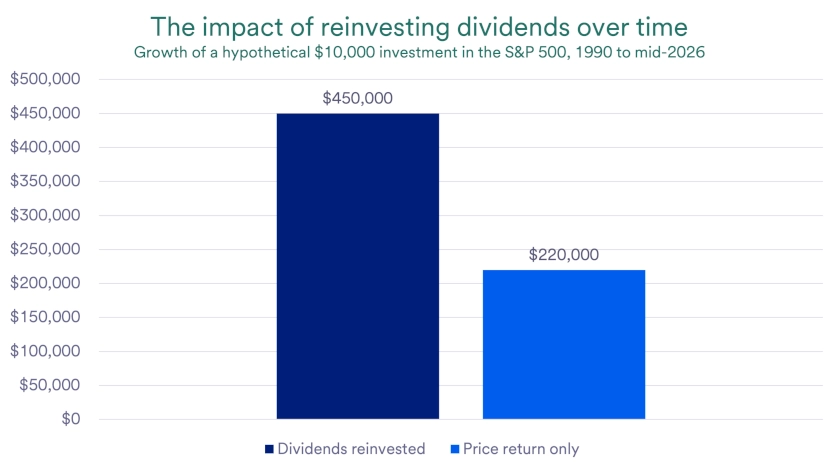
Reinvested dividends can be a meaningful part of long-term returns. Since 1990, $10,000 invested in the S&P 500 with dividends reinvested grew to roughly $450,000 by mid-2026. Without reinvesting dividends, the same $10,000 grew to about $220,000 from price changes alone. That difference shows why taxes on reinvested dividends are worth understanding.
There's also a practical recordkeeping benefit to understanding this. In a taxable account, reinvested dividends can add to your cost basis. Tracking that cost basis can help you avoid paying tax twice when you sell.
There’s no one right answer. The decision often depends on your goals and where you are in your financial journey.
Reinvestment may fit if you:
You may prefer cash distributions if you:
"The right choice depends on your goals," says Haworth. "For an investor focused on long-term accumulation, reinvestment can be an effective tool. For someone who relies on portfolio income, receiving dividends in cash may be more appropriate."
The current interest rate environment can also factor into the decision. "As cash and money market yields shift with Federal Reserve policy, the opportunity cost of holding dividends in cash rather than reinvesting them changes too," says Tom Hainlin, national investment strategist with U.S. Bank Asset Management Group. "In periods when cash yields are declining, reinvesting can look more attractive to growth-focused investors, while income-focused investors may still prefer the certainty of cash in hand regardless of where rates stand."
Your choice isn't permanent. Most brokerages let you turn reinvestment on or off, and many investors shift from reinvesting to taking cash as they approach retirement and their priorities move from growth toward income.
Dividend reinvestment plans can be a simple way to turn dividend payments into more shares. Over time, DRIPs can help you build your position and benefit from compounding. At the same time, reinvestment isn’t always the best choice. Taxes, income needs, and your overall financial goals should all play a role in the decision.
If you’re focused on long-term growth, reinvesting dividends can help you stay consistent and keep your money working. If you depend on portfolio income, taking dividends in cash may be a better fit. The best approach is the one that supports your overall strategy.
From investing online to working with a financial professional, learn more about your investing options.
Yes. Most brokerage and company-sponsored DRIPs let you switch between reinvesting and receiving cash at any time. The change usually starts with the next dividend payment rather than retroactively.
Many brokerage-sponsored DRIPs are free to join. Some company-sponsored plans may charge fees for purchases, transfers, or selling shares. Check your plan's terms, since fee structures vary by sponsor.
Fractional shares you buy through dividend reinvestment are generally sold along with your whole shares. Your brokerage statement should show the fractional amount and its cost basis at the time of sale.



 Equal Housing Lender. Deposit products are offered by U.S. Bank National Association. Member FDIC. Mortgage, Home Equity and Credit products are offered by U.S. Bank National Association. Loan approval is subject to credit approval and program guidelines. Not all loan programs are available in all states for all loan amounts. Interest rates and program terms are subject to change without notice.