
Start investing today with U.S. Bancorp Advisors.
Investment products and services are: Not a deposit | Not FDIC insured | May lose value
Compound growth happens when the return on your investment (or interest earned) generates its own growth over time.
The earlier you start investing, and the longer your money stays invested, the more time your money has to compound.
Compounding allows even small investments to grow significantly, making it a powerful tool for building wealth.
Compound growth is an incredibly simple but powerful financial phenomenon that can help you meet your investment goals. Here’s how it works, what affects it and how you can make the most of it in your investing strategy.
Compound growth occurs when the return on your investment generates its own return. Said more simply, through the power of compounding, even your interest earns interest. This effect can grow stronger with time.
The single biggest way to benefit from compounding is to start investing as early as possible.
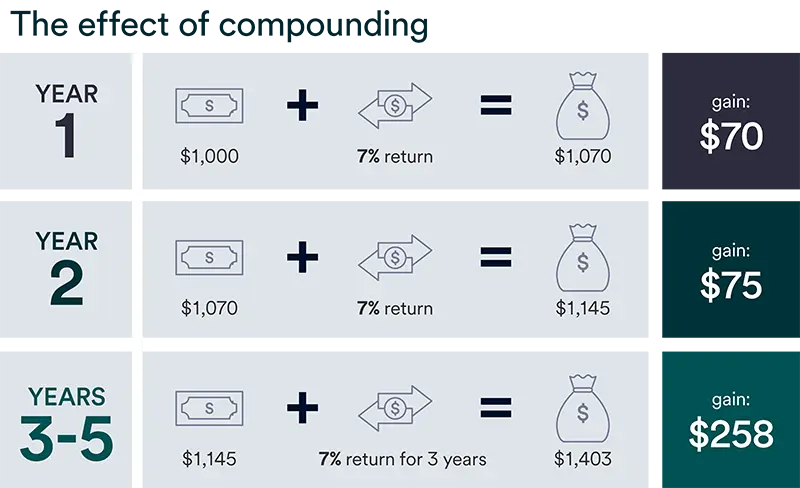
When you make an investment, you hope it earns a return . For instance, a $1,000 investment might return 7% in year one, for a total gain of $70. The next year, you could reinvest the $70 gain for a total investment of $1,070. If that investment once again returned 7%, you’d end up with $1,145—a gain of $74.90. That’s because the $70 in returns from year one compounded to give you an extra $4.90.
Now, imagine the return after five years if you invest more than $1,000 initially. Or if you invest for 30 years instead of five.
Compound growth has the most impact on long-term investing since its effects increase as time goes on.
Using the previous numbers, let’s say you withdrew your returns every year instead of letting them compound in the investment account. In the example above, that would be a withdrawal of $70 each year.
Five years later, assuming a 7% return each year, you would have earned $350 in withdrawals instead of $403 in compound growth. After 10 years total, taking the returns each year without compounding would earn you $700. Letting your investment earn compound growth over 10 years would result in a gain of $968.
If you’re investing for a long-term goal like retirement, the way in which returns can compound significantly over time means you can do more with less.
There’s a formula you can use to calculate the compound growth rate of an investment, which is referred to as the compound annual growth rate, or CAGR. It requires three inputs: the investment’s end value, beginning value and the time period.
Here’s the formula:
CAGR = [(End value/Beginning value)^(1/# of years)-1]x100 = % growth
The single biggest way to benefit from compounding is to start investing as early as possible. If you want to retire with a certain amount of money, the earlier you start, the less you would have to invest initially. You may even be able to set aside less as you age and put more money toward other goals. The longer your investments have to compound, the greater the impact.
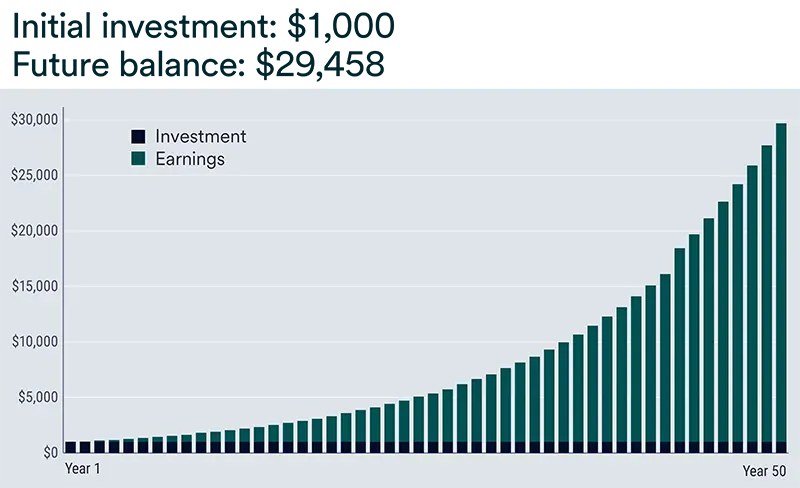
Here’s another illustration (again, using a yearly return of 7% as an example – see graphic below): Imagine you’re planning to retire at 70. If you invested your first $1,000 at age 40 and held it for 30 years, you’d have just over $7,613. If you had started at age 20, you’d have more than $29,458 at age 70 — and that’s without ever adding another penny.
The good news is even if you didn’t start early, you still have more time now than you will next year, or the year after that. The more you can put away today, the greater the opportunity for compounding to work.
One of the easiest ways to benefit from compound growth is to set up an automatic investing plan. As the name implies, this plan invests your money automatically at certain time intervals, such as each pay period.
Automatic investing is a common strategy for retirement saving. Here, you would have a certain amount of money automatically deducted from your pay and invested in your retirement plan each pay period. You can change the amount or frequency if your time horizon, investing goals or risk tolerance change at any point.
This strategy takes advantage of an investing concept known as buy-and-hold, or dollar-cost averaging, which tends to reduce the impact of market volatility on your portfolio and even out share prices over time. It also helps remove emotions from investing by taking the human element out of investing decisions, as well as the temptation to try to time the investment markets.
From investing online to working with a financial professional, learn more about your investing options.
Your plans and goals change as you move through life. So, too, should your investing strategy. Here’s guidance for how to invest at every age.
Let us help you craft a portfolio that reflects your goals, time-horizon and values.


 Equal Housing Lender. Deposit products are offered by U.S. Bank National Association. Member FDIC. Mortgage, Home Equity and Credit products are offered by U.S. Bank National Association. Loan approval is subject to credit approval and program guidelines. Not all loan programs are available in all states for all loan amounts. Interest rates and program terms are subject to change without notice.