
Capitalize on today's evolving market dynamics.
With changes to taxes and interest rates, it's a good time to meet with a wealth advisor.
The U.S. Federal Reserve (Fed) kept its policy interest rate at a range of 3.50%-3.75% as it navigates heightened inflation uncertainty and a slow labor market.
The median Fed official forecast projects one rate cut in 2026 despite increasing inflation expectations.
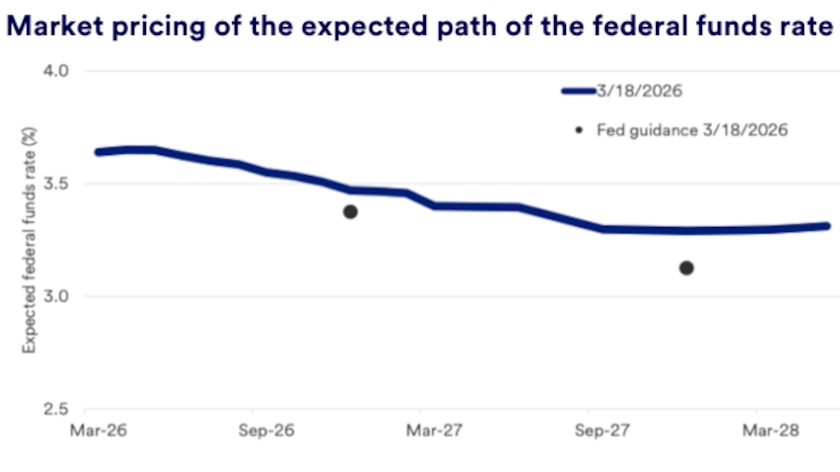
Markets price in the likelihood that the Fed cuts once in 2026, but they shifted in recent weeks to potential hikes from other major central banks to stem inflation.
The Federal Reserve (Fed) held its target federal funds interest rate in the 3.50%-3.75% range at the March meeting, a widely anticipated outcome. Nearly all Fed voting members supported the decision, with one favoring a 0.25% rate cut. The Fed kept policy unchanged, balancing expectations for a pickup in inflation due to higher energy prices with a soft but stable labor market, while noting elevated uncertainty. Chairman Jerome Powell said, “We have an energy shock of some size and duration. We don’t know what that will be.” On the impact of higher oil prices, Powell said, “The economic effects could be smaller or bigger. We just don’t know.”
The Fed made a slight change to its statement, recognizing the uncertain implications of developments in the Middle East for the U.S. economy. The statement also described unemployment as “little changed in recent months.”
Powell, whose term as Chair expires in May, emphasized that future policy decisions will be data dependent. Bond yields reflect investor expectations the Fed will hold rates steady through the rest of Powell’s term. Investors expect the Fed will likely cut once in the second half of 2026 after nominee Kevin Warsh is expected to take over as Fed Chair. Warsh expressed support for rate cuts in 2025 but has not commented on Fed policy since oil prices increased.
The Fed’s Summary of Economic Projections (SEP) showed some impact of higher oil prices on officials’ forecasts. Officials increased their median projection for headline personal consumption expenditure (PCE) inflation, which directly incorporates energy costs, from 2.4% to 2.7% for 2026. Core PCE (excludes volatile food and energy costs), which Fed members have emphasized as a better indicator of underlying inflation pressures, increased from 2.5% to 2.7%, reflecting some passthrough of higher energy costs into goods and service prices. Despite the uncertain impacts of higher energy costs, officials increased their 2026 economic growth projection from 2.3% to 2.4%. The Fed maintained its 4.4% unemployment projection for this year while cutting interest rates 0.25% in 2026 and 0.25% in 2027. Although officials maintain a wide range of views on policy depending on the evolution of growth, inflation, and the labor market, the median policy rate projection aligns with recent market prices.
Earlier tightening helped mitigate inflation over the past four years, but higher oil costs risk elevating prices. Aggressive rate hikes from early 2022 to mid-2023 helped temper Core PCE inflation from a peak above 5.5% year-over-year in 2022 to 3.0% in January 2026. The Fed shifted as inflation slowed, cutting its target interest rate by 1.75% through 2024 and 2025. The Fed held rates steady at its January and March meetings, with Powell emphasizing that data would guide the Fed’s next steps. Oil prices have increased more than 40% in March, entrenching the Fed in wait-and-see mode as it balances its mandates of maximum employment while ensuring price stability.
On the balance sheet, the Fed stopped shrinking its bond holdings in December. Those holdings stand near $6.6 trillion today after peaking at $8.5 trillion in 2022. The Fed began buying short-term Treasury bills in December 2025 to ensure ample banking system reserves and keep short-term interest rates near its intended policy rate. By expanding the balance via announced Treasury bill purchases, the Fed improves market liquidity because investors do not have to absorb incremental supply. Liquidity — the money readily available to purchase goods, services and financial assets — can also cushion markets against unforeseen financial market shocks. Currently, liquidity measures remain constructive.
Two-year Treasury yields rose 0.06% after the meeting as investors digested the risk that inflation may cause the Fed to put policy changes on hold. The uncertain outlook weighed on large stocks, represented by the S&P 500, which fell 0.6% after the meeting. Small stocks, represented by the Russell 2000 Index, can be more sensitive to interest rates and fell 1.1%.
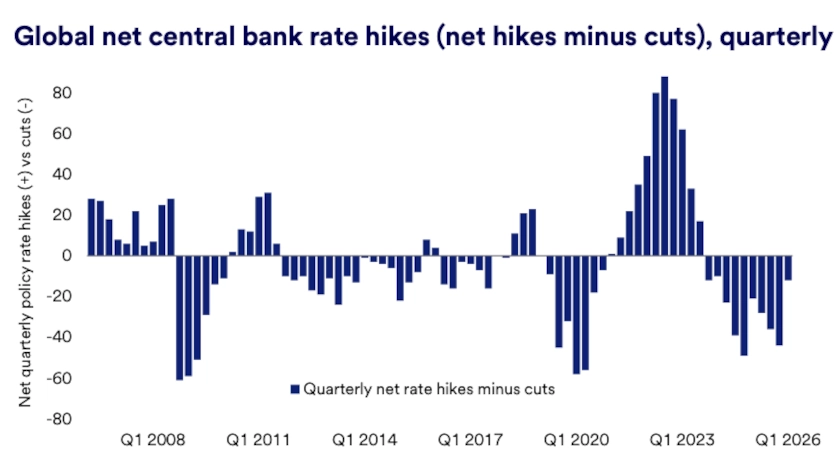
Globally, central banks eased policy in 2025. The European Central Bank, Bank of England and Bank of Canada each cut rates by 1.00%, and the Reserve Bank of Australia cut by 0.75%. Bond yields now price the possibility that foreign central banks may hike in 2026 to counter inflationary pressures from rising energy costs.
We maintain a constructive outlook for diversified portfolios and see opportunities in growth-oriented allocations including globally diversified stocks, global infrastructure and structured credit. While higher energy costs risk increasing inflation and dampening economic activity, consumer spending and corporate earnings growth remain resilient, with fiscal support in the form of lower corporate and individual taxes. A diversified portfolio spanning a variety of allocations can help limit the impact of price swings on individual assets. We will keep you informed as new data arrives and as we update our assessment of market conditions.
As always, we value your trust and are here to help in any way we can. Please do not hesitate to let us know if we can help address your unique financial situation or be of assistance.
This information represents the opinion of U.S. Bank. The views are subject to change at any time based on market or other conditions and are current as of the date indicated on the materials. This is not intended to be a forecast of future events or guarantee of future results. It is not intended to provide specific advice or to be construed as an offering of securities or recommendation to invest. Not for use as a primary basis of investment decisions. Not to be construed to meet the needs of any particular investor. Not a representation or solicitation or an offer to sell/buy any security. Investors should consult with their investment professional for advice concerning their particular situation. The factual information provided has been obtained from sources believed to be reliable but is not guaranteed as to accuracy or completeness. U.S. Bank is not affiliated or associated with any organizations mentioned.
Based on our strategic approach to creating diversified portfolios, guidelines are in place concerning the construction of portfolios and how investments should be allocated to specific asset classes based on client goals, objectives and tolerance for risk. Not all recommended asset classes will be suitable for every portfolio. Diversification and asset allocation do not guarantee returns or protect against losses.
Past performance is no guarantee of future results. All performance data, while obtained from sources deemed to be reliable, are not guaranteed for accuracy. Indexes shown are unmanaged and are not available for direct investment. The S&P 500 Index consists of 500 widely traded stocks that are considered to represent the performance of the U.S. stock market in general. The Personal Consumption Expenditures (PCE) Price Index is a measure of the prices that people living in the United States, or those buying on their behalf, pay for goods and services. It is known for capturing inflation (or deflation) across a wide range of consumer expenses and reflecting changes in consumer behavior. The Russell 2000 Index measures the performance of the 2,000 smallest companies in the Russell 3000 Index and is representative of the U.S. small capitalization securities market.
Equity securities are subject to stock market fluctuations that occur in response to economic and business developments. International investing involves special risks, including foreign taxation, currency risks, risks associated with possible differences in financial standards and other risks associated with future political and economic developments. Investing in emerging markets may involve greater risks than investing in more developed countries. In addition, concentration of investments in a single region may result in greater volatility. Investing in fixed income securities are subject to various risks, including changes in interest rates, credit quality, market valuations, liquidity, prepayments, early redemption, corporate events, tax ramifications and other factors. Investment in debt securities typically decrease in value when interest rates rise. This risk is usually greater for longer-term debt securities. Investments in lower-rated and non-rated securities present a greater risk of loss to principal and interest than higher-rated securities. Investments in high yield bonds offer the potential for high current income and attractive total return but involve certain risks. Changes in economic conditions or other circumstances may adversely affect a bond issuer's ability to make principal and interest payments. The municipal bond market is volatile and can be significantly affected by adverse tax, legislative or political changes and the financial condition of the issues of municipal securities. Interest rate increases can cause the price of a bond to decrease. Income on municipal bonds is free from federal taxes but may be subject to the federal alternative minimum tax (AMT), state and local taxes. There are special risks associated with investments in real assets such as commodities and real estate securities. For commodities, risks may include market price fluctuations, regulatory changes, interest rate changes, credit risk, economic changes and the impact of adverse political or financial factors. Investments in real estate securities can be subject to fluctuations in the value of the underlying properties, the effect of economic conditions on real estate values, changes in interest rates and risks related to renting properties (such as rental defaults).
U.S. Bank and its representatives do not provide tax or legal advice. Your tax and financial situation is unique. You should consult your tax and/or legal advisor for advice and information concerning your particular situation.
Are tariffs contributing to inflation in the U.S. economy?
We can partner with you to design an investment strategy that aligns with your goals and is able to weather all types of market cycles.


 Equal Housing Lender. Deposit products are offered by U.S. Bank National Association. Member FDIC. Mortgage, Home Equity and Credit products are offered by U.S. Bank National Association. Loan approval is subject to credit approval and program guidelines. Not all loan programs are available in all states for all loan amounts. Interest rates and program terms are subject to change without notice.